
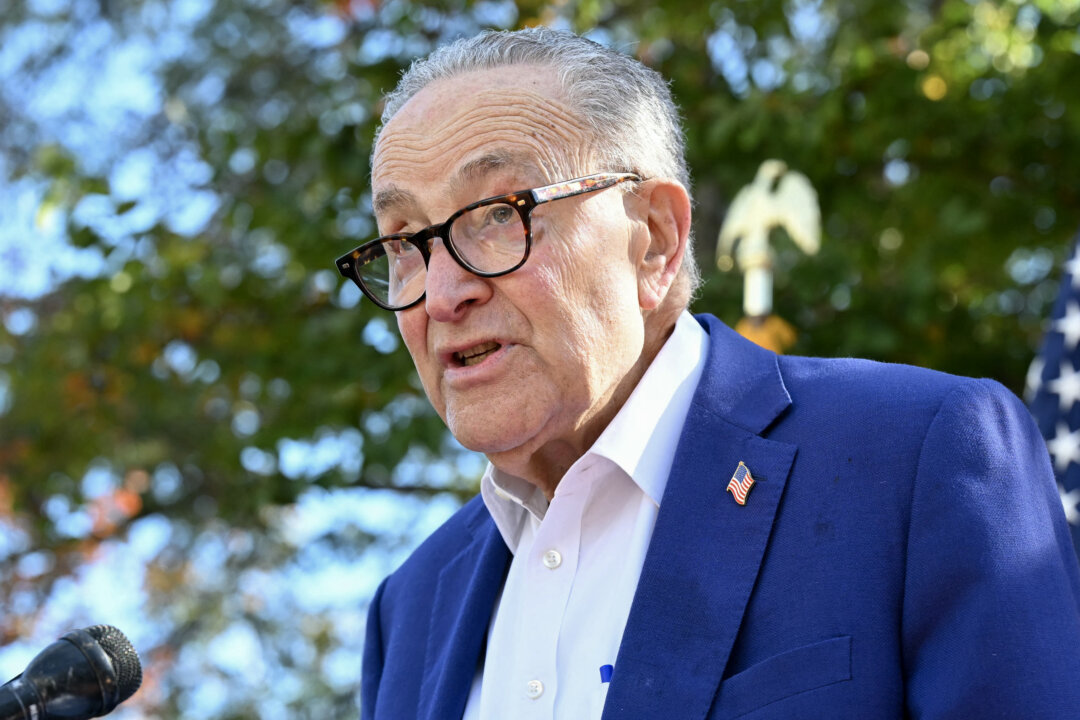
Senate Democratic Leader Chuck Schumer (D-N.Y.) has accused Nvidia CEO Jensen Huang of flouting U.S. export control law by shipping “extremely advanced chips” to China.
In a Nov. 24 X post, Schumer alleged that the situation is like “selling rocket engines to the Soviets during the Space Race” and called it “an unfathomable failure of enforcement by the Trump administration.”
“We urgently need to pass the bipartisan export control bills to start to cut off the flow of AI chips and manufacturing equipment to China once and for all, something I’ve worked on with [Sen. Elizabeth Warren] and bipartisan partners for months,” Schumer wrote.
Nvidia has not publicly commented on Schumer’s allegations, and the company did not respond to a query from The Epoch Times by the time of publication.
Huang has previously said there is no evidence Nvidia chips were being improperly diverted to China, and the company recently announced Nov. 17 that it had halted shipping even U.S.-approved chips to China.
Schumer’s accusation comes one day after Nvidia reinstated Huang as president, chief executive officer, and board member, citing confidence that the reinstatement “poses no national security risk.” Nvidia announced Huang’s resignation on Nov. 12, after recent reports citing unnamed sources linked Huang to Alice Huang, a former executive at Singapore-based Megaspeed, which had been a major customer of Nvidia.
“I take this responsibility with the greatest humility and renewed commitment,” Jensen Huang said in a statement after his return. “I want to thank the Nvidia Board for its confidence and deliberation through this process.”
The New York Times on Nov. 6 alleged that Alice Huang, who is not related to Jensen Huang, was suspected by U.S. intelligence agencies of ties to China’s Ministry of State Security. On the same day, Financial Times reported that she had a romantic relationship with the Nvidia CEO, who admitted two days later in a letter to employees that he had been unfaithful to his wife without naming any affair partner.
Megaspeed was placed on a U.S. trade blacklist Nov. 23 amid investigations into alleged diversion of Nvidia chips to China. The company has denied wrongdoing and said it would cooperate with government investigations.
“Megaspeed takes its compliance obligations under U.S. export control laws extremely seriously,” Megaspeed Chairman and CEO James Tan Yong Pong said in a Nov. 12 statement.
“Megaspeed welcomes appropriate government scrutiny and is committed to demonstrating through concrete actions that it operates responsibly, transparently, and in accordance with applicable U.S. laws.”
Meanwhile, President Donald Trump said he had intervened for national security reasons in Jensen Huang’s favor in the board’s decision to reinstate him.
“We can’t lose this guy,” Trump told CNBC. “It’s a threat to lose him … Jensen could take the next plane to China, and I guarantee you they would give him whatever he wanted.”
Nvidia had already formed a board-level export-control and national security committee after Jensen Huang’s resignation to monitor compliance and trade risks.
On Nov. 23, Schumer wrote on X that “Democrats will wield their full power to investigate any wrongdoing by the Trump Administration, Jensen Huang, other NVIDIA executives, and anyone selling out our national security for financial gain.”
House Foreign Affairs Committee Chairman Brian Mast (R-Fla.) released data showing the Commerce Department’s Bureau of Industry and Security approved export licenses covering nearly 880,000 Nvidia H200 and AMD MI325X chips for Chinese companies as of May 11, including more than 270,000 for Pentagon-designated Chinese military firms such as Alibaba and Tencent.
Mast called it “the most detailed public disclosure in the history of the Export Control Reform Act.” Nvidia said the licenses came “subject to strict conditions and limited volumes” and that it had stopped shipping H200s to China. As of May 11, none of the approved chips had shipped, according to the records Mast provided.
The company earlier ceased shipments of licensed Hopper data-center products, including H200 chips, to China.
“We are no longer shipping licensed Hopper Data Center products to China,” said Colette Kress, Nvidia’s interim CEO before Jensen Huang’s reinstatement.
The company had recorded $2.4 billion in such sales in the prior quarter.
Jensen Huang told shareholders in June that “national security is first and foremost” and that “where commercial opportunities conflict with U.S. national security, national security comes first.”
He said the company “complies with U.S. export controls” and that smuggled chips for data centers were “a dead end.”
The Commerce Department has issued rules designed to prevent Chinese firms from accessing advanced U.S. computing power through third-country data centers. In a rule that took effect Nov. 19, the Commerce Department began requiring licenses for advanced chips sent to overseas data centers that supply significant computing power to Chinese companies.
In September, Schumer and Sen. Elissa Slotkin (D-Mich.) urged Trump ahead of a meeting with Chinese leader Xi Jinping not to weaken controls.
“President Trump must draw a hard line,” Schumer said. “Do not weaken America’s export controls. Do not give China greater access to the advanced chips and chip-making equipment it needs to close the gap with the United States.”
In August 2025, Schumer and five other Senate Democrats wrote that a proposed 15 percent fee for Nvidia and AMD chip sales to China “blatantly violates the purpose of export control laws.”
They said the arrangement traded U.S. technological leadership for what amounted to a commission on sales to a strategic competitor.
Jensen Huang is scheduled to testify before the Senate Banking Committee on Dec. 3 and to appear for closed-door House briefings.
We had a problem loading this article. Please enable javascript or use a different browser. If the issue persists, please visit our help center.