
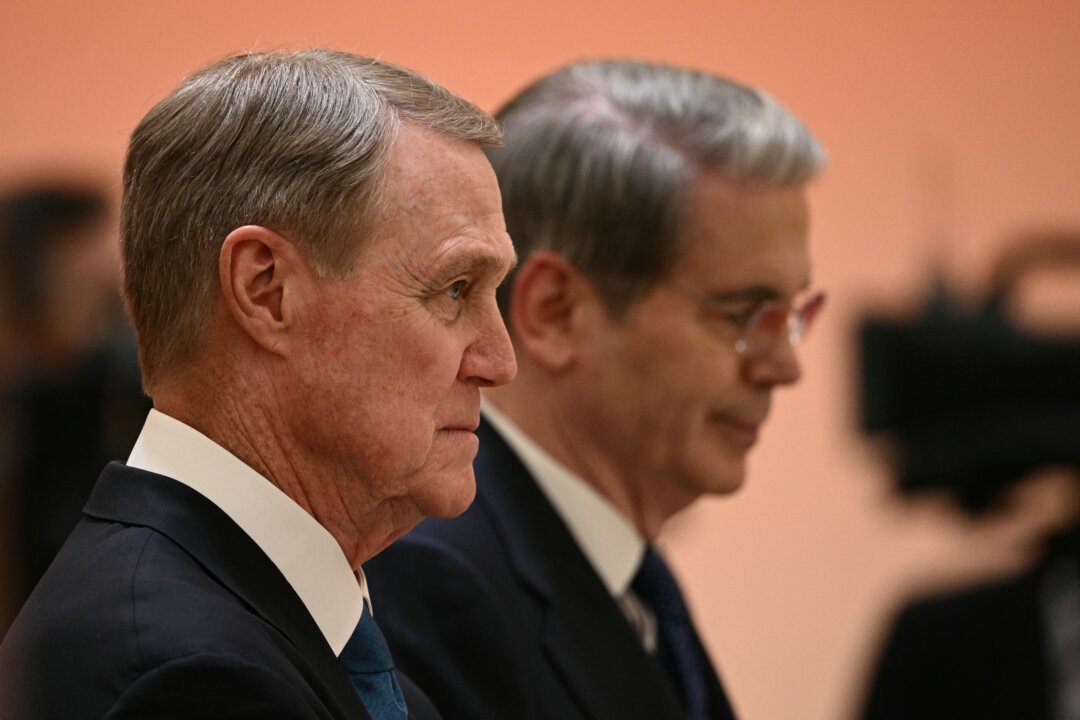
U.S. Ambassador to China David Perdue described relations between Washington and Beijing as “bumpy” on Nov. 11, citing the security controversy involving Nvidia CEO Jensen Huang and continuing delays in Chinese rare-earth shipments ahead of an expected meeting between President Donald Trump and Chinese leader Xi Jinping.
“The situation with Nvidia is another reminder that we have to stay diligent,” Perdue told Bloomberg Television at the Citi China Conference in Shanghai.
“National security is part of this economic conversation because economic security is national security,” he said. “And so, what we’re doing with China is bumpy right now.”
His remarks came a week before Trump and Xi are expected to meet during the Asia-Pacific Economic Cooperation summit in Shenzhen, China, on Nov. 18–19. The two governments have extended a trade truce, but disagreements over critical minerals and advanced technology remain.
Rare-Earth Delays Continue Despite Trade Truce
Perdue said American companies were still waiting for shipments of critical materials, including rare-earth elements, from China.
“We’ve been waiting for months on some of these very important elements that go into data centers and aircraft engine manufacturing and so forth,” he said.
His comments came after Beijing extended its suspension of certain export restrictions through Jan. 10, 2027.
The suspension covers measures introduced in October 2025, but earlier restrictions imposed in April 2025 on seven rare-earth elements remain in force.
Rare earths are metals used to make powerful magnets and other components needed for electronics, military equipment, and advanced manufacturing. China dominates the processing of many of these materials, making American manufacturers heavily dependent on Chinese supplies.
Suspending some export restrictions does not necessarily mean companies will immediately receive their shipments. China still maintains controls over other rare-earth exports, while Washington continues to press Beijing to fulfill its earlier trade commitments.
On Nov. 6, U.S. Trade Representative Jamieson Greer and Treasury Secretary Scott Bessent raised the issue during a call with Chinese Vice Premier He Lifeng.
Greer called for concrete action by China to fulfill previous commitments involving agricultural purchases, rare earths, and other critical minerals.
Nvidia Controversy Raises Security Concerns
Perdue also addressed the controversy involving Jensen Huang, chief executive of Nvidia, the American chipmaker whose advanced processors are central to artificial intelligence development.
Huang has acknowledged being unfaithful to his wife, following reports of an affair with Alice Huang, a businesswoman suspected by U.S. intelligence officials of having connections to Chinese intelligence. No U.S. authority has publicly established that she worked for Chinese intelligence.
Nvidia’s board announced an independent investigation on Nov. 8 following reports that its chief executive had been targeted by a foreign intelligence operation.
The company said it had no reason to believe national security or Nvidia’s proprietary information had been compromised. On Nov. 10, independent directors retained former federal prosecutor Joon H. Kim and his law firm to conduct the investigation.
Beijing has rejected the espionage allegations. Chinese Foreign Ministry spokesman Guo Jiakun called the claims unsubstantiated at a Nov. 10 press briefing.
Singapore’s Ministry of Home Affairs also disputed reports that its authorities had investigated Alice Huang’s alleged intelligence connections. The ministry said no such investigation had been conducted concerning her.
The allegations have prompted scrutiny in Congress. On Nov. 5, the Republican chairmen of three House committees requested that Huang attend a closed-door briefing on Nov. 18 about his interactions with Alice Huang and Nvidia’s safeguards against foreign espionage.
The lawmakers said the briefing was necessary to determine whether U.S. national security had been put at risk, particularly through potential Chinese access to sensitive American technology and information.
We had a problem loading this article. Please enable javascript or use a different browser. If the issue persists, please visit our help center.