
Democrats will take control of both chambers of Congress after the midterm elections. It’s the first time the opposition party has controlled both the House and Senate in the past 10 years.
Healthcare costs contributed in part to the results, according to KFF polling, with 59 percent of voters concerned about healthcare affordability, up from 2024. That included two in five Republican voters.
Half of voters—including 42 percent of independents and 9 percent of Republicans—preferred the Democratic Party to handle healthcare.
House Democrats drafted an 84-page healthcare policy agenda before the election, laying out their first days of action after taking office. The plan included reversing Medicaid cuts, restoring Obamacare premium subsidies, and expanding Medicare.
Here is what we know about potential changes in healthcare policies.
Reverse Medicaid Cut
The One Big Beautiful Bill Act (H.R.1) imposed nearly $1 trillion in Medicaid cuts over the next decade and rolled out work requirements in June.
“The first is I would expect Democrats to very quickly try to reverse the Medicaid cuts” and “restore enhanced premium subsidies in the [Affordable Care Act],” said Larry Levitt, executive vice president for KFF health policy in a panel discussion on Nov. 5.
The medical frailty definition for the Medicaid work requirements has already been challenged in court. The government defined medical frailty to restrict exemptions from the work requirement. A federal judge struck it down at the end of last month before the Jan. 1, 2027 implementation deadline.
The Medicaid changes could roll back some 10 million people. Those include 4.8 million able-bodied adults—who have no dependents and do not participate in the 80 hours a month of work-related activities—and 1.4 million with ineligible status for Medicaid enrollment under H.R.1.
Restore Obamacare Subsidies
Enhanced Affordable Care Act (ACA) subsidies paying insurers to lower premiums for middle-income people above four times the poverty level expired at the end of 2025.
“Health insurer and hospital stocks going way up the day after the election [is] a signal that the market expects more corporate welfare from Washington,” President of Paragon Health Institute Brian Blase said in a Nov. 5 post on X.
ACA marketplace benchmark premiums increased 26 percent in 2026. KFF predicted Obamacare premiums will increase again at another double-digit rate in 2027. That’s the second biggest rise since 2018.
“These are core issues for Democrats, and they’re united on these issues,” said Levitt. But President Donald Trump is likely to “veto any bill that the Democrats pass to do this.”

The Democrats attempted to advance a bill to restore ACA enhanced tax credits in January. Trump said he might veto it if it reaches his desk.
It’s like “a game of 3D chess,” Levitt said. Democrats might come to terms with Trump on some issues while pushing others forward.
“Maybe it’s a delay rather than a reversal. Or maybe it’s including some Trump priorities like health savings accounts as part of restoring ACA premium subsidies,” he said.
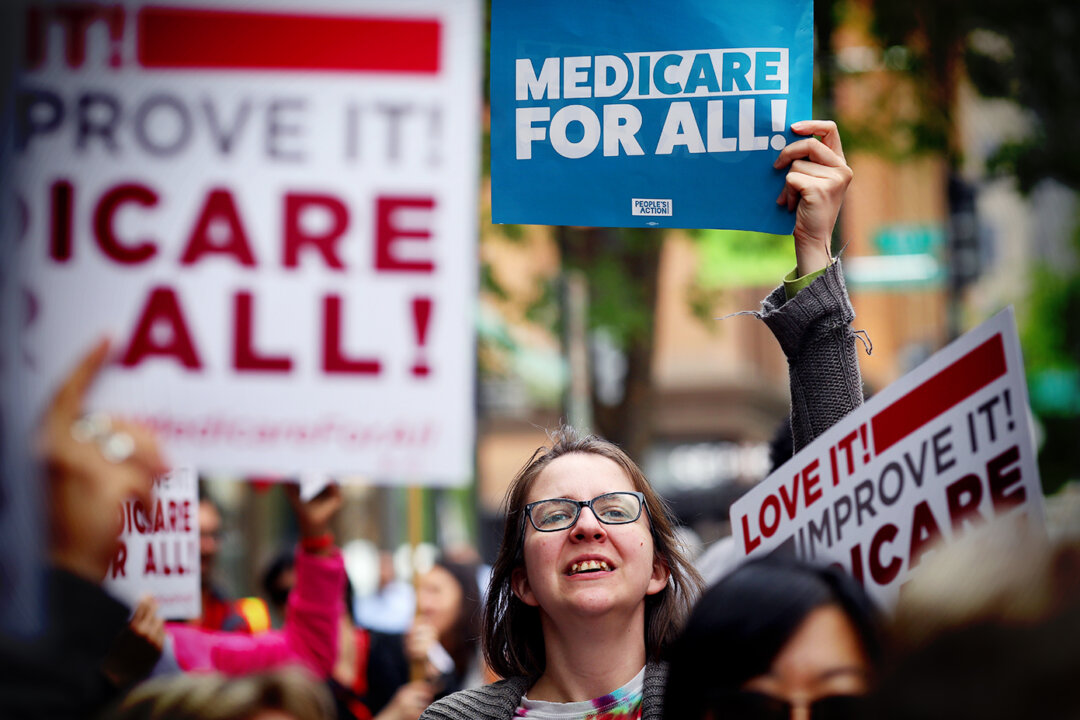
Medicare-for-All
Across partisans, more people have opted for Medicare-for-all over the past six years, according to KFF polling.
Two-thirds of U.S. adults prefer a national health plan in 2026, up from just over half in 2020. One-third of Republicans go for Medicare-for-all, up from 21 percent six years ago.
However, Mollyann Brodie, executive vice president and chief operating officer of KFF, said the number comes with caveats.
“The challenge is that when people are responding to that at this point, it is their initial reaction, and it is as much a reflection of just their frustrations with this health care system and with their cost of care as it is a real measure of support for fundamental change in how our healthcare system works,” Brodie said.
Levitt added: “I think everyone knows that it’s not going to pass in the next two years. This is all about positioning for the 2028 presidential campaign and what might happen after that.”
White House Council of Economic Advisers estimated that Medicare-for-All could cost $47.4 trillion in federal taxpayer dollars over the next 10 years.
Levitt said populist healthcare ideas could attract bipartisan support.
“If you listen to President Trump and Democrats on drug prices, they talk about a lot of the same things [and] use the same rhetoric,” he said.
“This could lead to a strange bedfellows kind of deal on bringing down drug prices, and similarly on price transparency, breaking up big insurance conglomerates, and prior authorization.”
We had a problem loading this article. Please enable javascript or use a different browser. If the issue persists, please visit our help center.