
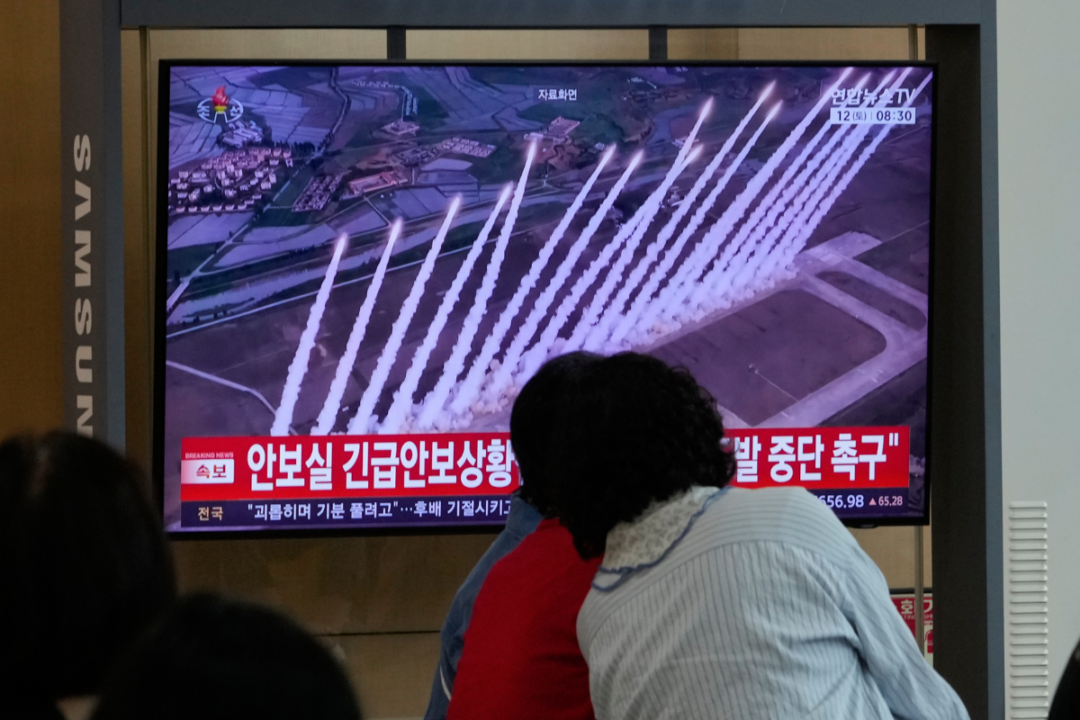
North Korea conducted its fourth missile test in a month, firing multiple projectiles towards the sea off its east coast, South Korea’s Defense Ministry said on Wednesday.
Seoul’s military detected missiles launched from the eastern region of Sondok, South Korea’s Joint Chiefs of Staff said in its statement, according to Yonhap news agency.
The military added that further analysis of the launch was underway in coordination with the United States.
The estimated dozen missiles are believed to have flown less than 187 miles, Yonhap reported.
The U.S. Pacific Command (USPACOM) said it was “aware” of the missile launches on Nov. 4, in a statement the same day, adding that it was “consulting closely with our allies and partners.”
“Based on current assessments, this event does not pose an immediate threat to U.S. personnel or territory, or to our allies,” the command added.
Seoul’s announcement regarding the launch was made shortly after Kim Yo Jong, the sister of North Korean leader Kim Jong Un and a major power player in Pyongyang, dismissed the idea of engaging in talks with the United States.
Kim Yo Jong said that North Korea has “no need to sit face to face with such unreliable and hostile persons who refuse to abandon their policy of confrontation,” according to the state-backed Korean Central News Agency (KCNA).
Kim Yo Jong also repeated Pyongyang’s denial that it was responsible for hacking the Binance cryptocurrency exchange, after the FBI blamed North Korea for the digital robbery.
She said that Washington’s assertion that North Korea was behind the $6.3 billion heist was a “malicious attempt to get a political and strategic profit.”
On Oct. 31, the FBI said it had identified a North Korean actor known as “TraderTraitor” as responsible for the Binance hack. TraderTraitor allegedly carried out a $1.5 billion Bybit hack on Feb. 21, 2025.
North Korea has engaged in multiple missile tests in recent weeks as relations between Seoul and Pyongyang continue to come under increasing strain.
Pyongyang labeled a recent joint military exercise by South Korean and U.S. forces as a “rehearsal” for targeting it in a nuclear war, and vowed, on Nov. 2, to ramp up its efforts to strengthen its own atomic deterrent.
The escalation in tensions on the Korean Peninsula was precipitated by a landmine explosion in the demilitarized zone in September, which injured several South Korean troops.
The U.N. Command, the body that formally decides whether the armistice has been breached, determined that the blast was Pyongyang’s fault.
Seoul has since demanded an apology, de-mined the site, and test-fired a hypersonic missile to ensure it’s prepared to respond to threats. It also proposed military talks with North Korea to de-escalate tensions.
Pyongyang has not yet acknowledged Seoul’s offer, dismissing the issue of the landmine explosion as a “farce,” and threatened to resume loudspeaker propaganda broadcasts across the border before the end of October; however, as of Nov. 2, the South Korean military has not detected any such actions, according to The Korea Herald.
Loudspeaker broadcasts are an old-fashioned, Cold War-era psychological warfare tactic the two Koreas have occasionally used against one another during periods of confrontation.
Since taking office last year, South Korea’s liberal government, led by President Lee Jae-myung, has stopped such broadcasts as part of efforts to improve ties with its communist neighbor, with North Korea later halting its own broadcasts.
However, Seoul has said that if Pyongyang resumes such broadcasts, it would do the same in response, and stressed that it will do what is necessary to protect its borders.
Although not actively involved in open conflict, North and South Korea technically remain at war.
We had a problem loading this article. Please enable javascript or use a different browser. If the issue persists, please visit our help center.