
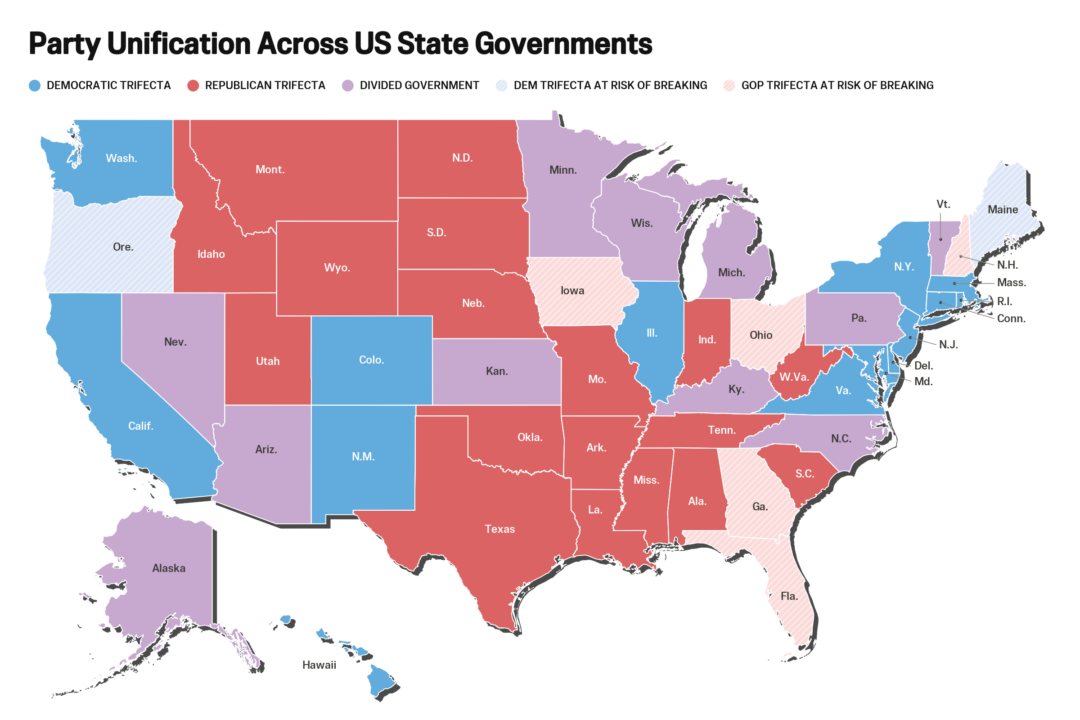
Trifectas
The fight for control of state legislatures and governors’ mansions is heating up in the final weeks of the 2026 midterm cycle, as both parties seek to retain—or flip—executive and legislative seats that will shape state and federal politics for years to come.
The top prize in state-level politics is a trifecta, or control of the governorship and the state legislature, including a lower chamber and a state Senate.
Currently, Democrats hold 16 trifectas to Republicans’ 23, while 11 states have a divided government.
About a dozen gubernatorial races are considered up for grabs this year, ranging from the Pacific Northwest to the Florida Keys.
The governor has the most unilateral influence over state policy, managing state agencies and wielding veto power to shape legislative policy. Flipping a seat can thus drastically stymie the legislature’s ability to carry out the agenda.
For various reasons, Republicans hold an advantage in state legislative elections that has proven difficult for Democrats to overcome, even as some analysts predict Democrats to win a wave of state-level races. Currently, the GOP controls 28 state legislatures while Democrats hold 18. Four other state legislatures are split, with Republicans controlling one chamber and Democrats the other.
Here is what to know.
Risk of Breaking
Florida
Florida Republicans currently control the governor’s mansion and the state House and Senate, and the state has voted reliably Republican since 2016.
The Sunshine State’s Legislature is not considered at risk for Republicans.
However, polls suggest that the GOP could potentially lose this trifecta as the gubernatorial race between Republican Rep. Byron Donalds and former Rep. David Jolly, who switched from Republican to Democrat, is increasingly competitive.

The Cook Political Report rates Florida’s gubernatorial race as leaning Republican, but the race remains relatively tight.
An average of five polls shows Donalds narrowly leading Jolly.
Donalds, who has been endorsed by President Donald Trump, has a platform of bringing down costs, cutting healthcare and business red tape, and bringing NASA headquarters to Florida from Washington.
Jolly is a former Republican member of Congress who received the Democratic nomination after switching parties. He’s running on increasing affordability for housing and healthcare. He has called for investing more in public schools and instituting a moratorium on data centers.


Georgia
As in Florida, Georgia Republicans enter the race with control of the governorship and both chambers of the state General Assembly.
While MultiState Elections rates both the state Senate and the state House races as likely Republican, the gubernatorial matchup is considered a toss-up.
The race for governor is between billionaire Rick Jackson, a Republican, and former Atlanta Mayor and Biden administration official Keisha Lance Bottoms, a Democrat.
The winner will succeed term-limited Republican Gov. Brian Kemp.
Bottoms’ platform consists of lowering healthcare costs and building more housing, while Jackson has vowed to freeze property taxes and to reduce and eliminate the state income tax.


The Cook Political Report rates the race as a toss-up, reflecting a years-long trend to the left in statewide Georgia races.
In 2020, Sens. Jon Ossoff (D-Ga.) and Raphael Warnock (D-Ga.) won their senatorial races alongside President Joe Biden’s narrow statewide victory. In 2022, Warnock fended off another challenge from Republicans to reclaim the seat. In 2024, Trump won Georgia by about 2.2 percentage points—Republicans’ lowest margin of victory in the Peach State since 1996.
Georgia last sent a Democrat to the governor’s mansion in 1998.
Bottoms trails Jackson in an average of the five most recent polls, though she previously led in most polls.
Iowa
In the Hawkeye State, Republicans are at risk of losing the governorship.
Though MultiState Elections rated the state House and state Senate races as likely Republican, the gubernatorial race is considered to be tilting Democratic.
In a Make America Healthy Again battle between Republican farmer Zach Lahn and Democratic State Auditor Rob Sand, most polls show Sand ahead.


Sand has led in every poll since June, and the Cook Political Report rates the race as leaning Democratic.
The winner will succeed Gov. Kim Reynolds, who declined to run for a third term.
Like other states, Iowa had been reliably Republican over the past several cycles, since Trump first won the state back in 2016 with a nearly 10-point victory. As recently as 2012, the state drew intense national attention as a battleground.
Ohio
In the Buckeye State, the Republican trifecta that has held since 2011 could be at risk of breaking, as Democrats hold a polling advantage in the state’s gubernatorial contests.
In the race, entrepreneur Vivek Ramaswamy, a Republican who gained prominence during his 2024 presidential run, is facing former Ohio Department of Health Director Amy Acton.
Earlier this year, the Cook Political Report shifted the race’s rating to lean Democratic, citing polls in which Acton led or tied with Ramaswamy, despite his financial edge.
Current polls show Acton leading Ramaswamy.


Meanwhile, the state House and state Senate are seen as likely holds for Republicans.
Like Iowa, Ohio was once a pivotal swing state that has veered toward Republicans in recent years. At the state level, it’s been dominated by the GOP since Republicans took both chambers of the Legislature in 2010.
In 2012, the Buckeye State backed President Barack Obama before swinging toward Trump in 2016, 2020, and 2024.
Maine
In Maine, Democrats are seeking to defend their trifecta.
Unlike the aforementioned states, the gubernatorial race in Maine is considered solidly favorable for Democrats.
However, the state House flipping to Republicans is a real possibility as control of the chamber remains a near-even split, with Democrats holding a 78–73 majority. Republicans would need to flip four seats to win a majority.
The state Senate is less at risk for Democrats, who control 20 of the chamber’s seats to Republicans’ 14.
In Maine, as in several other New England states, Republicans have more luck in state elections than in federal ones, as voters in the region often split their tickets in local races while backing Democrats at the federal level.

New Hampshire
While the Cook Political Report has rated New Hampshire’s gubernatorial race as likely Republican, the legislative race is competitive. Incumbent Republican Gov. Kelly Ayotte has a comfortable lead over her Democratic opponent, Cinde Warmington, in the polls.
Republicans hold a 16–8 majority in the state Senate. Democrats would need to flip five seats to win control. MultiState Elections rates the race as leaning Republican.
On the state House side, Republicans have a 212–169 majority. Democrats would need to flip 23 seats to take back the chamber. Nonetheless, MultiState Elections rates the state House race as leaning Democratic.
In the Granite State, a significant share of voters are unaffiliated with either party, making it difficult to predict the outcome of the state’s legislative elections.
Since 2017, Republicans have held a trifecta in New Hampshire—with the exception of 2019 to 2021, following the blue wave midterm election of 2018.


Oregon
In Oregon, Democrats’ trifecta stands at risk of breaking.
While the governorship and state Legislature are controlled by the Democrats, Cook Political Report has downgraded its rating for the gubernatorial race between incumbent Democratic Gov. Tina Kotek and Republican state Sen. Christine Drazan from likely Democratic to lean Democratic.
Polls have shown a mix between Kotek and Drazan in the lead in this close race.
The state House and state Senate are safer for Democrats in the West Coast blue haven, with Democrats controlling 37 of 60 state House seats and 18 of 30 state Senate seats.


Arizona
In this blue-trending western state, Democrats have the potential to form a new trifecta as Gov. Katie Hobbs seeks to drive a win for her party in both chambers of the state Legislature during her reelection bid this year.
At the top of the ticket, Hobbs faces a challenge from Republican Rep. Andy Biggs.
National issues—affordability, the impacts of Republican party-line cuts to Medicare and Medicaid, and data centers—are factors in the race. Hobbs’s campaign has emphasized abortion access. Meanwhile, local issues related to water access for Phoenix—a rapidly growing metropolis situated in the desert—have also been key in the race.
Hobbs has led Biggs by a double-digit margin in the majority of polls of the race conducted in 2026, and the Cook Political Report rates the race as leaning Democratic.
In the state House, Republicans currently control 33 out of 60 seats. In the state Senate, Republicans control 17 of 30 seats, meaning that Democrats just need to flip four to take a narrow majority in the chamber.


Kansas
In Kansas, meanwhile, Republicans have a pickup opportunity if they can reclaim the governorship.
The state House is dominated by Republicans, who control 88 of 125 seats, while the state Senate isn’t holding elections this year.
Gov. Laura Kelly, a Democrat, is not running for reelection, so the top of the ticket matchup is between state Sen. Ty Masterson, a Republican, and state Sen. Cindy Holscher, a Democrat.
Masterson has been the president of the Kansas Senate since 2021. He says he wants to cut taxes, bring jobs to Kansas, and raise pay for teachers. Holscher’s platform makes lowering the cost of living a top priority; she also wants to legalize cannabis.
The Cook Political Report rates the race as leaning Republican and Kansas has generally backed the party in national elections.
However, contests have been closer at the state level with, for example, Kelly, who won the governors’ race in 2018 and 2022.


Michigan
In this national swing state, either party could gain a trifecta, or the night could end with split control of the government.
The gubernatorial race is rated as leaning Democratic, while the state House and the state Senate races are seen as competitive.
Republicans have been looking to take back the Michigan gubernatorial mansion since they lost the seat to Gov. Gretchen Whitmer in 2018. Whitmer is ineligible to run this year because of term limits.
The Republican nominee is Rep. John James, while Democrats nominated Michigan Secretary of State Jocelyn Benson. The race is rated by the Cook Political Report as leaning Democratic.
In the state Senate, Democrats control 20 of the state’s 38 seats, meaning that they need to hold every seat they currently have to maintain a majority.
In the state House, meanwhile, Democrats are in the minority, with Republicans controlling 58 of the chamber’s 110 seats.


Minnesota
In Minnesota, Democrats have a potential pickup opportunity in the fight for the state Legislature.
The governor’s race is currently rated by Cook Political Report as solidly Democratic, making it unlikely that the seat will flip.
But in the state House, the parties are evenly matched in a 67–67 power-sharing arrangement, making the race a pure toss-up.
Meanwhile, Democrats also need to defend the state Senate majority, currently 34 of 67 seats. That means that Republicans just need to flip one seat.
Minnesota has been a political powder keg over the past two years, and national issues will likely be on these voters’ minds.
Starting in late 2025, the state was rocked by allegations of federal funding abuse connected to government assistance programs, including local Somali-run daycares.
Between the end of 2025 and the early months of 2026, the Trump administration flooded the state with federal immigration agents. Two Minnesotans, Renee Good and Alex Pretti, were described as domestic terrorists by the administration after they were killed by federal agents.
The funding abuse issue ultimately drove Democratic Gov. Tim Walz to drop his reelection campaign.

Nevada
In the Silver State, Democrats have relatively favorable odds of retaining their majorities in the state House and state Senate, putting all attention on the top-of-the-ticket race for governor.
This year Gov. Joe Lombardo, a Republican, is up for reelection.
Lombardo’s Democratic opponent is Nevada Attorney General Aaron Ford. He has promised to work for affordable housing and to address predatory practices by healthcare agents.
Lombardo has touted his record as governor during the campaign, referencing his work to expand state savings, cut regulation, and boost employment.
The state was flipped by Trump in the 2024 election for the first time since 2004. It came two years after Lombardo, a former sheriff, was first elected in 2022. The race is currently rated a toss-up by Cook Political Report.
Lombardo has remained close to the president, describing Trump as his “commanding officer” and saying that the two men’s close relationship has limited federal immigration enforcement in the state.


Pennsylvania
In Pennsylvania, Democrats are facing a moderately difficult victory in the state Senate elections.
Despite the state’s national battleground status, the governor’s seat, currently held by Democratic Gov. Josh Shapiro, is rated solidly Democratic by the Cook Political Report.
However, the Keystone State’s General Assembly is almost evenly divided.
To win a trifecta, Democrats will first need to hold their thin majority in the state House, where they currently control 103 seats to the Republicans’ 100.
They would also need to flip at least three seats in the state Senate, where Republicans currently hold a majority of 27 seats to Democrats’ 23 seats.

Wisconsin
In Wisconsin, Democrats have a tough but achievable path to a trifecta.
National attention has remained centered on this politically critical swing state, which voted for both Trump and Democratic Sen. Tammy Baldwin in 2024.
At the top of the ticket, Republican Rep. Tom Tiffany faces a tough fight to replace Democrat Tony Evers in the governor’s mansion. He’s facing Milwaukee County Executive David Crowley in a match The Cook Political Report rates as a toss-up.
Crowley’s defeat of democratic socialist state Rep. Francesca Hong by a hair earlier this year brought national attention to Crowley, who was considered more electorally viable in the general election.
Tiffany easily won the Republican nomination in his primary.
If Crowley wins, Democrats would also need to flip the state House and state Senate.
Republicans currently hold 54 seats to Democrats’ 45 seats in the state’s lower chamber. In the state Senate, Republicans control 18 seats to Democrats’ 15, meaning that Democrats would need to flip two seats to reclaim the chamber.


We had a problem loading this article. Please enable javascript or use a different browser. If the issue persists, please visit our help center.