
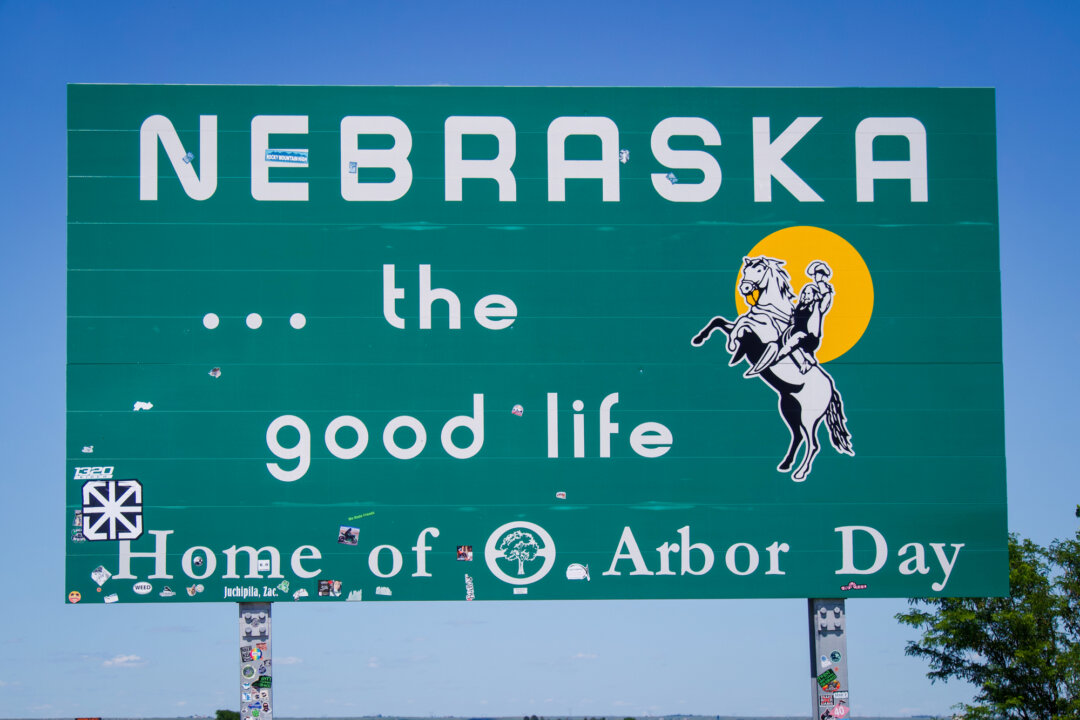
NORFOLK, Neb.—It’s less than one week until Election Day, and voters who spoke with The Epoch Times are concerned that political polarization is hampering efforts to address some of the largest challenges facing America.
In a state whose economy is largely fueled by agriculture, soaring fuel prices and competition from imports can combine to put the squeeze on rural constituents, who will pass that squeeze on to politicians seeking their support.
But farmers aren’t the only voters expressing their concerns.
The dozen or so voters who spoke with The Epoch Times listed immigration, allowing men to participate in women’s sports, and the impact of tariffs on Nebraska businesses, among other issues.
At first blush, it would seem that polarization would not be a big issue in Nebraska.
Apart from the Second Congressional District, which contains the city of Omaha and its environs, Nebraska is considered a deep red state. The second district is known as the Blue Dot because it is the state’s sole Democratic majority district.
Since 1966, Nebraska has given all five of its electoral college votes to Republicans in all but three elections.
Economists report that midway through his second term, Trump’s economic numbers are fairly positive. Real median income is up about 4 percent since the first quarter of 2025, according to the Bureau of Labor Statistics.
The Census Bureau reported the poverty rate at a record low of 10.2 percent last year, with a median household income of $87,460, which, adjusted for inflation, is the highest since 1967.
But such data can appear abstract to a farmer whose combine burns 20 gallons of $6 per-gallon diesel fuel each hour during harvest.

Stanley Kumm knows this because he spent his working life tilling Nebraskan soil. The 86-year-old retiree now helps his son and grandsons run the family farm. It’s still a challenging life, he said.
“We had corn, soybeans, and fed cattle. Been in the cattle business a long time,” Kumm told The Epoch Times.
As he waited for his wife to finish her shopping in Norfolk earlier this month, Kumm talked about the issues he will be considering as he casts his vote. He said he will likely vote Republican but he has some concerns.
“Yeah, this farming is tough. Just like now, the diesel fuel is like $6 a gallon,” Kumm said. “We’re combining, a lot of these machines take 20 gallons an hour, and that’s a lot.”
Kumm isn’t sure that America’s leaders are in the right state of mind to solve these problems.
“I think it seems like there’s a lot of rhetoric going on between the people. It seems like it’s getting worse. People aren’t getting along. I don’t know what’s the problem,” he said.
While Trump’s overall economic numbers should be generally favorable, Democrats are on the campaign trail pounding away at tariffs and the war with Iran as reasons for the increases in the cost of living.

One former Republican who now identifies as a Democrat said his business has been directly impacted by Trump’s tariffs.
Tyler Wilkinson spends his days repairing cell phones, handheld games, and other electronic products in Norfolk.
He says he grew up Republican, but has turned to the Democratic Party because of GOP fiscal policies. He believes that Democratic administrations have a better record when it comes to economic policy. He also believes the Trump administration has bypassed Congress on too many issues.
He said Trump’s policies, especially import tariffs, have directly impacted his business by making it difficult to order parts from overseas vendors. From his perspective, tariffs have created, rather than solved, a problem.

“A lot of people lean on trade deficits and say, ‘Oh, well, if we have a trade deficit with a country … that’s unfair. I don’t understand how that is unfair or unbalanced in any way. I have a huge trade deficit with Walmart. Walmart doesn’t buy any product from me,” he said.
He holds a similar view on the war with Iran. Wilkinson said the military action and subsequent closure of the Strait of Hormuz are the main reasons fuel prices increased. He said the financial strain on farmers—like Kumm and his family—is being passed along to service businesses like his.
“Farmers in our area literally are the lifeblood of every other business around. Every time that we see [conditions] really harm the farmer’s pocketbook, it affects our pocketbook,” he said.
Congress Should Be Involved
Wilkinson believes that Congress should be more involved in decision-making, especially when it comes to data centers. Now is the time for Congress to get involved to mitigate the impact the centers will have on local infrastructure and the environment, he said.
Wilkinson said it is a mistake to allow corporations to determine how best to build the centers as they may focus on profits over quality workmanship.
Caydon Scroggin is a 19-year-old college student and shoe store clerk. He said the political process pits Nebraskans against one another based on geography.

Scroggin grew up on a farm in Cozad, Nebraska. He said that over the years, a division has arisen between rural Nebraskans in the west and those who live in the eastern cities of Lincoln and Omaha.
Many in rural areas feel they are being taxed to pay for programs that they don’t need or use.
“For most of my entire life, growing up in a more rural area, a lot of decisions [were] made by people who don’t even live anywhere near where I’m from or anybody that I know is from,” Scroggin said.
He would also like to see a greater focus on education because he believes a better educated populace would be able to avoid many of the social problems of today. When it comes to the issue of data centers, he is concerned that the debate will focus on the digital benefits while glossing over environmental and social concerns.
Limits Are Needed
Scroggin suggested setting limits on how artificial intelligence (AI) is used and who can use it. The aim should be to ensure that humans control technology, rather than depend on it.
“I think having a society that can just, on a whim, have something make decisions and do all the problem solving for them is not a good thing,” he said.
Scroggin said that if data centers are going to be built, the plans should be offset by parks and other green spaces.
“I think we need some sort of restriction. I mean that’s on any company. We stop monopolies from happening; why is it not the same thing with AI?” Scroggin said.
Just a few miles from Scroggin’s store, a woman who will not vote in the U.S. elections waits for her order in a coffee shop and talks about her disillusionment with politics.
Issue Is Spiritual
Belinda Vanede is a Dutch citizen on the homeward-bound leg of a U.S. vacation with her partner. Middle-aged, she holds a master’s degree in political science, and says polarization is not unique to the United States. Which is why she no longer follows politics.
Vanede says the problem cannot be solved politically.
She believes the system is no longer focused on communities. Instead, it is about money and power. According to Vanede, the only way to reverse course is for people to seek enlightenment and to rebuild our sense of community.
“I think politics has become a game of you know profit and how much money you can put in your pocket. Not specifically in America; it’s all over. And I just don’t believe in the system anymore,” she told The Epoch Times.
“I believe that we need to return to small communities where people are involved with one another, where people care about one another, where there is mutual reciprocity between one another.”
Andrew Moran, Kevin Stocklin, and Emel Akan contributed to this report.
We had a problem loading this article. Please enable javascript or use a different browser. If the issue persists, please visit our help center.