
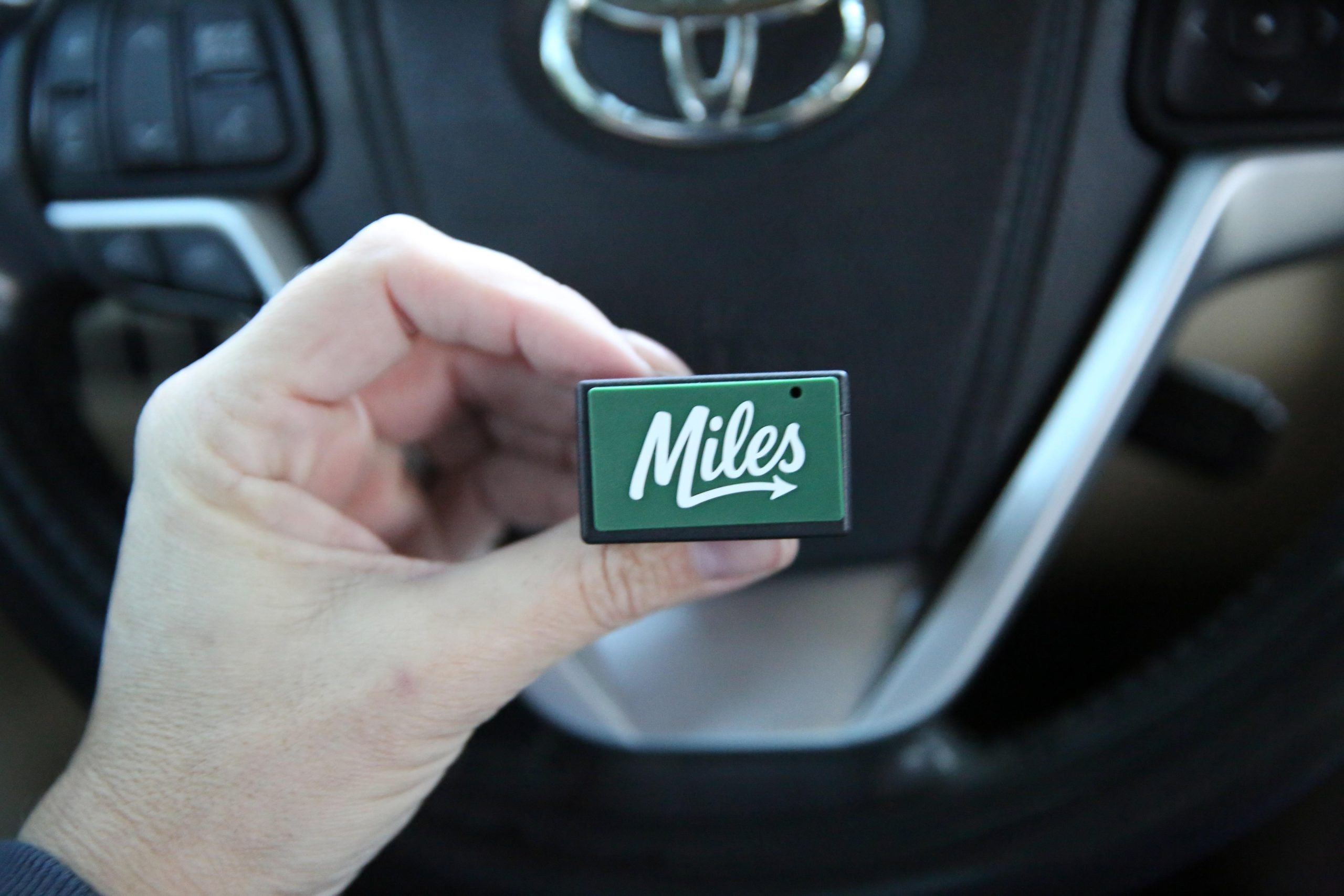
The Miles Plug adds crash detection, roadside help, location tracking, and a warning-light decoder to your car for as low as $11 a month.


My 15-year-old daughter just got her learner’s permit, so when I was pitched a new gadget tailored to teen drivers, I was intrigued. The Miles Plug is a small device that plugs into your car’s OBD-II port and monitors location, driving habits, and vehicle health, along with emergency accident response and roadside assistance.
The idea is that knowing all these things should help me feel more comfortable when my daughter starts driving alone. I tested the (now discontinued) Ring Car Cam when my son was learning to drive, but he hated it and refused to turn it on; I wondered if the Miles could provide the same peace of mind without feeling as intrusive.


Billed as “a wearable for your car,” Miles is a tiny cellular and GPS-enabled device that connects to an app to deliver real-time location, alerts, and driving insights (speeding, hard braking, trip recaps). The app also features an AI chatbot called the Miles Mechanic that decodes warning lights, tells you how urgent a fix is, and estimates repair costs.
Miles was developed by cofounders Matt McGovren and Kit Klein, who have a solid smart home pedigree. They worked at Wink in the early days and bring combined experience from Amazon (Ring and Blink), Ubiquiti’s smart home line, and other companies. “We built Miles to support teens and parents together, and keep them on the same team,” said McGovren in a press release. “Parents and teens see the same trips and the same alerts with nothing hidden, building trust instead of suspicion.”
Miles is available today at mileslabs.com and costs $99, plus $180 for a year of membership ($279 total, or $15 a month). A three-year plan is $396 with the Plug included ($11 a month). All plans are paid upfront with no auto-renewal. Anyone in the family can download and use the app, with each driver getting their own profile and alerts. Miles says it’s compatible with most gas and hybrid cars from 2008 onward and some EVs (there’s a compatibility checker).
While the prices seem steep, McGovren’s pitch is that it covers several services you might already be paying for: “You could piece together a roadside service, a family tracking service … and then you’re looking at $30, $40 a month,” he said in an interview with The Verge. And, unlike your car’s own branded app, Miles isn’t selling your data. Automakers have been caught collecting and selling driving data, with GM being banned from selling data to brokers for five years.
McGovren says Miles will never sell vehicle, trip, or location data, and the app has no ads: “You’re the customer, you’re not the product. Your data is not the product.” He says, “All the vehicle and trip data is encrypted,” adding that “the most sensitive data is end-to-end encrypted.” Additionally, the location data is tied to the car, not the phone, so it stops tracking when you walk away. The app lets you download your data, stop location collection, and delete your account and all its data.

I set up Miles in my 2014 Toyota Highlander I nicknamed Tanya and have been using it for a couple of days. Setup was simple, and the app is clean, uncluttered, and easy to follow. It took me through a few setup screens, including asking to share my phone’s location to relay data from the Plug over Bluetooth when cell service is spotty. I plugged it into my OBD-II port, and it read my VIN and correctly identified my car.
It logs every trip with route, distance, time, and driver initials (I haven’t had my daughter download the app yet; I’m interested to see whose phones it connects to when we’re both in the car). Arrived- and left-home alerts came through promptly, and the events tab flagged hard acceleration and a cluster of three hard-braking alerts when I was running a little late to collect my daughter from work.
I like the home card, which shows a vehicle health summary: engine OK, fuel 63%, battery 13.5V, and the odometer reading. I played with the Miles Mechanic chatbot and asked how my car is and what upcoming maintenance is due; it answered in plain English, telling me the cabin air filter is due at about 140,000 miles, and the oil change and tire rotation at 142,500.


I haven’t been testing it long enough to comment on battery drain, an issue with earlier products in this space. “It goes to sleep when your car is not driving or not on,” says McGovren. “We use a little bit of data to wake up and sync, but [that] doesn’t have a material impact on the battery.” He advises removing it if you won’t be driving the car for a while.

Beyond car battery life, an obvious concern for prospective users is how long Miles the company will last. Startup Automatic had a similar idea back in 2016, launching the Automatic Pro for $130 that plugged into your OBD-II port, tracked mileage and location, and monitored for crashes over a 3G radio. The service shut down in 2020. Miles is basically Automatic but with a business model; Automatic didn’t initially charge a monthly fee, Miles does.
McGovren says he and his team have seen a lot of “scar tissue from the smart home,” with companies that “thought they could make money later.” Both founders were at Wink during its outage, bankruptcy, and eventual sale to will.i.am’s company. Charging for membership upfront is meant to avoid that type of outcome. He says the company is “well capitalized” and offers a 60-day money-back guarantee to users.
Automatic also had several smart-home tie-ins, but at launch Miles doesn’t connect to your smart home. McGovren says they have an MCP server in beta that could deliver “all of this information … to your AI of choice, your home assistant of choice,” he says. “And now the car becomes part of this bigger ecosystem. We aren’t just trying to tie you into our app.” He envisions a future where you own your car’s data and can connect it to any service you want, and be able to ask Alexa, Siri, or Google, “When’s my next oil change?” or “How much gas is in my car?”
Miles is pitched as a solution for monitoring your teen driver, including notifications of possible crashes and risky driving, without also having to monitor their phone. But it also feels like a good solution for anyone with an older car or who doesn’t want to rely on data-tracking apps from insurance companies or car manufacturers but wants easy access to their car’s data. I plan to test it more thoroughly, hopefully try out the MCP integration, and follow up with a full review.
Photography and screenshots by Jennifer Pattison Tuohy / The Verge