
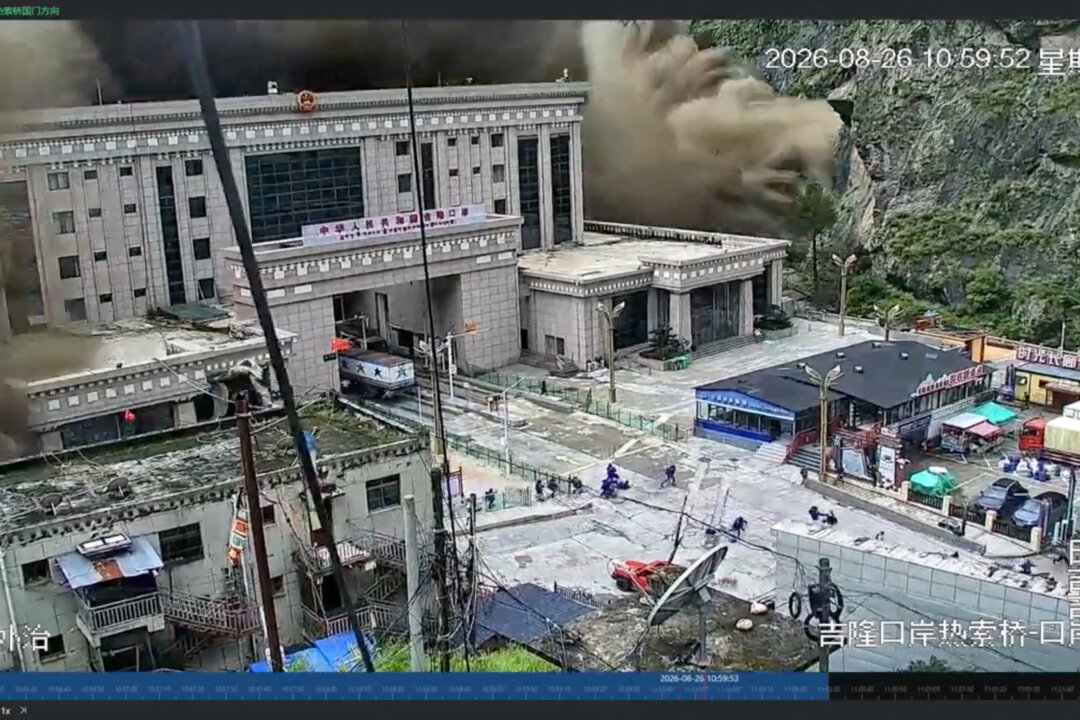
Chinese insiders are raising questions about whether regime authorities failed to act on warnings of an impending landslide that devastated a major China–Nepal border crossing in Tibet on Aug. 26, leaving more than 1,100 people dead and thousands missing.
One insider alleged that officials detected the danger minutes before the disaster but did not promptly issue a warning or order an evacuation.
The insiders spoke to The Epoch Times on condition of anonymity out of fear of reprisal.
One person familiar with China’s emergency-management system told The Epoch Times that authorities in China-occupied Tibet detected signs of danger upstream before the landslide struck the Gyirong Port but did not raise the warning level or promptly report the threat to Beijing.
The landslide struck the Gyirong Port, a major land border crossing between China and Nepal, after a massive ice collapse in Nepal.
According to China’s state-run Xinhua News Agency on Aug. 30, the disaster obliterated about 0.7 square kilometers of land and destroyed 27 buildings and related facilities.
The ice originated in a glacial area at an elevation of about 5,200 meters (17,060 feet). It traveled roughly 22 kilometers (13.67 miles) in about seven minutes before reaching the border crossing at an elevation of around 1,800 meters (5,906 feet), according to Xinhua.
Its speed left people at the port with little or no time to escape.
An insider from within the Chinese regime, surnamed Zhou, told The Epoch Times that Tibetan authorities had detected the danger ahead of the landslide.
“Looking at the timeline of the disaster, the Tibetan side had already detected the danger five minutes before the landslide reached the port, and they judged that its direction was Gyirong,” Zhou said.
“But the Tibetan officials did not take it seriously, resulting in hundreds of people being buried, and the border crossing facility was also gone.”
He said staff at a local environmental monitoring center waited until the landslide hit the Gyirong Port before reporting the disaster and said they were responsible for delays in the disaster warning and response.
These allegations have not been addressed in the official accounts released by Beijing, and The Epoch Times could not independently verify the accounts.
Nepali officials had pressed China to provide early data sharing on glacier movements and water levels following another flood and landslide last year.
Sauharda Joshi, a hydrologist at Nepal’s Department of Hydrology and Meteorology, told Nepal News that there was no timely warning from Chinese authorities about this year’s flood.
“The flood crossed into Nepal around 8:40 a.m. and reached Syabrubesi within 10 minutes,” he said. “If we had been informed while the flood was building up in Tibet, human casualties could have been significantly minimized.”
Lessons From 2025 Disaster
The disaster came just over a year after another major event in the same valley.
On July 8, 2025, a flood burst from a glacial lake and swept through the area, destroying the China–Nepal Friendship Bridge connecting the Gyirong Port on the Chinese side with Rasuwagadhi on the Nepalese side. Nepali officials reported 11 deaths in the incident.
The recurrence of a major disaster in the same valley has prompted questions about whether authorities reassessed the safety of the border crossing.
A geological expert in China’s Gansu Province, surnamed Chen, told The Epoch Times that Chinese authorities should have treated any significant upstream anomaly as a potentially extreme threat rather than relying on the previous year’s experience.
“Local bureaucrats were lax in their work and handled the new danger based on the experience of the previous disaster,” he said.
“Every time a disaster occurs, the same thing happens again. So many people were buried. This was caused by human factors.”
Chen also compared the response to recent flooding in China’s Guangxi region, where he said authorities failed to promptly notify residents about dam breaches.
“Even if they notify people, it is several hours later, after the disaster has already become a fact,” he said. “What is the point of notifying them?”
China’s Ministry of Natural Resources said it activated a Level II geological-disaster emergency response about four-and-a-half hours after the disaster, according to Xinhua.
A Chinese professor, surnamed Wang, told The Epoch Times that Chinese authorities had still not provided a complete public account of what warning and evacuation measures were implemented after the 2025 disaster.
“The same is true of this disaster: They did not learn from the lessons, and if this systemic problem is not resolved, there will be another one,” Wang said.

Beijing’s Response
The disaster has also drawn high-level attention from China’s central government.
Chinese leader Xi Jinping issued instructions for responding to the disaster on Aug. 26, while Premier Li Qiang also issued instructions.
Beijing initially sent Vice Premier Zhang Guoqing to Tibet with officials from relevant government departments to oversee rescue efforts, according to Xinhua.
The following afternoon, however, Li traveled to Gyirong himself, visiting the disaster area and inspecting rescue operations. Xinhua reported that he went to Tibet at Xi’s request.
The presence of large numbers of foreign nationals has added another layer of pressure.
The Chinese regime said 261 foreigners were among those reported missing, according to Xinhua.
An insider from within the Chinese regime, surnamed Shao, told The Epoch Times that foreign embassies had contacted Beijing seeking information about their nationals.
“More than 200 foreigners are from more than 20 countries, especially 18 Americans who are missing,” Shao said.
“The United States and Canadian embassies called to inquire about their nationals. Of course, the CCP has to give them an explanation.”
The involvement of foreign nationals means the disaster is not simply a domestic emergency for the Chinese regime. It has also become a diplomatic issue for Beijing, particularly as foreign governments seek information about missing citizens.
On Aug. 28, the CCP’s Politburo held a meeting to discuss rescue operations following the Gyirong landslide.
Reporting by Xinhua on the meeting did not mention allegations that local authorities had delayed reporting the danger, nor did it specify when the upstream threat was first detected.
Ye Zilong and Reuters contributed to this report.
We had a problem loading this article. Please enable javascript or use a different browser. If the issue persists, please visit our help center.