
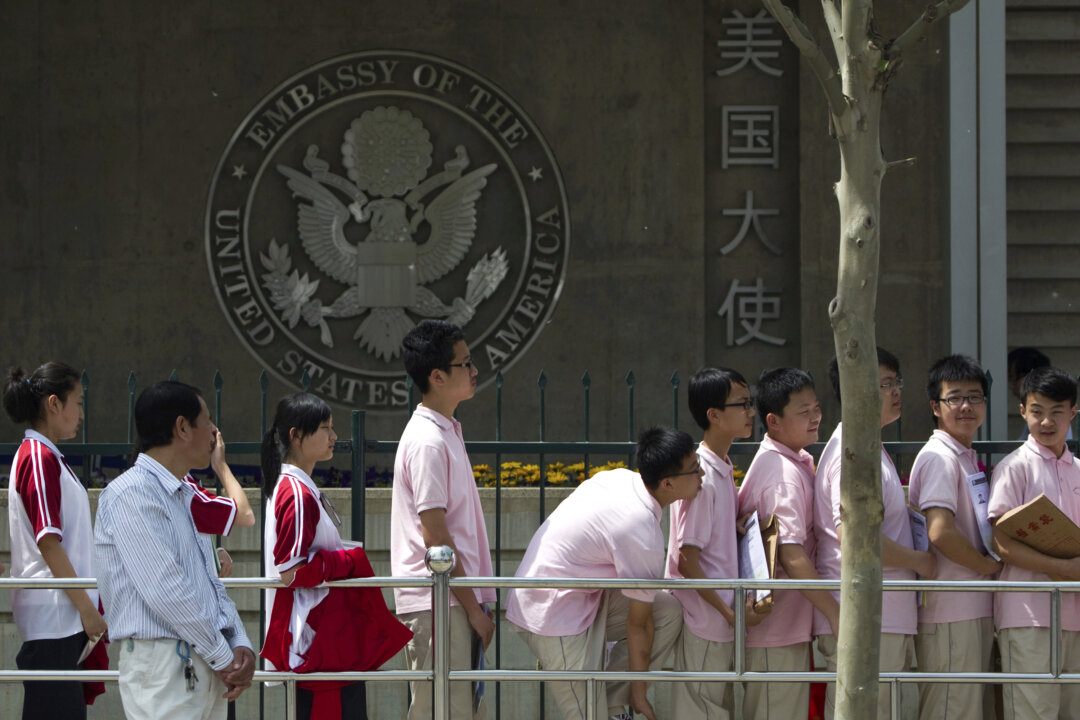
The Department of Homeland Security (DHS) cited China-linked research security and military cases to help justify a nationwide overhaul of how the United States monitors foreign students and exchange researchers.
Under a final rule published July 17 and set to take effect Sept. 15, many F-1 students and J-1 exchange visitors will no longer be admitted for an open-ended “duration of status.” Those staying beyond fixed admission periods will instead have to undergo new federal reviews.
DHS cited Chinese nationals convicted of fraudulently using research visas and smuggling biological materials, along with cases involving alleged concealed ties to China’s People’s Liberation Army (PLA).
The department said the old system left immigration officers without regular opportunities to directly reassess some foreign students and researchers.
The rule applies to foreign students and exchange visitors regardless of nationality.
Research Visas and PLA Ties
One of the cases involved Liu Zhongsan, who operated the U.S. office of the China Association for the International Exchange of Personnel, which the Justice Department identified as a Chinese government agency involved in recruiting scientists, academics, engineers, and other experts.
A federal jury convicted Liu in 2022 of conspiring to defraud the United States and commit visa fraud.
Prosecutors said Liu helped fraudulently obtain J-1 research-scholar visas for Chinese government employees so they could work for the Chinese regime in the United States while concealing that work from U.S. authorities.
In one example cited by prosecutors, Liu helped a Chinese government employee obtain a J-1 visa by securing a university research position for her. Prosecutors said her real assignment in the United States was to work for the China Association for the International Exchange of Personnel, the Chinese government agency Liu represented.
DHS also cited a Chinese national who entered the United States on a J-1 visa to conduct scientific research at the University of California, San Francisco.
Federal prosecutors alleged in 2020 that he falsely stated on his visa application that his service with the People’s Liberation Army had ended.
According to court documents cited by the Justice Department, the medical researcher later told border officers he remained employed by a PLA military-university laboratory and that his supervisor had instructed him to observe the UCSF laboratory’s layout and bring information back to China on how it could be replicated.
Biological Materials
DHS also cited cases at the University of Michigan involving Chinese research scholars and biological materials.
Yunqing Jian pleaded guilty on Nov. 12, 2025, to smuggling Fusarium graminearum into the United States and lying to FBI agents.
The fungus causes disease in major crops including wheat, barley, corn, and rice. It is responsible for billions of dollars in economic losses worldwide each year, according to the Justice Department.
Court records cited by prosecutors said Jian had received Chinese government funding for work involving the fungus in China.
The final rule says the Michigan cases were among examples included in DHS’s June 2, 2026, analysis of data from the Student and Exchange Visitor Information System, known as SEVIS.
DHS has not publicly released a separate report detailing that analysis. The department did not respond to a request for further details about the analysis.
More Federal Review
Under the current duration of status system, foreign students and exchange visitors can remain in the United States as long as they continue their approved studies or programs and comply with their visa status, without seeking a new immigration extension at a fixed interval.
DHS said that structure gives immigration officers too few predetermined opportunities to directly verify whether they remain engaged only in activities permitted under their immigration classifications.
The new rule generally limits F and J admission to the length of an approved program, up to four years. Those needing more time must apply to U.S. Citizenship and Immigration Services (USCIS) for an extension.
During the rulemaking process, DHS noted, some commenters argued that the security cases DHS cited had already been detected under existing laws and monitoring systems and that espionage concerns should be addressed through more targeted law enforcement and national security measures.
DHS rejected that argument in the final rule and said the changes will allow it to periodically and directly assess whether foreign students and exchange visitors are complying with their immigration status and obtain updated information about their activities.
The rule also allows USCIS to require biometrics and interviews during extension-of-stay applications. DHS said biometrics can be used to confirm identity and conduct background and security checks.
Federal auditors had previously identified gaps in information used to assess research security risks.
The Government Accountability Office (GAO) reported in November 2022 that Immigration and Customs Enforcement (ICE) had incomplete data that could help identify foreign students and scholars who might pose technology transfer risks.
GAO illustrated that ICE determined SEVIS already collected five of seven data categories identified under a federal research security directive. ICE told GAO that two additional categories—including prior education and research affiliations—could not be collected without new regulations.
DHS, the University of Michigan, and UCSF did not respond by publication time to questions about the cited cases and the additional safeguards DHS says the new vetting system would provide.
We had a problem loading this article. Please enable javascript or use a different browser. If the issue persists, please visit our help center.