
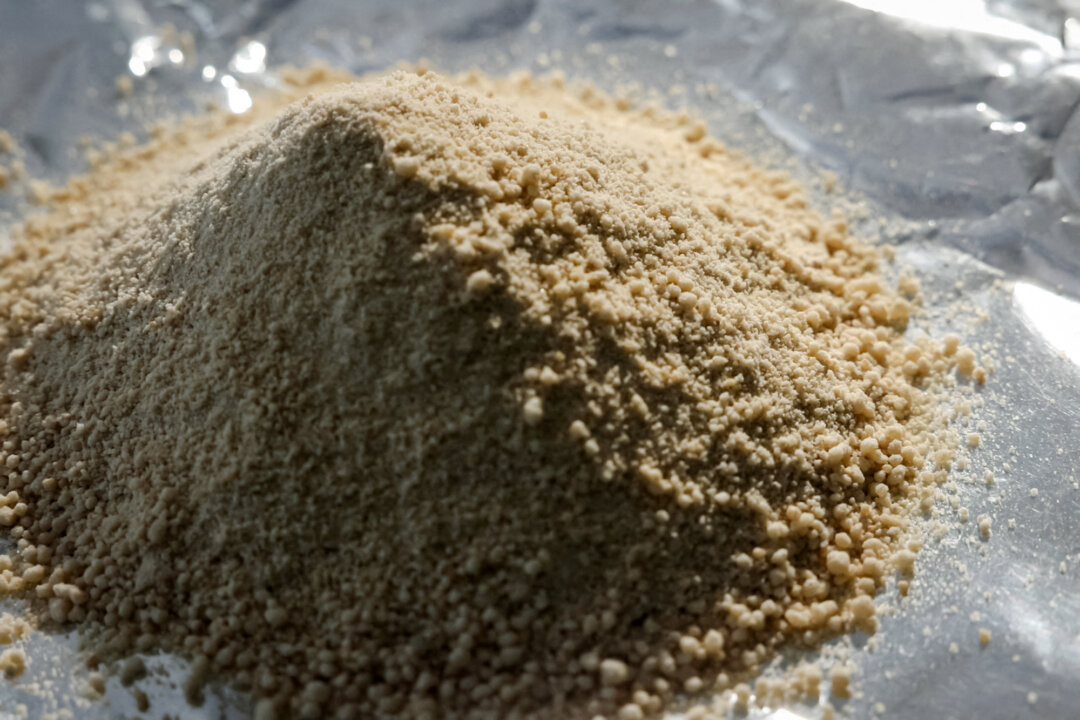
Hernan Geovani Ojeda Elenes, 48, of Culiacan, Mexico, pleaded guilty Aug. 27 to two federal drug conspiracy charges and admitted responsibility for producing and distributing at least five metric tons (about 11,000 pounds) of fentanyl.
Ojeda Elenes bought large quantities of fentanyl precursor chemicals from companies in China, arranged for them to enter the United States through an Arizona freight forwarder, and moved them into Mexico, where he used them to manufacture fentanyl for distribution back into the United States, according to court filings.
The Justice Department described Ojeda Elenes as a fentanyl manufacturer for the Sinaloa cartel. He operated a trafficking organization with his father, Hernan Domingo Ojeda Lopez, and others in Mexico’s Sinaloa state. The organization focused on methamphetamine and cocaine before shifting primarily to fentanyl around 2019 because members believed it would be more profitable.
Fentanyl is a synthetic opioid up to 50 times stronger than heroin and 100 times stronger than morphine, according to the Centers for Disease Control and Prevention. Illicit fentanyl can be mixed into other drugs or pressed into counterfeit pills, leaving users unaware of its presence.
CDC data show 47,735 U.S. overdose deaths involved synthetic opioids such as fentanyl in 2024, down from 72,776 in 2023.
Chinese Chemicals Moved Through Arizona
Ojeda Elenes admitted buying large quantities of 4-piperidone and N-phenylpiperidin-4-amine, also known as 4-AP, from chemical supply companies in China.
He arranged for the chemicals to be imported into the United States and delivered to a freight forwarding business in Arizona, then directed that they be transported across the U.S.–Mexico border to him. He used the chemicals at a fentanyl laboratory he operated in Mexico, according to the court filing.
The filing says U.S. law enforcement seized approximately 25 kilograms (about 55 pounds) of 4-piperidone belonging to members of the organization in September 2020. In January 2023, authorities seized approximately 240 kilograms (about 529 pounds) of 4-AP from the Arizona freight-forwarding business.
The court papers do not name the Chinese suppliers or the Arizona freight forwarder. The Epoch Times asked the Justice Department for more information on them and didn’t receive a response by publication time.

Fentanyl Trafficked Across US
The court filings tie Ojeda Elenes’s organization to fentanyl seizures in several states.
Authorities recovered approximately two kilograms (about 4.4 pounds) in Illinois in April 2020 and approximately five kilograms (about 11 pounds) in Oklahoma the following month after the drugs were transported by a trucking business operated by Ojeda Elenes’s brother, Nefer Ojeda-Elenes.
Another approximately 30 kilograms (about 66 pounds) was seized in Ohio in January 2023, according to the filing. In early 2024, authorities obtained approximately 15 kilograms (about 33 pounds) in two undercover purchases in California arranged by Ojeda Elenes’s father and facilitated by other members of the organization.
Prosecutors estimated in a January 2026 detention filing that the organization was importing approximately 1,000 kilograms (about 2,200 pounds) of fentanyl per month into the United States. They cited cooperating witnesses, electronic communications, and seizures of fentanyl and precursor chemicals among the evidence against Ojeda Elenes.
Ojeda Elenes’s father is a co-defendant in the same District of Columbia prosecution. He was among 26 defendants transferred from Mexico to U.S. custody in August 2025.
His brother was sentenced in Illinois in March 2025 to 19 years in federal prison after pleading guilty in a separate case involving seven kilograms (about 15.4 pounds) of fentanyl.
Sentencing Ahead
Ojeda Elenes was indicted under seal in March 2024 and brought from Mexico to the United States in January 2026. He pleaded guilty to conspiring to manufacture and distribute fentanyl for unlawful importation into the United States and conspiring to distribute chemicals for fentanyl manufacture.
The fentanyl count carries a mandatory minimum sentence of 10 years and a maximum of life imprisonment. The parties calculated an advisory sentencing range of 30 years to life.
No sentencing date has been set. U.S. District Judge Ana C. Reyes ordered the parties to report back on sentencing on Dec. 2.
Targeting Fentanyl Precursors
U.S. efforts to restrict fentanyl precursor chemicals predated Ojeda Elenes’s organization’s shift toward the drug.
In 2017, two major fentanyl precursors—N-phenethyl-4-piperidone, or NPP, and 4-anilino-N-phenethylpiperidine, or ANPP—were placed under international control. The U.N. drug agency later said traffickers adapted by turning to alternative precursor chemicals.
In 2022, 4-AP—the same chemical identified in Ojeda Elenes’s case—was among three additional fentanyl precursors placed under international control.
By March 2023, the State Department said it continued to see precursor chemicals originating in China being used for illicit fentanyl production and called on Beijing to curb their diversion.
That month, Secretary of State Antony Blinken and Mexican Foreign Secretary Marcelo Ebrard also discussed joint efforts to disrupt precursor chemicals used to make illicit fentanyl and other synthetic drugs, according to a State Department readout.
In June 2023, the Justice Department announced its first prosecutions of China-based chemical manufacturers and Chinese nationals for trafficking fentanyl precursor chemicals into the United States. Four companies and eight executives or employees were charged.
Two executives of Wuhan-based Hubei Amarvel Biotech were later convicted of fentanyl precursor importation and money laundering and are serving U.S. federal prison sentences. Qingzhou Wang was sentenced to 25 years and Yiyi Chen to 15 years.
We had a problem loading this article. Please enable javascript or use a different browser. If the issue persists, please visit our help center.