

The Chinese regime’s detention of U.S. citizen U Min Zin amounts to coercive “hostage diplomacy,” serving as a serious global warning that other authoritarian states could adopt similar tactics, experts warn.
Scholars at Risk—a U.S.-based academic freedom watchdog group—urged the relevant authorities “to facilitate Min Zin’s immediate and unconditional release, and for his safety to be guaranteed,” according to a statement on Aug. 27.
It also expressed gratitude for the U.S. State Department’s Aug. 20 designation of Min Zin as “wrongfully detained” by the Chinese Communist Party (CCP).
The department said it will “continue to advocate for Mr. Zin and call for the release of all U.S. citizens who are arbitrarily detained or exit-banned in China.”
Min Zin, a scholar on Burma (also known as Myanmar), was taken into custody on June 3 while attending an academic conference in China’s southwestern Yunnan province at the invitation of the Chinese regime.
A Chinese foreign ministry spokesperson claimed on Aug. 21 that Min Zin was suspected of engaging in activities “endangering Chinese national security.”
The regime’s assertion is “preposterous,” Hunter Marston, an adjunct fellow at the Center for Strategic and International Studies in Washington, told The Epoch Times.
“He has not written anything uniquely sensitive to China or China’s influence in Myanmar. Therefore the most logical explanation is that Beijing will seek to use his arrest for political leverage,” he said.
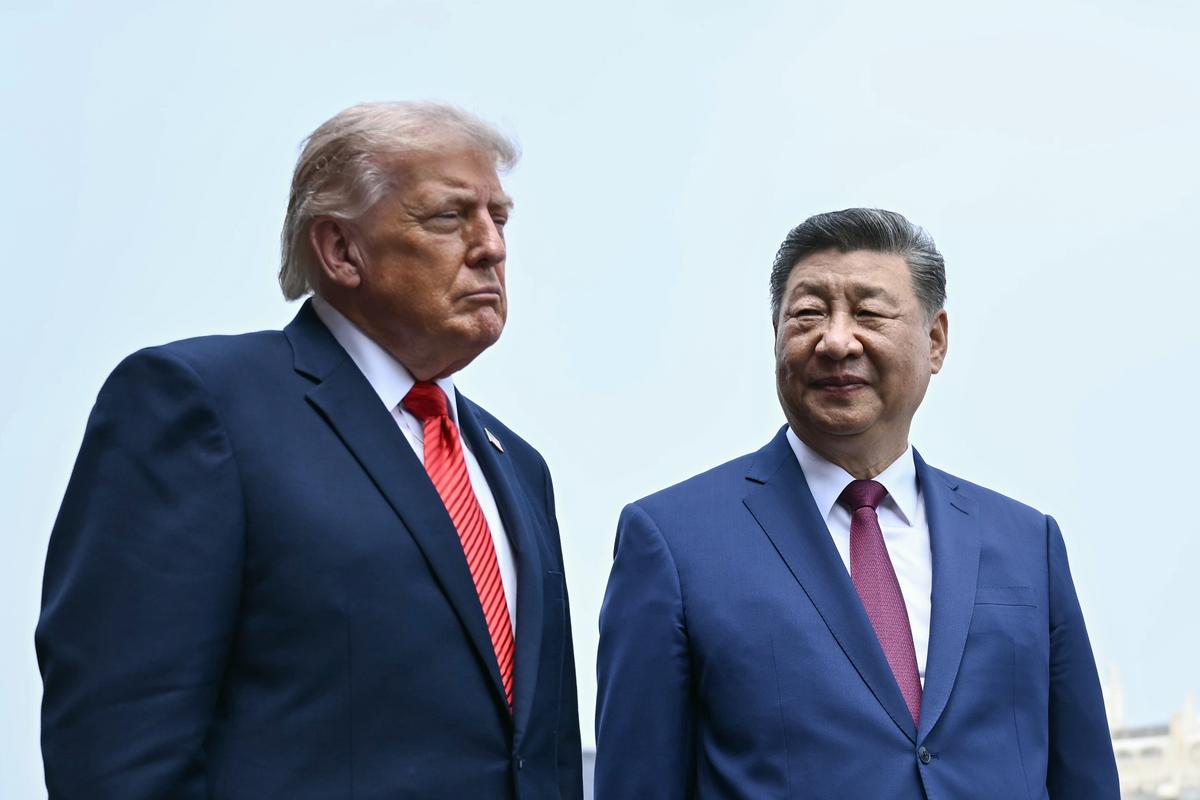
President Donald Trump is expected to meet with his Chinese counterpart Xi Jinping around Sept. 24.
Marston said that Min Zin’s arrest suggests that Beijing is taking a page out of Russia’s playbook to engage in coercive “hostage diplomacy.”
“This move has alarming implications if other authoritarian states around the world engage in similar tactics,” he said.
Sun Kuo-hsiang, a professor of international affairs and business at Nanhua University in Taiwan, said the regime’s move is a “serious warning” to the international community.
“Globally, this creates a chilling effect on scholars, journalists, NGOs and businesses,” Sun told The Epoch Times.
“It discourages travel, fieldwork, and investment in China; undermines academic and diplomatic exchanges; and enables Beijing to use foreign nationals as potential bargaining assets.”
Sun said China’s broadened counterespionage and national-security framework could enable ordinary academic research, consulting, journalism or contact with diplomats to be recast as spying.
“[Beijing’s legal terms] such as ‘national security,’ ‘intelligence’ and connections with ‘foreign organizations’ are deliberately vague,“ he said.
Sun said that Min Zin’s entry into China for an officially invited event makes the detention “especially alarming.”
“Even prior cooperation with Chinese institutions may no longer provide protection when an individual’s research conflicts with Beijing’s strategic interests,” he said.

Ties to Burma
Aung Maw Zin, Min Zin’s brother, told Voice of America that the scholar’s research is publicly available and mainly focuses on the situation in Burma, rather than targeting China, according to its Aug. 26 report.
He expressed shock over the arrest, noting that Min Zin had traveled to China to seek dialogue, “not as China’s enemy.”
Sun said Min Zin’s personal ties to Burma could be another underlying motive behind Beijing’s move.
“Min Zin was probably targeted for his access to sensitive networks involving Chinese scholars, Western policymakers, and Burma’s military, and ethnic armed organizations,” he said.
“It may enable authorities to investigate his sources and intimidate other researchers.”
Burma has been embroiled in a civil war since a 2021 military coup, with ethnic armed groups engaged in intense fighting against the military junta.

Analysts told The Epoch Times in December 2025 that Beijing is banking on the junta’s continued grip on power to secure its economic and political interests in Burma, even as the military continues its deadly crackdown on civilians.
‘Deeper Distrust’
Sun said Beijing could use Min Zin’s case to stage a token gesture ahead of the Trump–Xi summit.
The regime “can first detain an American on opaque national-security grounds and then release him shortly before or during the summit,“ Sun said.
“It presents the decision as goodwill and expecting reciprocal movement on Chinese prisoners, sanctions, export controls, or diplomatic symbolism.”
Hostage diplomacy could be tactically useful but “strategically self-defeating,” according to Sun.
“It may secure a prisoner exchange, but Washington is unlikely to trade major interests involving Taiwan, technology, or tariffs for one detainee,” he said.
Beijing claims Taiwan as its territory and has vowed to annex it by force, a major point of contention with Washington, which is legally bound to arm the island for its self-defense.
Sun said that Beijing may believe that freeing Min Zin would help Xi manufacture a summit “victory,” yet it raises the political cost for Trump of offering substantial concessions.
“China may gain a short-term bargaining chip, but at the price of deeper distrust, reputational damage, and a stronger international coalition against state-sponsored arbitrary detention,” Sun said.
We had a problem loading this article. Please enable javascript or use a different browser. If the issue persists, please visit our help center.