
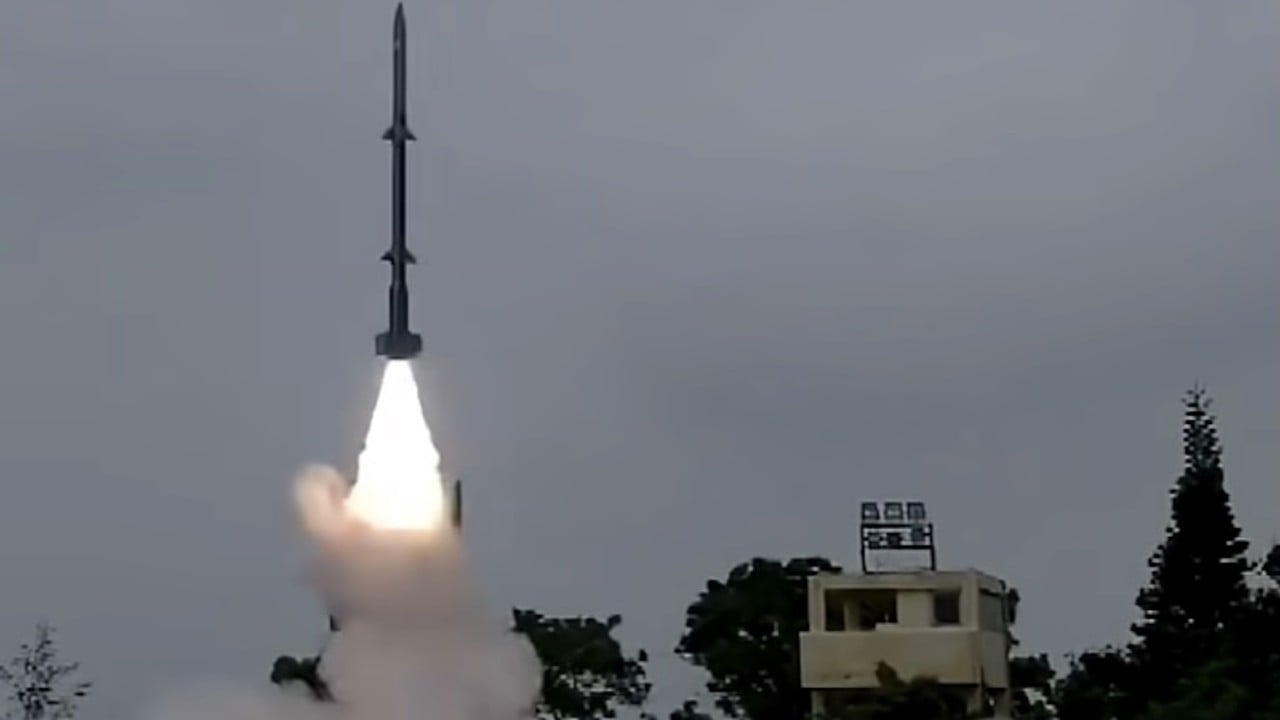
India’s first test of its Kusha long-range surface-to-air missile system is seen as a milestone that could pave the way for New Delhi to bolster its home-grown air defence network and meet the challenges of future conflicts.
Developed by the state-run Defence Research and Development Organisation, the system is expected to become a key part of the two-phase Mission Sudarshan Chakra, Prime Minister Narendra Modi’s plan for a multilayered national defence umbrella against ballistic missiles, fighter aircraft, drones and other threats by 2035.
The Kusha’s flight test on July 23 has put the spotlight on such threats and India’s reliance on imported weaponry such as Russia’s S-400 Triumf surface-to-air missile system, whose deliveries have been delayed by Moscow due to its military needs as the Ukraine conflict continues.
The Indian air force leadership has hailed the S-400’s performance in last year’s military conflict with Pakistan during Operation Sindoor, saying the system had intercepted five Pakistani fighter jets and an early warning and surveillance aircraft.
Ravi Gopal Krishna Kapoor, a retired air marshal with the Indian Air Force, said the Kusha could be easily integrated into the country’s air defence architecture as it was a domestically developed system.
“The threats are multiplying with the proliferation of drones and missiles further complicated by fifth-generation fighters. The best way of air denial is to have a robust integrated multilayered air defence system capable of detecting, identifying, engaging and destroying intruders,” Kapoor said.