
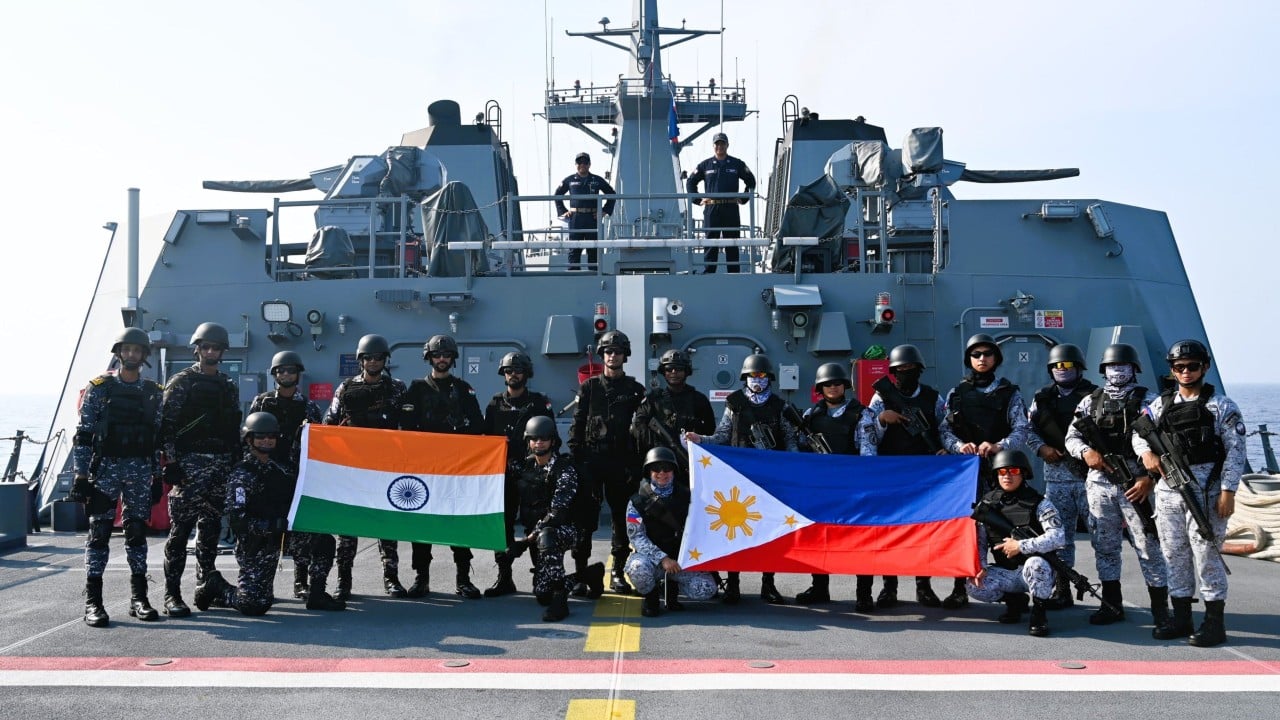
In the space of just two months, India’s navy has held joint exercises off the coasts of Britain, France, South Africa, Oman, the Philippines, South Korea, Japan and Russia’s far east.
Such a run of exercises signals a bid for a larger maritime role on the world stage, analysts say. Yet it also raises questions about whether a navy currently short on submarines and struggling to expand can support such global ambitions while also guarding India’s home waters.
Since mid-September, over a span of fewer than 60 days, Indian ships have taken part in:
-
Slinex with Sri Lanka off Visakhapatnam (September 17-21)
-
ADMM-Plus drills with multiple countries off Subic Bay (September 21-25)
-
Varuna with France at Toulon (September 22-28)
-
AIME with Asean member states at Subic Bay (September 28-October 2)
-
Konkan with the UK off Plymouth (October 8-15)
-
Ibsamar with Brazil and South Africa at Simon’s Town (October 12-20)
-
Indra with Russia at Vladivostok (October 13-18)
-
Simbex with Singapore in the Bay of Bengal (October 21-26)
-
IN-RoKN with South Korea at Busan (October 26-29)
-
Malabar with the US, Japan and Australia near Yokosuka (November 5-12)
-
Naseem Al Bahr with Oman off Muscat (November 8-12)
Why so many drills?
Indian officials cite the navy’s ability to operate concurrently across the Western Pacific, Mediterranean, North and South Atlantic and Indian Ocean as proof of its operational reach, logistics and endurance – and a reflection of both New Delhi’s policy of strategic autonomy and its global maritime vision and security doctrine, dubbed “Mahasagar”.