
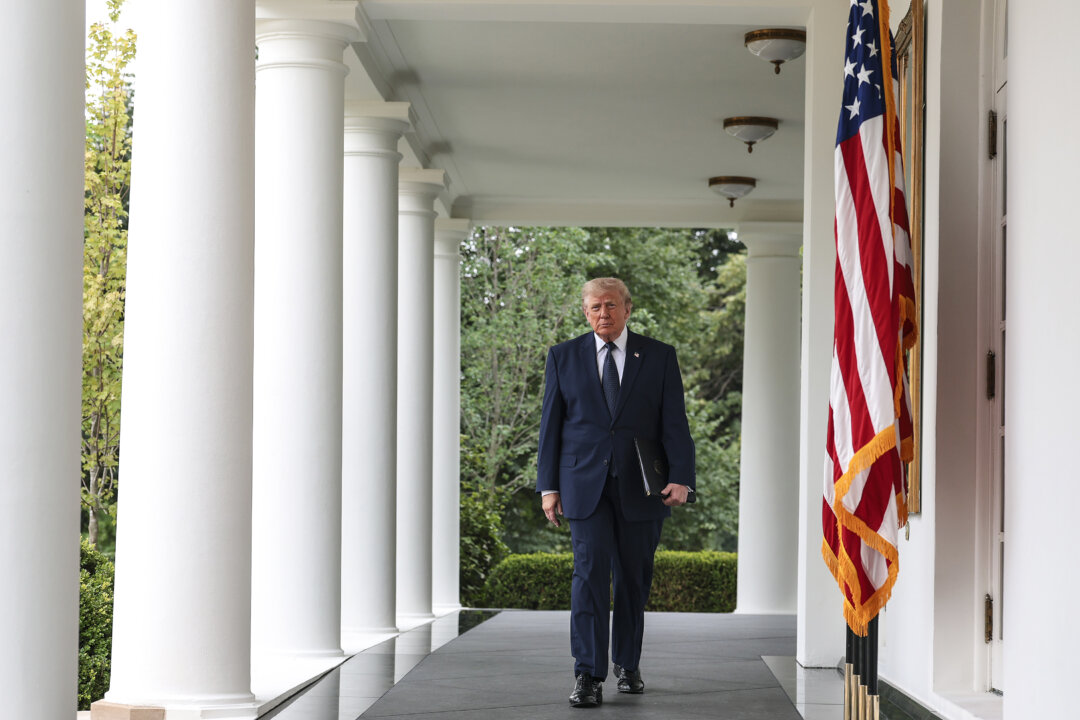
WASHINGTON—Following a midterm “blue tsunami” that handed Democrats majorities in both the House and Senate, attention has shifted to how President Donald Trump will navigate a divided Washington through the end of his term in January 2029.
Some believe a hostile Congress will block the president’s agenda or pursue impeachment, but Trump has said he is ready to work across the aisle.
It remains uncertain whether this divided government will result in total gridlock or surprising policy wins for Trump over the next two years.
Luke Nichter, professor of presidential studies at Chapman University in Orange, California, questions whether Democrats truly want to work with Trump.
“The question is: Do Democrats want compromise or do they want revenge? Because I think we all know that the investigations in the House are going to start almost right away in January,” he told The Epoch Times.
Starting in January, Democrats in the House and Senate will have the power to issue subpoenas as they investigate Trump and his administration on a number of issues.
They’ve already launched probes into members of the White House team, the Trump family, and renovation projects in Washington. Democrats have signaled aggressive plans to broaden oversight.
On election evening, as Democrats secured control of the House, Rep. Robert Garcia (D-Calif.), who is expected to chair the House Oversight Committee next year, warned the White House.
“Lawyer up,” he wrote on X, in all caps.
Trump, however, expressed optimism about working with Democrats and passing policies “appropriate and good for the country.”
He said he had already spoken with Democratic leaders on election night.
Full control of Congress will grant Democrats significant power to thwart Trump’s agenda, but questions remain about how effectively Democrats could overcome the president’s veto power.
Before the election, Trump said he would “veto everything” when asked how he would deal with a potentially Democrat-controlled Congress. He said he was prepared to become “Mr. Veto.”
Republican strategist Ford O’Connell told The Epoch Times that Democrats would struggle to change some of Trump’s policies, such as tariffs, through legislation. To override a presidential veto, Democrats would need two-thirds of the votes in the House and Senate.
“When they get frustrated, they’re going to wind up investigating, prosecuting, and engaging in lawfare,” O’Connell said.
If Democrats resort to these aggressive impeachment efforts against Trump and his officials, he said, Republicans will have a shot to win the White House in 2028.
Democrats Prepare Pressure Campaign
Leveraging their new power, Senate Minority Leader Chuck Schumer (D-N.Y.) and congressional Democrats are set to escalate pressure on Trump for an immediate end to the conflict with Iran. They can also keep pushing the president to roll back his tariff policies to ease consumer prices.
On Nov. 4, Schumer, who is now expected to become majority leader, was asked by reporters whether he can work with Trump.
He said that Democrats will work on driving costs down “with the president or without him.”
Big Data Poll director Richard Baris predicts that the Democrats will prioritize taking down the executive branch, targeting Trump’s key policies and his political power.
“We’ll see what they have in store for us, but immediately they are going to go after this administration,” Baris said during a recent interview on Alex Jones’s show.
“They’re going to dismantle it, and they’re going to drive [Trump] down.”
Before the election, Trump said he may use preemptive pardons to protect Tesla and SpaceX CEO Elon Musk and everyone who has worked for Trump, if needed.
“We just have to protect those people,” the president said in an interview on the podcast “Pod Force One” with host Miranda Devine of the New York Post.
“I would not even think about it. I’d do it. I did it for J6,” Trump said, referring to his pardoning of roughly 1,500 people who were charged by the Biden administration over the Jan. 6, 2021, breach of the U.S. Capitol.
Last week, Musk warned that Democrats’ winning the House and Senate and electing a president in 2028 would mean “the end of democracy” in the United States.
Over the next two years, Trump is also expected to face challenges from within his own party. Vice President JD Vance has already commented on the election, attributing Republican losses to the Iran war.
He also said on X on Nov. 4 that any honest conversation about where the GOP goes from here must start by addressing this issue.
Nichter predicted that some Republicans will distance themselves from Trump over the coming months.
If Republicans preparing for 2028 decide to return to traditional conservatism and smaller government, while Trump makes spending deals with Democrats, the party members will move in different directions, he said.
“It doesn’t necessarily have to be open betrayal. But I think the interests of Trump in his final two years aren’t necessarily going to be the interest of the Republican front-runner in 2028.”
Opposition to Trump’s Policies Among Voters
Throughout his campaign, Trump asked voters to pretend that he’s on the ballot.
The exit poll data suggested that Trump remained a significant factor in the election; 43 percent of voters said their ballot was cast primarily in opposition to the president. This was higher than the share who said the same in 2018.
Like many GOP strategists, O’Connell said that the election result is not necessarily an endorsement of Democrats or their policies.
“It was an angry reaction to the pace of change, and voters lashed out,” he said.
“We live in a swipe-and-click generation, and essentially, voters want instant gratification when it comes to affordability and home economics. They clearly were not happy about the war and tariffs.”
Speaking to reporters on Nov. 4, Trump said he agreed with Vance’s comments but said he does not regret launching the Iran conflict.
“It’s largely true because it drove the gasoline up a little bit short term,” Trump said, referring to the Iran war.
“But at the same time, if I had to do it again, I’ll have to do it again because long term, it’s the only answer. You can’t let Iran have a nuclear weapon.”
Trump also told CNBC on Nov. 4 that he “wouldn’t want to take tariffs off.”
Still, the president said that he can work with Democrats “on many things, many more things than people understand.”
We had a problem loading this article. Please enable javascript or use a different browser. If the issue persists, please visit our help center.