
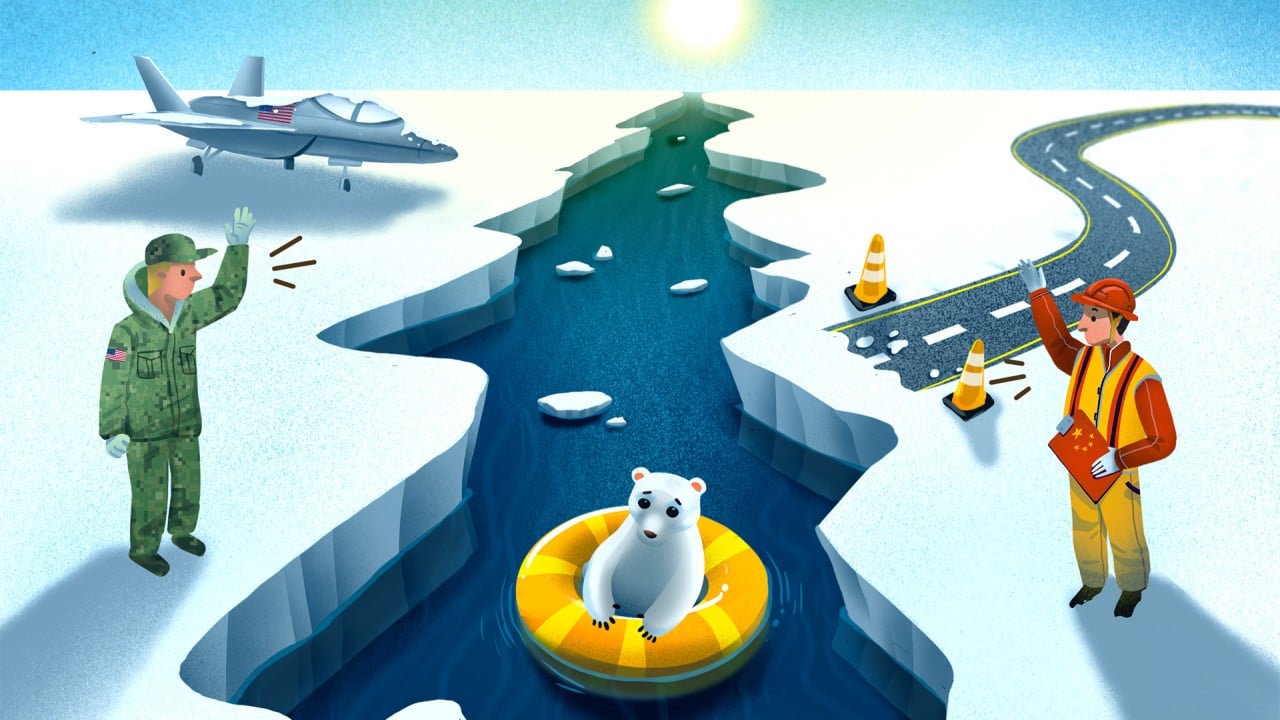
US President Donald Trump’s landmark visit to China comes as the Iran war disrupts global energy supplies, fuels economic uncertainty and adds fresh strain to Washington-Beijing ties. In the first part of a series examining how rivalry, interdependence and geopolitical crises are reshaping the relationship between the two powers, we look at the Arctic as an arena for competition.
The Arctic is heating up, both physically and in terms of geopolitics.
As Arctic warming accelerates and sea ice declines to record or near-record lows, the region is becoming more accessible for shipping and resource extraction – something that also fuels great power rivalry.
Advertisement
The competition between China and the United States in the polar region is expected to intensify, but analysts said “functional” cooperation would still be necessary and may yet prove more important.
Events such as the Strait of Hormuz crisis, attacks by Yemen’s Houthi rebels on Red Sea shipping in solidarity with Gaza and even the temporary closure of the Suez Canal in 2021, when a cargo ship became stuck, have highlighted the importance of the Arctic as a potential alternative sea lane.

01:56
Egypt releases container ship that blocked Suez Canal for nearly a week following deal with owner
Egypt releases container ship that blocked Suez Canal for nearly a week following deal with owner
However, the increasingly heated China-US rivalry has also raised concerns that an area once described by former Soviet leader Mikhail Gorbachev as a “zone of peace” may be becoming a new frontier for the strategic rivalry between Washington and Beijing.
Advertisement