
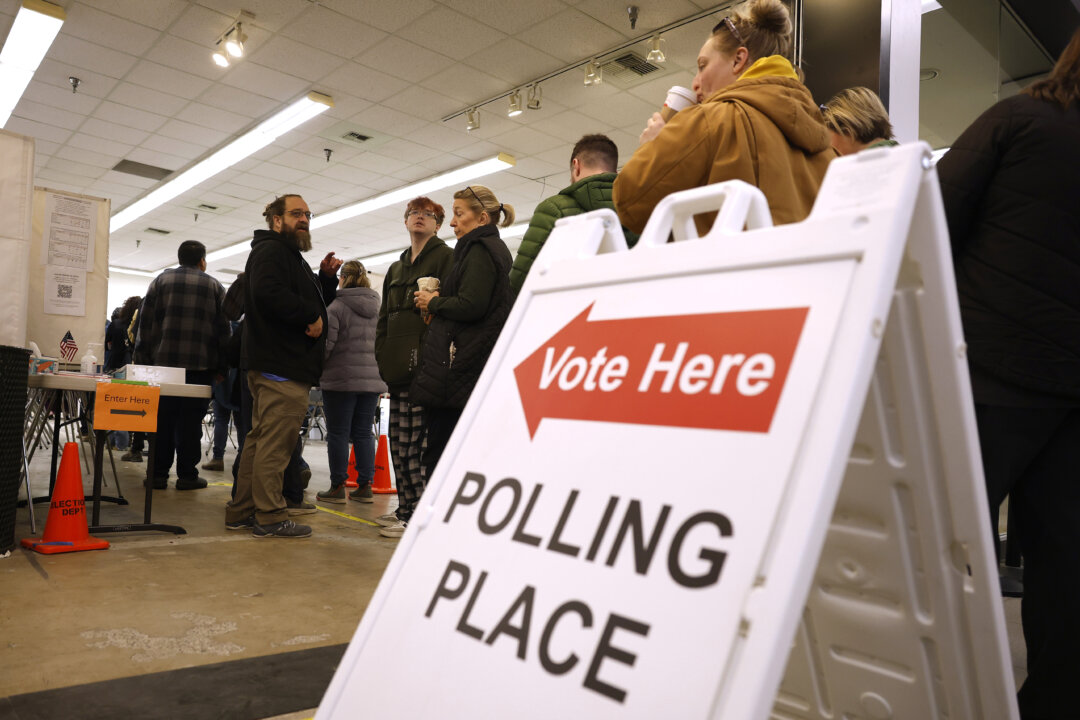
Alaska’s races for U.S. Senate, U.S. House, and governor could remain unresolved until Nov. 18, more than two weeks after the election.
That’s because the state’s laws and regulations allow for 15 days to finish counting absentee ballots and run any needed ranked-choice rounds. A separate, federal lawsuit also is challenging certification of the Senate race.
Here’s what to know about the delays.
Delays in Counting Votes Are ‘Alaska Normal’
U.S. Senate candidate Mary Peltola, a Democrat, told a crowd of supporters on Nov. 3 that it would not take hours or days, but weeks, for the election results to be finalized.
“It’s going to take a long time to make sure we’re counting every vote from every far-flung hinterland community, from every tiny outpost, from all of our service members serving overseas, our young people going to colleges,” Peltola said. “This is Alaska normal.”
Alaska election officials will accept eligible absentee ballots from overseas through Nov. 18 if they were postmarked by Nov. 3. Only after those and other outstanding ballots are counted will the state run additional rounds of ranked-choice voting in races that require them.
The schedule is set by Alaska law and regulations. Most absentee ballots mailed from within the United States must be postmarked by Nov. 3 and arrive by Nov. 13, 10 days after the election. Election officials must also verify voter eligibility and check for duplicate voting before counting absentee ballots.
Alaska’s August primary showed how mail delays can keep ballots from being counted even when voters cast them in person.
The Alaska Division of Elections said about 75 in-person absentee ballots from seven rural communities arrived after the state certified the primary results on Aug. 31. Those ballots had to be mailed to a regional elections office, where staff and a review board check whether voters are eligible before their ballots can be counted.
For the November general election, the division rerouted in-person absentee ballot mail from the region to its Anchorage office to reduce the risk that ballots would again arrive too late to be counted.
The state is aiming to certify the results on Nov. 25.
Ranked Choice Can Add Delays in a Close Race
None of the first-choice leaders in Alaska’s three major statewide races had a majority in the unofficial returns reported early on Nov. 4.
In Alaska’s U.S. Senate race, Republican Sen. Dan Sullivan faces Peltola, Republican Gerald Heikes, and unaffiliated candidate Daniel J. Sullivan Jr.
In the U.S. House race, Republican Rep. Nick Begich faces nonpartisan candidate Bill Hill, Democrat Eric Hafner, and Libertarian Jim McDermott.
Democrat Jonathan Kreiss-Tomkins is running for governor with nonpartisan running mate Zac Johnson. The three Republican tickets are Bernadette Wilson and Michael Shower, Dave Bronson and Josh Church, and Treg Taylor and Candi English.
Alaska’s state elections page states that ranked-choice voting results won’t be available until 15 days after the election (Nov. 18), “once all eligible ballots are reviewed and counted.”
Ranked-choice ballots are counted in rounds. If a candidate gets more than 50 percent in round one, he wins. There can be several rounds before a winner is determined.
DOJ Appeals Dismissal of Lawsuit
A late October New York Times article reported that “operatives aligned” with Peltola spent months recruiting candidates to take votes away from incumbent Republican Sen. Dan Sullivan. The Department of Justice (DOJ) alleged that a Daniel J. Sullivan decided to run for Senate to confuse voters who wanted to vote for Sen. Dan Sullivan.
A federal lawsuit asked the court to block certification of any result that may have been affected by voter confusion. The DOJ wanted an investigation to determine if votes cast for Daniel J. Sullivan were intended for Sen. Dan Sullivan.
In an Oct. 30 filing, the DOJ said that voter confusion could undermine the legitimacy of a federal election and that justified court intervention.
Setting aside ballots ranking Daniel J. Sullivan Jr. would impose little additional burden because election officials already had to preserve the ballots, the DOJ stated. It said its request would leave voting rules in place and allow an investigation if any confusion could have affected the outcome.
Judge Sharon Gleason of the U.S. District Court for the District of Alaska dismissed the DOJ’s complaint on Nov. 1. Gleason said the Justice Department lacked standing to challenge certification of Alaska’s U.S. Senate race.
Gleason said the DOJ lacked standing because it had offered no workable way to set aside ballots and investigate whether voters who chose Daniel J. Sullivan had intended to vote for Sen. Dan Sullivan, while preserving the secrecy of their ballots.
The DOJ appealed on Nov. 1.
We had a problem loading this article. Please enable javascript or use a different browser. If the issue persists, please visit our help center.