
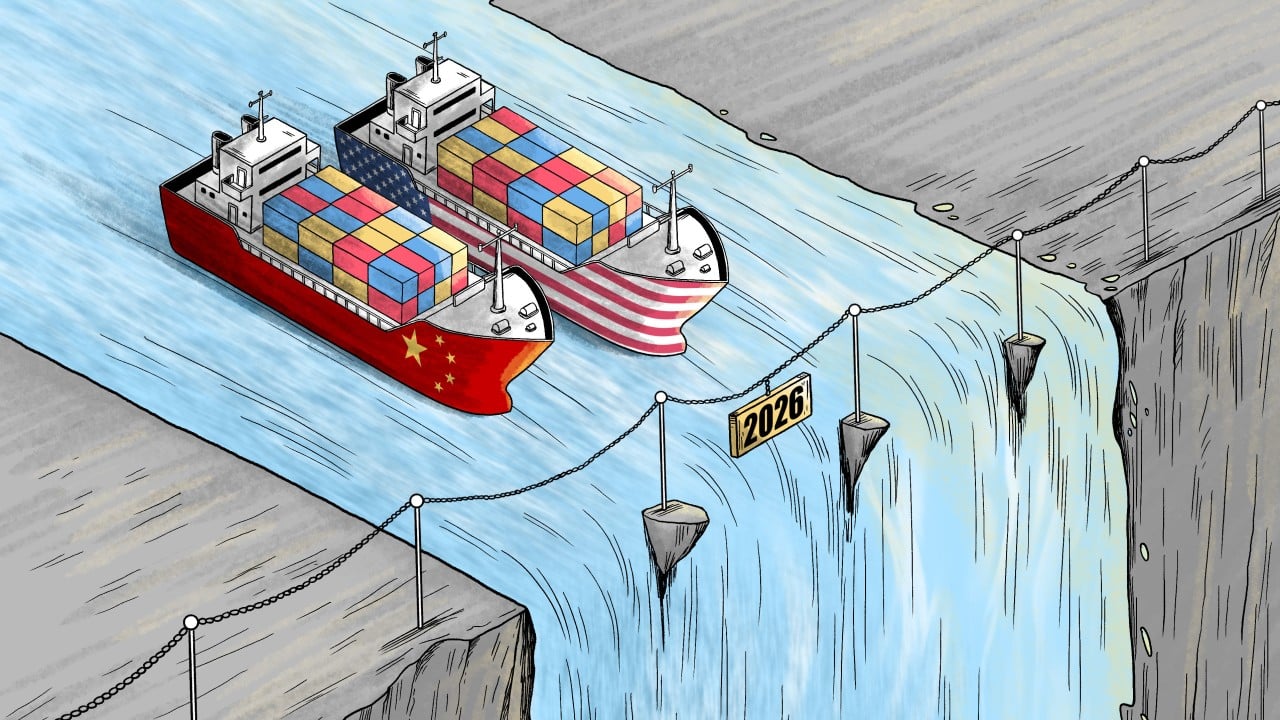
It has been a turbulent year for the fraught US-China relationship. In a new series, we look back at the events of 2025, starting with the geopolitical struggle between the two rival superpowers.
In a year marked by domestic crises and global turmoil, Washington and Beijing are set to end 2025 with a fragile truce after they stepped back from the brink of full-blown tariff warfare – but deeper antagonisms remain.
The downward spiral of rhetoric and retaliation started with US President Donald Trump’s tariff threats and vow for a “total decoupling” from China – echoing his first‑term trade war. But it culminated in an unexpected late‑year thaw at a leadership summit in Busan, South Korea.
Advertisement
Observers broadly agree that this was neither a return to engagement nor a shift towards “managed competition” but rather a tactical pause. It was seen as a mutual de-escalation shaped by domestic imperatives and global pressures that have pushed most countries to hedge rather than choose sides.
It lowered the temperature but did little to alter a relationship that most analysts see as structurally adversarial, with the pause seen as having more to do with the greater struggle over the future of the global order.
Advertisement
At the core of that struggle is the question of which political and economic system will prove more resilient in a crisis‑ridden world – a contest that experts say has only intensified in the past year, even as both sides temporarily set aside their harshest economic weapons.
The year’s events also underscored a fundamental asymmetry between Washington and Beijing, with each testing the limits of coexistence.