
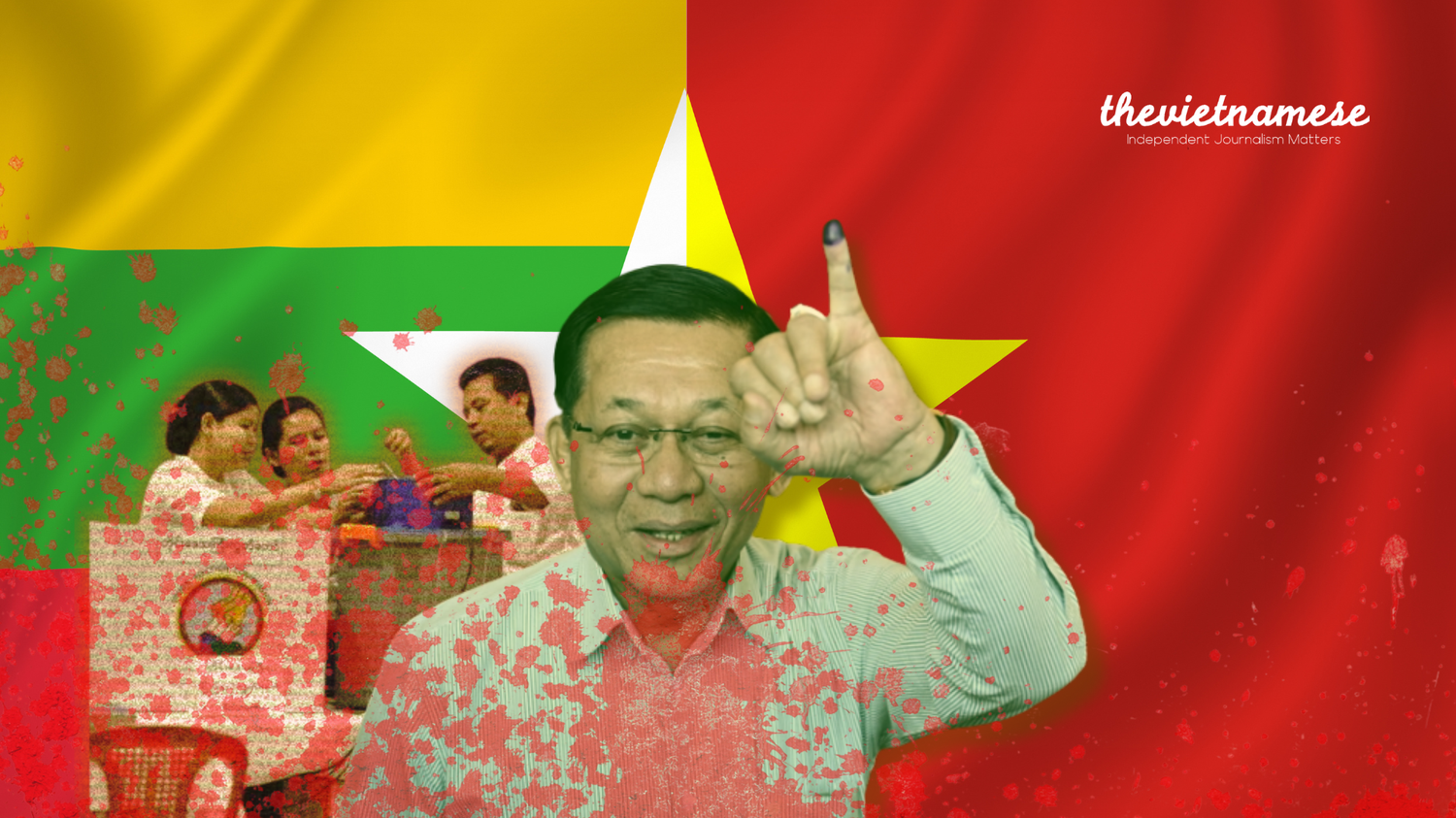
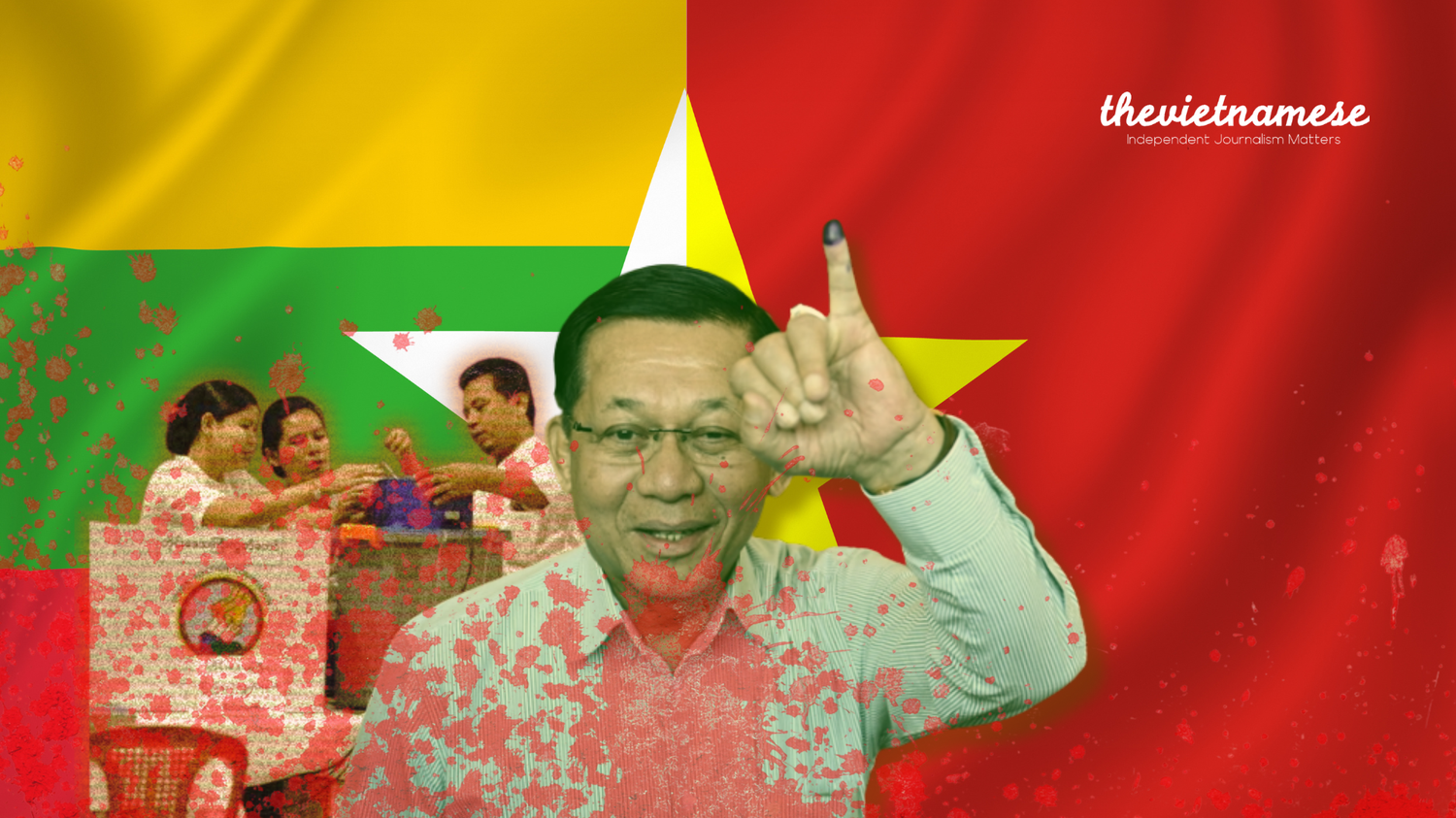
Across the blood-stained landscape of Myanmar, a carefully choreographed political theater is unfolding under the guise of the 2025-2026 general election. This process, orchestrated by the military junta’s State Security and Peace Commission (SSPC), is being conducted in three distinct phases: the first commenced on Dec. 28, 2025, the second on Jan. 11, 2026, and the final installment is set for Jan. 25, 2026.
Far from a genuine exercise in democratic will, the international community has largely dismissed the event as a “sham” intended to provide a thin layer of legitimacy to a regime that seized power through a violent coup in February 2021. An article from the International Crisis Group notes that these elections are not a popular consultation but a procedural mechanism to shift from a state of emergency back to constitutional rule on the junta’s own terms.
While many nations have recoiled in horror from this performance, Việt Nam has chosen to step into the spotlight as one of the junta’s most steadfast international legitimizers.
Alongside Cambodia, Việt Nam was one of only two members of the Association of Southeast Asian Nations (ASEAN) to dispatch official observers to monitor the polls. This delegation arrived to participate in a process overseen by a Union Election Commission (UEC) whose majority—9 out of 14 members—are currently sanctioned by the European Union and Canada for their roles in undermining democracy.
Việt Nam finds itself in questionable company, joining a roster of observers from Russia, China, Belarus, India, Kazakhstan, and Nicaragua. This alignment is particularly appalling given that Russia, China, and India are the junta’s top three arms suppliers. Justice For Myanmar (JFM) has explicitly labeled these nations “partners in crime” for sustaining the junta’s campaign of terror through profitable military partnerships.
The Depths of Việt Nam’s Military-Corporate Ties
The motivations for Việt Nam’s presence in this “theatrical performance,” as UN Special Rapporteur Tom Andrews described the election, are rooted in strategic desperation and corporate greed. Việt Nam’s engagement with the ruling junta ignores the fact that the regime is classified as a terrorist organization under Myanmar’s own laws.
Instead, Hà Nội views the survival of the junta as a prerequisite for protecting its significant regional interests. For Việt Nam, a stable, military-led Myanmar serves as a strategic counterweight, helping to diversify its regional partnerships and arguably reducing a singular reliance on other great powers.
This bargaining for legitimacy involves a cold-blooded exchange where political recognition is traded for access to something of value.
The depth of this relationship is most visible in the military-to-military ties between the two nations. In October 2025, Chu Công Phùng, Chairman of the Vietnam-Myanmar Friendship Association, met with acting president Min Aung Hlaing to cordially discuss “political progress” and preparations to hold a “free and fair election.”
This meeting took place against a backdrop of a comprehensive military cooperation agreement signed back in 2011, which paved the way for Vietnamese support of the Myanmar military’s modernization efforts.
Viettel, a Vietnamese state-owned enterprise under the direct control of the Ministry of Defense, is the primary vehicle for this collaboration. JFM claims that Viettel subsidiaries have provided the Myanmar military with access to technology, infrastructure development, and training, effectively aiding and abetting an army responsible for genocide, war crimes, and crimes against humanity.
This relationship is both a commercial boon and a strategic alliance where Viettel serves as an arm of the Vietnam People’s Army, required by its charter to carry out special military tasks.
Profiteering from Surveillance and Digital Terror
At the heart of this toxic partnership is Mytel, Myanmar’s leading telecommunications operator. Mytel is a joint venture that functions as a “military-crony public-private partnership.”
Viettel Global Investment JSC owns a 49% stake in the company, while the remaining shares are largely controlled by Star High, a subsidiary of the military conglomerate Myanmar Economic Corporation (MEC), and a consortium of crony investors known as Myanmar National Telecom Holdings (MNTH).
But Mytel is not just any company. It is a telecommunications provider: a sector where governments and militaries often have malicious vested interests in maintaining control.
These interests manifest in a chilling system of mass surveillance and financial enrichment. Mytel has constructed at least 38 towers directly on military bases, many located in ethnic areas where the army is perpetrating grave human rights violations. These towers provide the military with supplemental communications and a platform for digital repression, including the real-time tracking of mobile subscribers and network traffic.
This infrastructure was built using technology from an international network of suppliers, including Huawei, ZTE, and NEC, granting the Myanmar generals access to high-end equipment they might otherwise struggle to obtain.
Financially, the gains for both Việt Nam and the Myanmar generals are staggering. Leaked documents analyzed by JFM suggest that the Myanmar military could receive over $700 million from Mytel over the coming decade.
For Việt Nam, the returns are already tangible. In 2025 alone, Viettel repatriated $385.5 million from its overseas markets, marking the fourth consecutive year of remittances near the $400 million mark. Lieutenant General Tào Đức Thắng, Chairman and CEO of Viettel, has even described 2026 as a “pivotal year” for the company to act with “more initiative, speed, boldness, and efficiency.”
This effectiveness is apparently measured in the profits harvested from a country in the throes of a civil war.
Exploiting a Humanitarian Disaster
Việt Nam is not alone in this exploitation; other governments are equally guilty of funding and pushing the junta to stay in power to secure their own interests. Russia and China, the primary suppliers of the aircraft and arms used in indiscriminate airstrikes against civilians, are backing the election for the benefit of their own infrastructure projects.
For Beijing, the priority is protecting its infrastructure, trade routes, and energy corridors. For New Delhi, it is about border management and connectivity projects like the Kaladan multi-modal transit route. Belarus continues to equip the junta with “technology for terror” by training Myanmar soldiers in its universities.
These nations choose to take the junta’s rhetoric of a return to normalcy at face value because it serves their bottom line, ignoring the fact that the normalcy they seek is one built on the graves of those who resist military rule.
The reality is that while Việt Nam and its cohort of observers celebrate the illusion of the functional election, the people of Myanmar are enduring a humanitarian nightmare. Over 3.5 million people are internally displaced, and roughly 20 million—more than a third of the population—remain in desperate need of aid.
Civilians are being “coerced from all sides.” The military forces them to vote under threat of losing their homes or food rations, while armed opposition groups threaten those who participate in the “sham.”
The international community must not be fooled by this “managed performance of legitimacy.” It is in the best interest of nations like Việt Nam, Russia, Belarus, China, and India to keep the junta in charge because a genuinely democratic Myanmar would demand an end to the systemic corruption and military-corporate entrenchment that fuels their profits. Their actions are a betrayal of the millions of citizens who have fought and resisted tyranny for five years.
The opportunistic greed of the Vietnamese government and its state-owned enterprises must be condemned. Every nation that has chosen strategic convenience over the basic human rights of the Myanmar people shares the guilt and burden of the resulting carnage. The only path to peace is the total cessation of support for the junta, the dismantling of the military cartel, and the restoration of the country’s wealth to its rightful owners—the people. Anything less is complicity.
References:
- Al Jazeera. (2026, January 11). Myanmar’s military holds second phase of elections amid civil war. Al Jazeera. https://www.aljazeera.com/news/2026/1/11/myanmars-military-holds-second-phase-of-elections-amid-civil-war
- Democratic Voice of Burma. (2025, December 29). International response to start of Myanmar military’s 2025-26 elections. https://english.dvb.no/international-response-to-start-of-myanmar-militarys-2025-26-elections/
- Horsey, R. (2025, December 9). Myanmar’s Military Seeks Vote of Approval in One-sided Polls. International Crisis Group. https://www.crisisgroup.org/asia-pacific/myanmar/myanmars-military-seeks-vote-approval-one-sided-polls
- Human Rights Watch. (2025, November 16). Myanmar: Elections a Fraudulent Claim for Credibility. https://www.hrw.org/news/2025/11/16/myanmar-elections-a-fraudulent-claim-for-credibility
- Justice For Myanmar. (2020, December 20). Nodes of Corruption, Lines of Abuse: How Mytel, Viettel and a global network of businesses support the international crimes of the Myanmar military. https://jfm-files.s3.us-east-2.amazonaws.com/public/JFM_Nodes_of_Corruption_high_res.pdf
- Justice For Myanmar. (2021, March 4). How hundreds of millions of dollars from Mytel subscribers will flow to military generals. https://www.justiceformyanmar.org/stories/how-hundreds-of-millions-of-dollars-from-mytel-consumers-will-flow-to-military-generals
- Justice For Myanmar. (2021, November 5). Boycott and coup attempt cost Mytel USD$24.9 million in three months. https://www.justiceformyanmar.org/stories/boycott-and-coup-attempt-cost-mytel-usd-24-9-million-in-three-months
- Justice For Myanmar. (2025, November 29). China, Russia, Belarus and India have voiced support for the Myanmar junta’s sham election and may even send fake observers. Facebook. https://www.facebook.com/justiceformyanmar.org/posts/pfbid04TsXwReopU3dta56vEjZsyTzf3b6K7EA2BfiYhnCM5vzs1PLTaMu5AiLm5XEiV5Ql?rdid=xX3c99y6yP6K1xAU
- Justice For Myanmar. (2023, January 23). Developing a Dictatorship: How governments and international organisations are supporting the illegal Myanmar military junta – and what must be done to stop this. https://assets-global.website-files.com/5e691d0b7de02f1fd6919876/63d74c96a7491d786488da53_Developing%20a%20Dictatorship.pdf
- Justice For Myanmar. (2025, December 1). The majority of the illegal Myanmar junta’s Union Election Commission (UEC) are sanctioned. Facebook. https://www.facebook.com/justiceformyanmar.org/posts/pfbid02hsDkVzoqXDBVh6rchejeXa1Wuf5FHYnbjc3M1Ga3Pw9M1y8vBjMqF5y54FcbMUttl?rdid=KNMCTHaWA5ZgTKJ8
- Mishra, V. (2026, January 8). Myanmar vote a ‘facade’ to entrench military rule, independent rights expert says. UN News. https://news.un.org/en/story/2026/01/1166729
- Mishra, V. (2025, December 23). Myanmar elections marked by fear as UN warns civilians are coerced from all sides. UN News. https://news.un.org/en/story/2025/12/1166662
- Mizzima. (2026, January 8). The Sham Election of the Myanmar Military Junta. Mizzima News from Myanmar. https://eng.mizzima.com/2026/01/08/30030
- Myanmar News Agency. (2025, October 17). Myanmar, Vietnam vow to further strengthen friendship and cooperation. The Global New Light of Myanmar. https://cdn.digitalagencybangkok.com/file/client-cdn/gnlm/wp-content/uploads/2025/10/17_October_2025_Gnlm.pdf
- Reed, A. (2021, March 24). Oppression Through Greed: What The Myanmar Military And Vietnam Stand To Gain. The Vietnamese Magazine. https://www.thevietnamese.org/2021/03/oppression-through-greed-what-the-myanmar-military-and-vietnam-stand-to-gain/
- Reed, A. (2023, December 19). Bargaining for Legitimacy: Vietnam’s Involvement in the Myanmar Junta’s Struggle for Recognition. The Vietnamese Magazine. https://www.thevietnamese.org/2023/12/bargaining-for-legitimacy-vietnams-involvement-in-the-myanmar-juntas-struggle-for-recognition/
- Shahid, R. (2026, January 9). Neither free nor fair: What Myanmar’s ‘sham’ elections mean for the country and its neighbors. Atlantic Council. https://www.atlanticcouncil.org/dispatches/neither-free-nor-fair-what-myanmars-sham-elections-mean-for-the-country-and-its-neighbors/
- Thai Khang. (2026, January 14). Viettel leads mobile markets in 7 out of 10 overseas investments. VietNamNet. https://vietnamnet.vn/en/viettel-leads-mobile-markets-in-7-out-of-10-overseas-investments-2481574.html
- Thiha, A. (2025, August 20). Myanmar’s December Election: Engineering Continuity Through Institutional Redesign. Stimson Center. https://www.stimson.org/2025/myanmars-december-election-engineering-continuity-through-institutional-redesign/
- United Nations Office for the Coordination of Humanitarian Affairs. (2025, March 28). Myanmar humanitarian update No. 45. https://www.unocha.org/publications/report/myanmar/myanmar-humanitarian-update-no-45-28-march-2025