
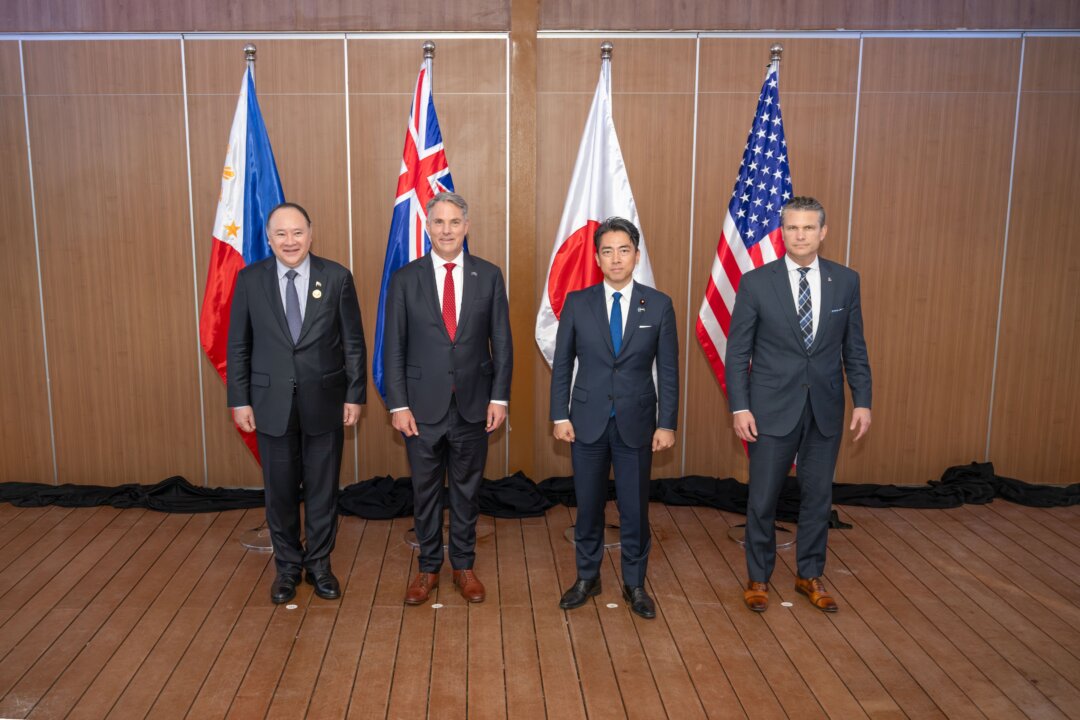
The United States, Japan, Australia, and the Philippines agreed to expand defense cooperation at a regional security meeting in Cebu, Philippines, on Oct. 28, including closer coordination of military exercises and defense policy.
The four countries also discussed joint investment in military infrastructure in the Philippines, where Manila has been strengthening security partnerships amid repeated confrontations with Chinese vessels in the South China Sea.
The four defense leaders—U.S. Secretary of War Pete Hegseth, Japanese Defense Minister Shinjiro Koizumi, Australian Defense Minister Richard Marles, and Philippine Defense Secretary Gilberto Teodoro—met on the sidelines of the Association of Southeast Asian Nations (ASEAN) Defense Ministers’ Meeting-Plus.
Following the meeting, Hegseth emphasized practical military cooperation along the First Island Chain, a series of islands extending from Japan through Taiwan to the Philippines.
“We are moving beyond words to practical cooperation along the First Island Chain—bolstering readiness to ensure peace through strength,” he wrote on Oct. 29.
Hegseth and Teodoro also discussed modernizing military command-and-control systems, strengthening security cooperation, and deterring threats in the South China Sea.
“We are accelerating efforts to modernize [the Armed Forces of the Philippines] and enhance our interoperability along the First Island Chain,” he wrote on Oct. 29, referring to the ability of U.S. and Philippine forces to operate together.
Marles said at an Oct. 29 press briefing that the four countries discussed coordinating military operations, jointly investing in infrastructure in the Philippines, and improving defense policy coordination. He cited existing infrastructure developments on the islands of Luzon and Mindanao, although no specific new construction projects or funding commitments were announced.
Marles also described growing cooperation in military exercises. Hundreds of Australian troops joined the U.S.–Philippine Balikatan exercise this year, while hundreds of American personnel are expected to participate in next year’s Australia–Philippines Exercise Alon.
The discussions came as Keen Sword 27, a multinational military exercise involving all four countries and five other nations, concluded on Oct. 29.
In an Oct. 29 statement distributed by U.S. Forces Japan, Rear Adm. Jay Clark, director of the Keen Sword exercise’s Bilateral Exercise Control Group, described the importance of infrastructure and coordination among partner forces.
“This exercise demonstrated our capability to provide the critical infrastructure required to support all partner nations collaborating on operational, medical, logistics, and sustainment initiatives,” Clark said. “The exercise allowed us to continue refining and improving resilient bilateral and coalition communication channels.”
Philippines’ Maritime Disputes With China
Teodoro and Koizumi also held bilateral talks on Oct. 28, during which they expressed serious concerns over China’s increasingly frequent coercive activities around Japan and continuing dangerous actions against the Philippines in the South China Sea.
The two ministers opposed attempts to change the status quo through force or coercion and agreed to strengthen defense cooperation, including planned equipment transfers and continued negotiations on an agreement to protect classified military information. The equipment discussions build on talks announced in May.
On Sept. 24, Chinese vessels blocked a Philippine resupply mission to troops stationed at Second Thomas Shoal, according to the Philippine military.
A 2016 international arbitration tribunal ruling rejected the legal basis for China’s sweeping maritime claims over much of the South China Sea. Beijing refuses to recognize the ruling.
Beijing Accuses Manila of Obstructing Defense Meeting
As the ASEAN defense gathering concluded on Oct. 29, Beijing accused an unnamed Philippine politician of obstructing China’s participation.
Chinese Defense Ministry spokesman Zhang Xiaogang made the accusation at a press briefing but did not identify the politician or specify the alleged obstacles. He also claimed that numerous ASEAN countries had objected to the Philippine actions, without naming them.
China sent a defense attaché rather than Defense Minister Dong Jun to the gathering.
The latest disagreement followed an earlier diplomatic dispute on Oct. 19, when Manila summoned Chinese Ambassador Jing Quan over remarks that Philippine officials interpreted as a threat of military force.
Teodoro, who chaired the ASEAN gathering, rejected Beijing’s suggestion that other ASEAN members opposed the Philippines’ handling of China’s participation.
“Insofar as ASEAN is concerned, I do not believe our ASEAN member countries feel that way. If not, they would have let me know,” he said at the Oct. 29 closing press conference. “So it is China’s position, it is not ASEAN’s position.”
Teodoro said China had been given an opportunity to state its position, but that dialogue partners must follow ASEAN’s rules.
“No country has the right to characterize ASEAN processes except ASEAN member countries,” he said. “How they are going to be heard is for ASEAN proper to determine and not anybody else.”
We had a problem loading this article. Please enable javascript or use a different browser. If the issue persists, please visit our help center.