
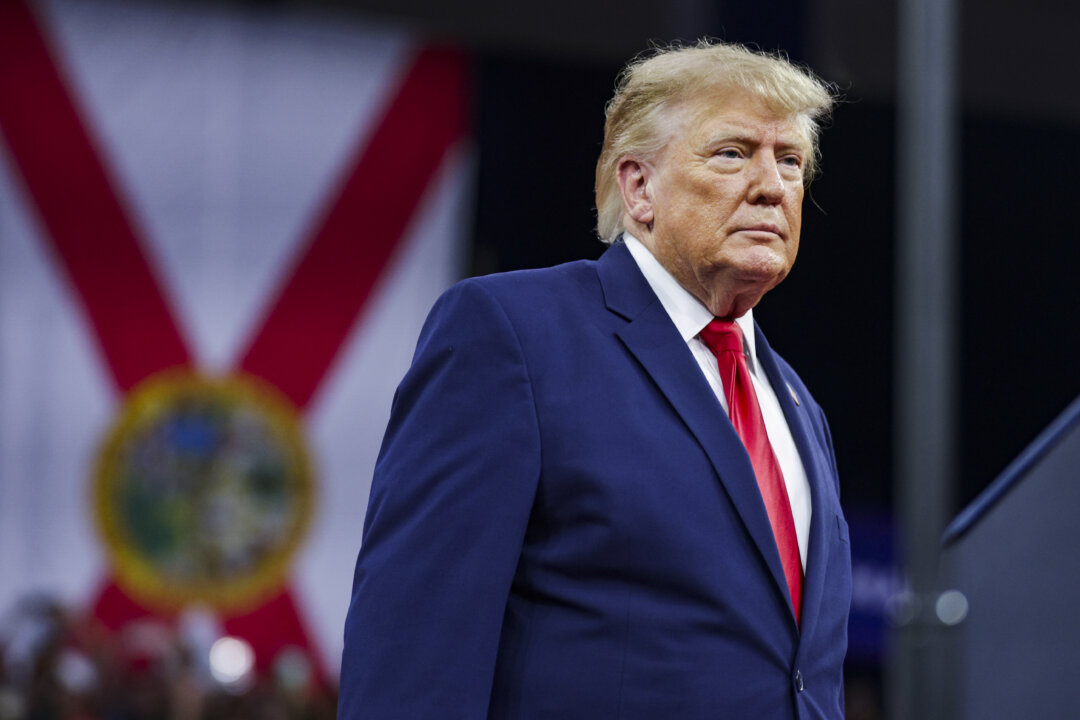
President Donald Trump said that the war with Iran is going to end “very soon,” reiterating his pledge that Tehran will never be allowed to have a nuclear weapon and predicting that gasoline and diesel prices will fall once the conflict winds down.
Speaking in an interview with Kansas City radio station KCMO on Friday, Trump criticized the 2015 Iran nuclear deal that he canceled during his first term in office, describing the Obama-era Joint Comprehensive Plan of Action as a “road to a nuclear weapon.”
“If they had a nuclear weapon, I probably wouldn’t be talking to you right now,” Trump said. “We’d be addressing them as ‘Sir.’”
Trump suggested U.S. military operations would continue until the United States secures a guarantee from Iran preventing the country from obtaining nuclear arms.
“Iran cannot have a nuclear weapon,” he said. “And that’s going to end very soon, one way or the other, it’s going to end very soon.”
U.S. Central Command has ceased strikes against Iran in and around the Strait of Hormuz in recent weeks.
Trump has, however, said he might order the use of the “Mother of All Bombs” in a future attack on Iran, and that the United States might launch a “little” version of Operation Epic Fury, the military operation that kicked off the war in late February.
Adm. Brad Cooper, commander of U.S. Central Command, said in a Friday morning update that about 50,000 U.S. troops are in the region supporting a range of operations, including patrolling the Strait of Hormuz to keep shipping routes open.
“This week, we reached a significant milestone, having now assisted Gulf partners in exporting more than 1.5 billion barrels of crude oil since summer,” he said. “U.S. forces have been laser focused in this effort.”
Gasoline and diesel prices have risen sharply since the Iran war began, after Iranian forces moved to block ships sailing through the Strait of Hormuz and laying mines in the key maritime chokepoint.
Separately, Trump on Thursday confirmed outreach to Iran by Vice President JD Vance, but clarified that this was about getting medical supplies into the country amid the U.S. naval blockade and not about reviving peace talks.
Asked by reporters later that day whether Vance sent the letter at his direction, Trump said no.
“What that is is they need help with medical supplies and various things. He [Vance] asked me what I thought. I said, if you want to do that, that’s okay. Basically, it’s getting supplies in to help people that are not well,” Trump said.
Iran’s semi-official Tasnim news agency on Wednesday reported that Vance sent a letter to Rezaei, and that Iran had received it but had not yet responded. The Tasnim report added that Iran’s demands for ending the war remain unchanged.
Mohammad Bagher Ghalibaf, Iran’s parliament speaker, said Thursday that Tehran had repeatedly made its conditions clear to mediators and that progress depended on meeting them.
“The carrot-and-stick approach has no effect on Iran,” Ghalibaf wrote on X. “Progress can only be achieved once Iran’s seven conditions have been agreed upon.”
Iran has repeatedly said its demands for reopening the Strait of Hormuz include lifting the U.S. blockade of Iranian ports, removing U.S. sanctions on Iranian oil exports, and ending hostilities on all regional fronts.
We had a problem loading this article. Please enable javascript or use a different browser. If the issue persists, please visit our help center.