
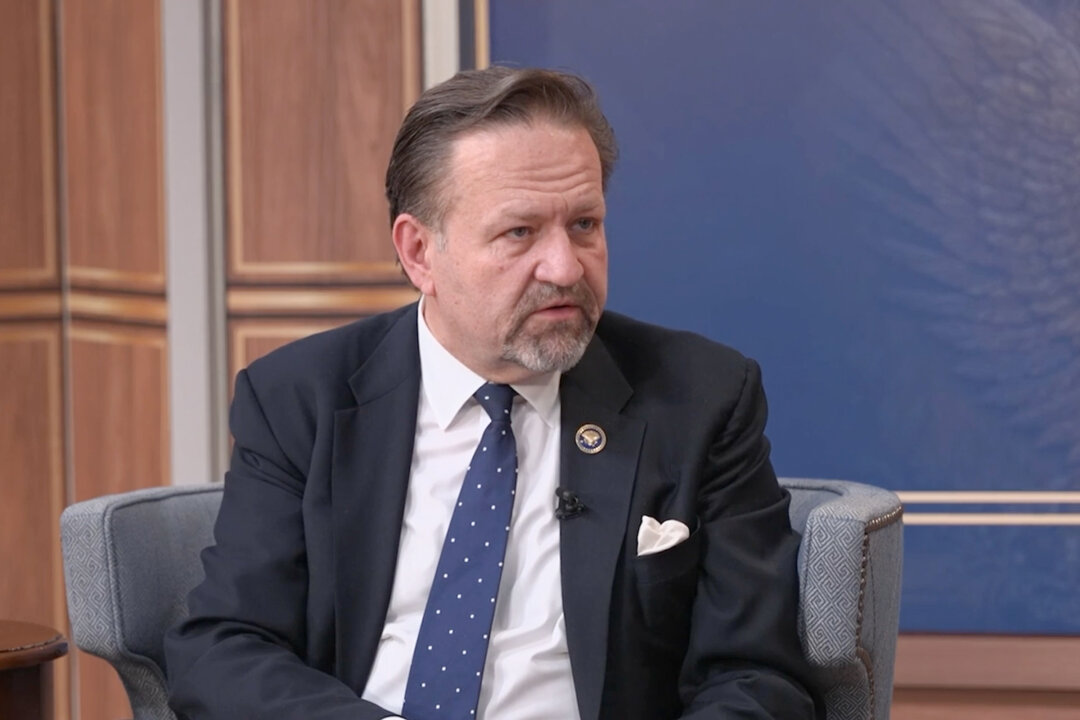
The Trump administration has had “history-making” success securing the release of U.S. citizens held hostage or wrongfully detained in foreign countries, Sebastian Gorka, deputy assistant to the president and senior director for counterterrorism at the National Security Council, told The Epoch Times.
The administration has orchestrated the release of 115 U.S. citizens, Gorka said in an exclusive interview with Epoch Times senior editor Jan Jekielek that aired on Oct. 27.
“No other president has liberated 115 Americans in 20 months ever,” he said.
Gorka repeatedly maintained that the United States has not made concessions to foreign regimes in exchange for the release of American hostages and detainees.
No other president has liberated 115 Americans in 20 months ever.
Sebastian Gorka, senior director for counterterrorism, National Security Council
He outlined shifting terrorism trends following the administration’s efforts to remove the threats posed by Islamic terrorist organizations in the Middle East, and said it is now addressing threats from extremist organizations in the United States.
American Hostages and Detainees Released
Gorka said releasing Americans who were wrongfully detained or held hostage is “of paramount import” to President Donald Trump and that ensuring that no American is left behind is “one of the most obvious examples of what ‘America First’ means.”
The most recent example was the release of Stephen Hubbard, an American teacher, who had been detained and sentenced to nearly seven years in prison by Russian officials in 2024. He was convicted of fighting as a mercenary in Ukraine.
Hubbard returned to the United States after U.S. envoy Steve Witkoff met with Russian President Vladimir Putin. Gorka credited Hubbard’s release to Witkoff’s “unrelenting determination” and repeated visits to Russia as part of the administration’s efforts to end the war between Russia and Ukraine.

In March 2026, Dennis Coyle, an American researcher from Colorado, was released and returned to his family in the United States after being held captive by the Taliban in Afghanistan for more than a year.
Marc Fogel, an American teacher, was returned to the United States in February 2025 after being imprisoned in Russia for 3 1/2 years.
Keith Siegel, an Israeli American dual national, was also released in February 2025 after being held hostage by the Hamas terrorist organization for 484 days.
In March 2025, George Glezmann, an American airline mechanic, was released after being detained by the Taliban for 836 days.
Gorka said it is ‘absolutely conceivable’ that the number of hostages could be reduced to zero before Trump leaves office.
Ksenia Karelina, a Russian American dual national and ballet dancer, was wrongfully detained in a Russian penal colony for 14 months before being released in April 2025 as part of a prisoner swap with Moscow.
In August, a group of Democratic lawmakers urged the Trump administration to take further action and designate five U.S. nationals in Russia as wrongfully detained under the Robert Levinson Hostage Recovery and Hostage-Taking Accountability Act. They suggested that it was a “valuable tool” that would “maximize U.S. government coordination and advance negotiations to ensure their swift release.”


Gorka told The Epoch Times there are currently fewer than 10 American hostages still in need of release. However, he clarified that the number did not include wrongfully detained U.S. citizens in foreign countries.
With more than two years remaining in Trump’s second administration, Gorka said it was “absolutely conceivable” that the number of American hostages could be reduced to zero.
No Concessions Made
Gorka told The Epoch Times that the United States has not made any concessions under the Trump administration as part of the negotiation process to secure the release of hostages and wrongfully detained individuals.
“We haven’t paid one red cent because when you pay a ransom, what happens? Well, then they’ll take more Americans hostage,” he said.
“We do not negotiate with those who hold Americans or take them hostage.”
We haven’t paid one red cent because when you pay a ransom, what happens? Well, then they’ll take more Americans hostage.
Sebastian Gorka, senior director for counterterrorism, National Security Council
Concessions are not needed, Gorka added, because Trump shows U.S. adversaries that he is “not an individual to be trifled with.”
While Gorka repeatedly denied the need for concessions, he acknowledged that the process to secure the release of Americans is not instantaneous. Referencing negotiations with Russia and the Taliban, he said the process takes time, commitment, and convincing.
“But at the end of the day, no ransom was paid by America for one of our citizens,” he said.
Gorka’s comments echoed recent statements from Trump about Hubbard’s release. In an Oct. 21 post on social media, Trump said the United States was “not required to give anything in return.”
However, he said the negotiations that led to Hubbard’s release would likely have been halted if the administration had immediately imposed new sanctions on Russia.
Gorka acknowledged that the process to secure the release of Americans is not instantaneous. It takes time, commitment, and convincing.
Gorka outlined three components in securing the release of American hostages and wrongfully detained citizens from foreign governments or regimes not recognized by the United States, such as the Taliban.
First, he said the FBI plays a role in active hostage cases. The Hostage Recovery Fusion Cell, which is based at the FBI and includes members of the intelligence community, the State Department, the War Department, the Office of the Director of National Intelligence, and other agencies, manages those cases.

The Hostage Recovery Fusion Cell is responsible for identifying options for recovering American hostages and coordinating activities to resolve hostage situations.
Secondly, the National Security Council’s Counterterrorism Directorate handles policy-related decisions regarding hostage situations, including the mechanisms that are put in place to secure the release of Americans.
Finally, Gorka said, the United States uses envoys such as Witkoff to negotiate the release of U.S. citizens from foreign governments and regimes.
Warnings for Americans
The State Department issued an updated advisory on Oct. 19, urging Americans traveling to China to “exercise increased caution.” The advisory cites risks that U.S. citizens could be wrongfully detained or face exit bans, which could prevent them from leaving China without being officially detained.
Think twice before you send American citizens to countries that have a record of using Americans as bargaining chips.
Sebastian Gorka, senior director for counterterrorism, National Security Council
Asked about the advisory, Gorka said China and other countries have attempted to use Americans as leverage through wrongful detentions and exit bans, but that the administration was sending a clear message to hostile regimes.
“Yes, we know that there are trade negotiations. Yes, we know the whole tariff structure is one of the president’s tools in his toolkit, but we will not permit you to use Americans as pawns,” Gorka said.
He warned U.S. citizens and nongovernmental organizations to reconsider travel to countries that have a pattern of taking Americans hostage.
“To my fellow Americans, especially certain [nongovernmental organizations] out there that are doing good work, especially spreading the word of the Lord and other humanitarian purposes, think twice before you send American citizens to countries that have a record of using Americans as bargaining chips,” he said.
Counterterrorism Battle Shifting
The United States is winning the counterterrorism battle, Gorka said.
Under the Trump administration, 1,086 jihadis have been neutralized by U.S. military forces, according to the deputy assistant. One operation carried out earlier this year in Africa resulted in the removal of 199 jihadis in a single weekend, he said.

Despite this success, Gorka warned that terrorist tactics are shifting.
Gorka described the biggest threat during the first decade of the global war on terror as the “9/11 scenario,” in which foreigners were recruited and trained in terrorist havens, such as camps in Afghanistan, to hijack planes or build explosive devices. The terrorists were then deployed to the United States to carry out acts of terrorism.
Following the removal of the ISIS terrorist group in Iraq and Syria under the U.S. military’s Operation Inherent Resolve, as well as the removal of al-Qaeda terrorist group camps in Afghanistan, terrorist organizations no longer have those places in which to recruit foreign fighters, train them, and send them to the United States, Gorka said.
He told The Epoch Times that terrorist organizations are now largely restricted to using social media platforms and the internet to inspire disaffected Americans to commit acts of violence on American soil.
Gorka said terrorist organizations are now largely restricted to using the internet to inspire disaffected Americans to commit acts of violence on American soil.
The White House released a new counterterrorism strategy in May, identifying violent left-wing extremists such as Antifa and anarchist groups as terrorism threats. It also addressed the “red-green” alliance between the far-left and Islamists.
“We will use all the tools constitutionally available to us to map them at home, identify their membership, map their ties to international organizations like Antifa, and use law enforcement tools to cripple them operationally before they can maim or kill the innocent,” the strategy document said.
In July, a group of 11 Democratic lawmakers sent a letter to Secretary of State Marco Rubio criticizing the Trump administration’s new counterterrorism strategy as a “politically partisan document.”

“We strongly urge the Department to return its focus to a serious mission set that is definitionally apolitical, data-driven, and rooted in reality, instead of rubberstamping the political priorities of extremists within the Administration whose views and policies put U.S. national security—and the American people—at risk,” the lawmakers wrote.
The Washington-based Center for Strategic and International Studies released a report in September 2025 that shows an increase in the number of left-wing terrorist attacks and plots in the United States in recent years.
There are countries in whose interest it is to amplify artificially those voices that undermine the duly elected administration and commander in chief.
Sebastian Gorka, senior director for counterterrorism, National Security Council
Gorka said countries such as China, Russia, and Iran also work to foment violence and division in the United States to serve their own national purposes.
“There are countries in whose interest it is to amplify artificially those voices that undermine the duly elected administration and commander in chief of the United States,” he told The Epoch Times. “It’s not organic, so they have to artificially accelerate it.”
We had a problem loading this article. Please enable javascript or use a different browser. If the issue persists, please visit our help center.