
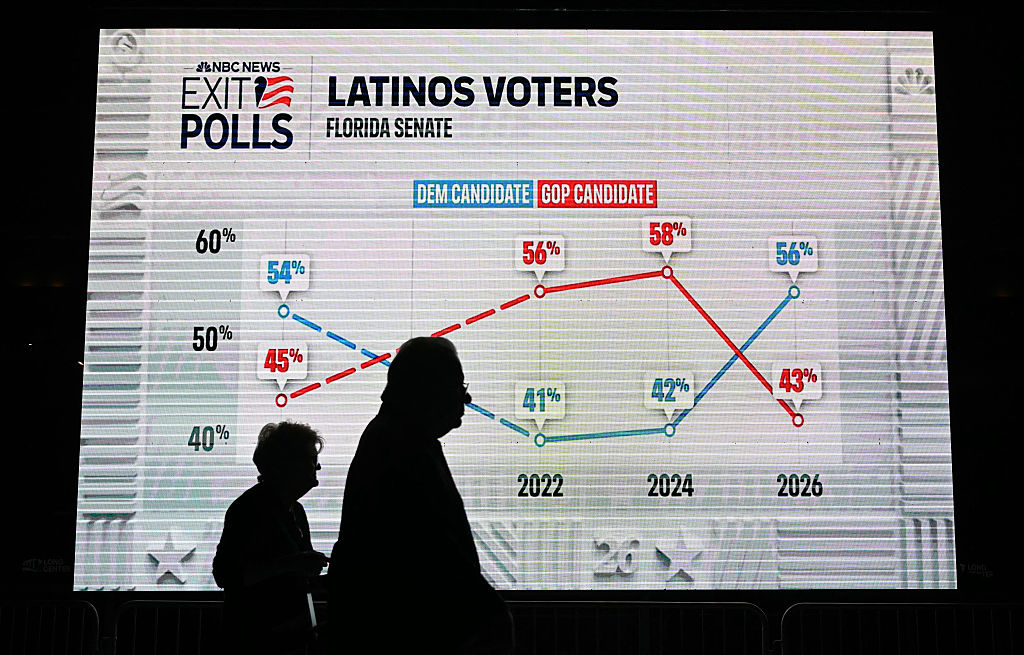
Democrats defied expectations and expanded into deep-red territory on Nov. 3, fracturing President Donald Trump’s coalition and delivering double-digit swings in key demographics that drove his 2024 victory.
Democrats gained control of Congress, picking up at least seven Senate seats: Maine, Ohio, Texas, North Carolina, South Carolina, Kansas, and Iowa.
More wins are possible, as Democratic candidates hold narrow leads in undeclared races in Alaska and Mississippi. The party reached a 237-seat House majority with 59 races yet to be called.
“We haven’t seen a Congress that looks like this since the ’90s. I think this will go down as one of the most impactful election landslides we’ve seen since the 1970s when the Watergate class entered Congress,” Aaron Dusso, an associate professor of political science at Indiana University–Indianapolis, told The Epoch Times.
These are the biggest shifts that carried Democrats to a 2026 midterm victory.
Democrats Expand Map Into Red Territory
One of the early wins for Democrats was a South Carolina Senate victory for the first time since 1998, ousting Sen. Darline Graham (R-S.C.), who had been recently appointed to finish the unexpired term of her deceased brother, Lindsey Graham.
Democrats flipped several other Senate seats across the South and Midwest in states that had supported Trump in three presidential contests: North Carolina, Texas, Kansas, Iowa, and Ohio.
Those losses reflected a rejection of Trump and Republicans “by extension,” Joshua Koss, an assistant professor of political science at Eastern Michigan University, told The Epoch Times.
Democrats had campaigned in the red states on affordability and the Iran war, and criticized Republicans for giving Trump a “blank check,” Koss said.

Democrats extended their reach into ruby-red Mississippi, which Trump won by more than 20 points in 2024. The race between Democrat Scott Colom and incumbent Sen. Cindy Hyde‑Smith (R-Miss.) is yet to be called and is essentially tied with 95 percent of votes counted.
Koss suggested that the shift there is similar to what has played out in Georgia over the past decade, as population changes have allowed Democrats to make breakthroughs in grassroots organizing and mobilizing black voters. African Americans make up 36.8 percent of Mississippi’s population and 32.4 percent of Georgia’s population.
The state of the economy was the No. 1 factor driving Democratic gains in Republican strongholds, Dusso said.
“The war with Iran’s effect on gas prices was easy for voters to see, and they assigned blame to the president and his party,” Dusso said. “Inflation ended the Biden administration and appears to be doing the same damage to the Trump administration.”

Demographic Shifts
Gains made by the Republican coalition over the past decade evaporated overnight as voters across nearly every demographic moved away from the GOP.
“The shift was substantive,” Jim Lee of Susquehanna Polling told The Epoch Times.
Under Trump’s leadership, Republicans had made inroads into some traditionally Democratic-voting communities, including black and Hispanic communities. That culminated with the 2024 election, when 15 percent of black voters and 48 percent of Hispanics chose Trump.
This year, just 9 percent of black voters and 34 percent of Hispanics supported Republicans, according to the Pew Research Center.
Men also pulled back from the Republican agenda in 2026, research data show. The GOP had a net loss of 6 percentage points among all men and a 4 percent drop among white men.
The drop was slightly higher among college-educated white men (minus 5 points) than among those without a college education (minus 2 points).
Trump had stronger support from white male voters in 2016, when 62 percent voted for him. In 2026, 55 percent of white men supported Republicans for Congress, the lowest percentage since 2018.
Voters in all age groups shifted away from the GOP in 2026. The sharpest decline, minus 21 points, was among those aged 18 to 24.
“All these groups share something in common,” Lee said. “They’re all upset about what they pay at the pump. It’s not rocket science.”
Republican and Republican-leaning voters also shifted away from the party, as did conservative and moderate Democratic-leaning voters. Trump reached 8 percent of those voters in 2024. That melted to 3 percent in 2026.
And Republican support among independent voters dropped by 10 percentage points in 2026.
“That was a generational chance to try and make inroads with a population that you hadn’t been able to get to,” Dusso said. “I don’t know how they’re going to have that kind of opportunity again.”
Progressives Outperform Expectations
One major litmus test of Nov. 3 was whether Democrat Dr. Abdul El-Sayed and other progressive candidates would continue the momentum generated by Zohran Mamdani, who won the New York City mayoral race in 2025.
Some observers predicted that the Mamdani movement was unique to heavily blue areas such as New York City.
Yet with 98 percent of votes counted, El-Sayed had amassed 52.5 percent of the votes cast, ahead of Republican Mike Rogers by 7 percentage points. That margin is well above the polling predictions, which hovered at about a 2-point margin for the Democrat.

Sen. Gary Peters (D-Mich.) narrowly beat Rep. John James (R-Mich.) by less than 2 percentage points in 2020. Then-Sen. Debbie Stabenow (D-Mich.), a multi-decade institutional Democrat, beat James by 6.5 percentage points in 2018, another blue wave year, winning with 52.3 percent and 2.2 million votes.
“Very few candidates can come away with that clean a margin after dealing with the sheer level of opposition and outside spending,” Koss said of El-Sayed.
Progressive Democrat Troy Jackson also defied expectations in Maine, unseating 30-year veteran Sen. Susan Collins (R-Maine) by 7 percentage points.

The Democratic establishment has tried for decades to oust Collins with “handcrafted” candidates, Koss said. Jackson’s win may force the party to rethink what voters really want, he added.
An even bigger surprise was the performance of Florida state Rep. Angie Nixon, a Democrat, who came within 3 percentage points of unseating incumbent Sen. Ashley Moody (R-Fla.). By comparison, Sen. Rick Scott (R-Fla.) won reelection in Florida in 2024 by nearly 13 percentage points.
Nixon, a member of the Democratic Socialists of America, won two of Florida’s Hispanic-majority counties, Miami-Dade and Osceola, by 7.1 percent and 18.4 percent, respectively. In 2024, Trump won Miami-Dade by 11.5 percent and Osceola by 1.5 percent. That’s an average shift of 19.25 percentage points across both counties.
Koss suggested that Nixon’s overperformance with Florida Hispanic voters, many of whom are socially conservative and have fled socialist regimes, could mean that they have become immune to the Republican Party’s warnings about socialism.

Lee cautioned that the outcome is not a mandate for progressives in Congress.
August polling had predicted a 7-point win for El-Sayed but also revealed a split among Democrats on progressive policies such as Medicare for All and price controls on groceries.
We had a problem loading this article. Please enable javascript or use a different browser. If the issue persists, please visit our help center.