

During the revision of one of the most consequential legal documents shaping journalism in Việt Nam—the Press Law—a series of troubling developments have unfolded. [5] A BBC journalist remains unable to leave the country months after police confiscated her passport. [1] The public has struggled with confusion and anxiety over conflicting information regarding the death toll from historic floods in the South Central region. [2][3] Simultaneously, the Ministry of Public Security has issued a wanted notice for Lê Trung Khoa, the Berlin-based editor-in-chief of Thoibao.de. [4]
Against this backdrop, the National Assembly passed the revised Press Law on the morning of Dec. 10, with 437 out of 440 deputies voting in favor. The law is set to take effect on July 1, 2026. [6]
State media have hailed the new legislation in glowing terms, calling it a “breakthrough policy” that will “remove bottlenecks” and “open up strong new development opportunities.” [7] However, is this assessment accurate?
Three specific provisions help illuminate whether this law is truly a “breakthrough.” Since the full official text remains unavailable as of Dec. 15, the following examination is based on the draft version released in February.
Binding “Journalism” to the “Revolution”
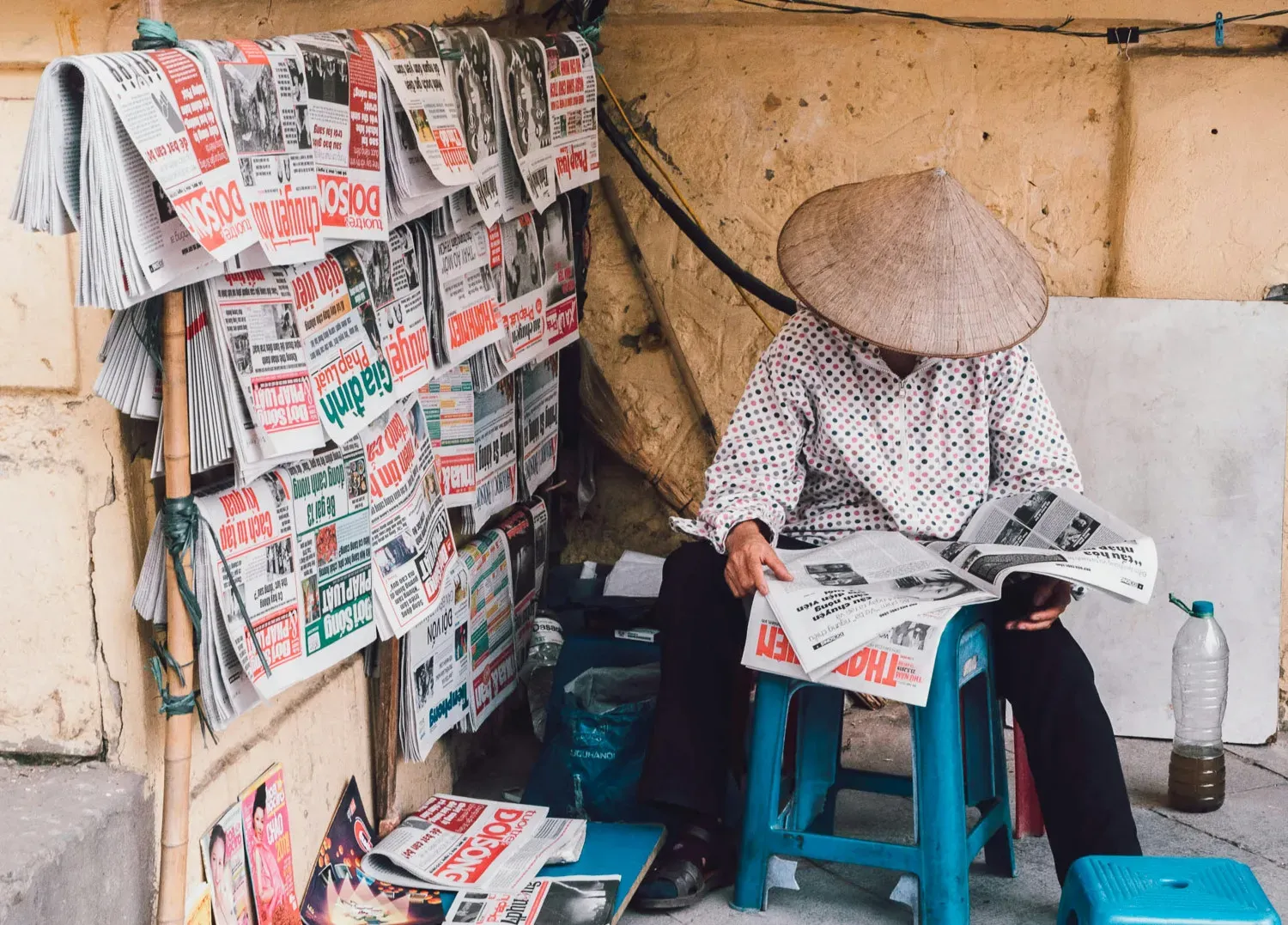
Journalism in Việt Nam has long been described as “revolutionary journalism,” a tool serving the Communist Party and the state. [8] State media openly affirm this function; most recently, on June 21, the Central Commission for Information and Education and the Central Commission for Mass Mobilization organized elaborate events to commemorate the 100th anniversary of “Vietnamese Revolutionary Journalism.” [9]
This centenary marks a history in which journalism was transformed into an instrument for regime consolidation rather than an independent profession committed to the public interest. The 2016 Press Law reflected this by defining the press as the mouthpiece of the Party (Clause 1, Article 4), prohibiting the publication or broadcast of information that denies revolutionary achievements (Article 9), forbidding the abuse of press freedom and freedom of expression to infringe upon state interests or the rights of organizations and citizens (Clause 2, Article 13); and requiring journalists to protect the Party’s lines and policies (Clause 3, Article 25). [10] Yet, the specific phrase “revolutionary journalism” did not appear once in the 2016 text.
This distinction vanishes with the revised Press Law. The new legislation asserts the fusion of “journalism” and “revolution” more explicitly than ever before.
Article 3 of the draft law defines the foremost mission of the press as “revolutionary journalism, closely associated with the cause of national liberation, and the building and defense of the Socialist Republic of Việt Nam […]” [11] This directive is backed by political foundations cited in the amendment dossier, including Politburo Resolution No. 52/2019 and Secretariat Conclusion No. 23/2017. [12][13]
The unambiguous purpose of this legislative project is to institutionalize the Party’s leadership over the press. [14][15] This raises a question: is this truly the proper function of journalism?
The answer, plainly, is no.
Journalism was conceived to serve the public by truthfully reflecting all facets of social life, including the conduct of powerful authorities. According to the Global Charter of Ethics for Journalists issued by the International Federation of Journalists (IFJ), a journalist’s foremost duty is to respect the truth and the public’s right to know. [16] This principle, also articulated by the Society of Professional Journalists (SPJ), requires that journalists be free to report on wrongdoing without fear of interference. [17]
For this to happen, independence is paramount. Newsrooms must be able to decide what to publish based on factual accuracy rather than political considerations.
However, when the law elevates propaganda and regime defense as journalism’s highest mission, the commitment to truth is inevitably relegated to secondary status. Once the press acts as a mouthpiece for the Party, it becomes nearly impossible to publish sensitive reporting on the state. Governance issues are only reflected when explicit permission is granted.
This creates a dynamic where the press only “releases the valve” on sensitive topics after receiving official directives. Even then, information is carefully filtered to ensure it never crosses prescribed boundaries. In this environment, critical content is strictly censored, blocked, or punished. [18][19][20] Conversely, articles that reinforce Party ideals—such as the People’s Public Security piece “A Discordant Low Note Called Trấn Thành”—are held up as exemplary, regardless of their connection to reality. [21]
Meanwhile, journalists who dare to tell the truth are swiftly branded as “reactionary” and imprisoned. This has led international commentators to describe Việt Nam as the “third-largest prison in the world” for independent journalists. [22] This is not a metaphor: as of now, around 40 journalists and bloggers remain behind bars. [23]
Police Compel the Disclosure of Sources
Consider a scenario where a whistleblower in a food company discovers that unsafe ingredients are being used in their products. They approach a journalist to expose the wrongdoing, only to have that journalist forced to reveal their identity to the police. Whether in government, schools, or private companies, few would dare to speak out under such conditions. This is why anonymous whistleblowing exists.
The protection of sources is a global standard, essential for accessing critical information on corruption and abuse of power. Without it, sources remain silent, and journalism loses its ability to conduct independent oversight.
However, the revised Press Law undermines this principle by allowing heads of investigative bodies to demand the disclosure of sources for “investigation, prosecution, and adjudication.” [24] This provision significantly expands the Ministry of Public Security’s authority over the press, a power previously reserved for prosecutors and courts. [25]
Under the new law, investigative bodies can easily use the pretext of an investigation to force disclosure. This regression will likely drive self-censorship, deterring journalists from covering the police, judiciary, or national security. Consequently, vital truths may be pushed further into the shadows.
A Tightening Grip on Journalism in Cyberspace
The revised Press Law is obsessed with one domain: “cyberspace.” Under the new provisions, social media channels operated by press agencies—Facebook, YouTube, TikTok—are no longer treated as open platforms but are subject to the same strict controls as traditional state media. [26]
Control over this domain has been consolidated. On Dec. 10, the same day the National Assembly passed the Press Law, it also adopted amendments to the Cybersecurity Law. These changes place authority over the digital realm firmly in the hands of the Ministry of Public Security. [27]
This grants the Ministry sweeping powers to order the immediate removal of content without a complaints process, while mandating that data be stored for potential investigations. The result is a profoundly “anti-journalistic” legal framework.
International observers are alarmed. Aleksandra Bielakowska of Reporters Without Borders (RSF) warned that these changes will make Việt Nam “an almost impossible place for journalists to report freely.” [28] With the country already ranked 173rd out of 180 in the RSF Press Freedom Index, independent journalism faces near-total suffocation.
The troubling incidents seen in recent months are not anomalies; they are standard operations in Việt Nam’s tightly censored media system. With the passage of these laws, this system is now tighter than ever. It leaves a single, haunting question: when will Việt Nam finally have real journalism?
Trường An wrote this article in Vietnamese and published it in Luật Khoa Magazine on Dec. 15, 2025. Đàm Vĩnh Hằng translated it into English for The Vietnamese Magazine.
References:
- Holmes, O. (2025, October 29). BBC journalist barred from leaving Vietnam and interrogated repeatedly. The Guardian. https://www.theguardian.com/world/2025/oct/29/bbc-journalist-barred-from-leaving-vietnam-and-repeatedly-interrogated
- The Vietnamese. (2025, December). Disputed flood death toll: The crisis of trust in Vietnamese state media. https://www.thevietnamese.org/2025/12/disputed-flood-death-toll-the-crisis-of-trust-in-vietnamese-state-media/
- VnExpress. (2025, November 24). Lũ Nam Trung Bộ lớn nhất trong hơn 50 năm qua. vnexpress.net. https://vnexpress.net/lu-nam-trung-bo-lon-nhat-trong-hon-50-nam-qua-4984432.html
- The Vietnamese. (2025, December). As extradition law advances, police seek Lê Trung Khoa and Nguyễn Văn Đài—both say they will continue their work. https://www.thevietnamese.org/2025/12/as-extradition-law-advances-police-seek-le-trung-khoa-and-nguyen-van-dai-both-say-they-will-continue-their-work/
- Duthaoonline.Quochoi.Vn. (n.d.). Luật Báo chí (sửa đổi). duthaoonline.quochoi.vn. https://duthaoonline.quochoi.vn/dt/luat-bao-chi-sua-doi/250923093812009369
- Quốc hội thông qua Luật Báo chí (sửa đổi). (n.d.). Cổng Thông Tin Điện Tử Quốc Hội. https://quochoi.vn/tintuc/Pages/tin-hoat-dong-cua-quoc-hoi.aspx?ItemID=97485
- In, B. I.-. B. (2025, December 11). Luật Báo chí sửa đổi và những chính sách đột phá. https://www.qdnd.vn. https://www.qdnd.vn/chinh-tri/cac-van-de/luat-bao-chi-sua-doi-va-nhung-chinh-sach-dot-pha-1016421
- Xây dựng nền báo chí cách mạng Việt Nam hiện đại, nhân văn, dân tộc, đáp ứng kỳ vọng, niềm tin yêu của Đảng, Nhà nước và nhân dân. (n.d.). Tạp Chí Cộng Sản. https://www.tapchicongsan.org.vn/media-story/-/asset_publisher/V8hhp4dK31Gf/content/xay-dung-nen-bao-chi-cach-mang-viet-nam-hien-dai-nhan-van-dan-toc-dap-ung-ky-vong-niem-tin-yeu-cua-dang-nha-nuoc-va-nhan-dan
- Anh, N. (2025, May 9). Nhiều hoạt động hướng tới kỷ niệm 100 năm Ngày Báo chí cách mạng Việt Nam. Báo Nhân Dân Điện Tử. https://nhandan.vn/nhieu-hoat-dong-huong-toi-ky-niem-100-nam-ngay-bao-chi-cach-mang-viet-nam-post866385.html
- Thuvienphapluat.Vn. (2025, August 15). Luật Báo chí 2016. THƯ VIỆN PHÁP LUẬT. https://thuvienphapluat.vn/van-ban/Van-hoa-Xa-hoi/Luat-Bao-chi-2016-280645.aspx?anchor=dieu_9
- See [5]
- Chinhphu.vn. (n.d.). Hồ sơ đề nghị xây dựng Luật sửa đổi, bổ sung một số điều của Luật Báo chí. Cổng Thông Tin Điện Tử Chính Phủ – http://chinhphu.vn. https://chinhphu.vn/du-thao-vbqppl/ho-so-de-nghi-xay-dung-luat-sua-doi-bo-sung-mot-so-dieu-cua-luat-bao-chi-6030
- Thuvienphapluat.Vn. (2025, October 24). Kết luận 23-KL/TW năm 2017 về tăng cường chỉ đạo, quản lý, phát huy vai trò của báo chí, xuất bản trong việc ngăn chặn, đẩy lùi sự suy thoái về tư tưởng chính trị, đạo đức lối sống “tự diễn biến”, “tự chuyển hóa” trong nội bộ do Ban Chấp hành Trung ương ban hành. THƯ VIỆN PHÁP LUẬT. https://thuvienphapluat.vn/van-ban/Bo-may-hanh-chinh/Ket-luan-23-KL-TW-2017-tang-cuong-vai-tro-bao-chi-trong-day-lui-su-suy-thoai-tu-tuong-chinh-tri-392270.aspx
- Duthaoonline.Quochoi.Vn. (n.d.). Quốc hội nghe Tờ trình dự án Luật Báo chí (sửa đổi). duthaoonline.quochoi.vn. https://duthaoonline.quochoi.vn/quoc-hoi-nghe-to-trinh-du-an-luat-bao-chi-sua-doi-E5A0FA213A0B-FE2B5E5CB923ca
- Dự án Luật Báo chí (sửa đổi): Hoàn thiện quy định pháp luật để thể chế hoá chủ trương, chính sách của Đảng về báo chí. (n.d.). https://bvhttdl.gov.vn/du-an-luat-bao-chi-sua-doi-hoan-thien-quy-dinh-phap-luat-de-the-che-hoa-chu-truong-chinh-sach-cua-dang-ve-bao-chi-20251022201614675.htm
- Global Charter of Ethics for Journalists – IFJ. (n.d.). IFJ. https://www.ifj.org/who/rules-and-policy/global-charter-of-ethics-for-journalists
- Society of Professional Journalists. (n.d.). The SPJ Code of Ethics. https://www.spj.org/pdf/spj-code-of-ethics.pdf
- IMAP Vietnam 2023 Internet Censorship Report. (n.d.). iMAP. https://imap.sinarproject.org/reports/2023/imap-vietnam-2023-internet-censorship-report
- Lê Giang, Trịnh Hữu Long. (2025, December 10). Nhanh hiếm thấy: Viện Kiểm sát phát cáo trạng truy tố Lê Trung Khoa đúng 30 ngày sau khi khởi tố vụ án. Luật Khoa Tạp Chí. https://luatkhoa.com/2025/12/nhanh-hiem-thay-vien-kiem-sat-phat-cao-trang-truy-to-le-trung-khoa-dung-30-ngay-sau-khi-khoi-to-vu-an/
- The Vietnamese. (2025, December). National Assembly pushes through record number of laws, expands police powers over the media. https://www.thevietnamese.org/2025/12/national-assembly-pushes-through-record-number-of-laws-expands-police-powers-over-the-media/
- Phương, B. (2025, September 4). “Nốt trầm” lệch pha mang tên Trấn Thành – Báo Công an Nhân dân điện tử. Báo Công an Nhân Dân Điện Tử. https://cand.com.vn/Kinh-te-Van-hoa-The-Thao/not-tram-lech-pha-mang-ten-tran-thanh-i780244/
- Egalluscio. (2025, May 6). Joint letter to US Secretary of State for Vietnam Human Rights Day. PEN America. https://pen.org/joint-letter-to-us-secretary-of-state-for-vietnam-human-rights-day/
- Trịnh Hữu Long. (2024). Foreign tech companies in Vietnam: Challenges and failures in upholding human rights. Legal Initiatives for Vietnam. https://www.article19.org/wp-content/uploads/2024/11/Foreign-Tech-Companies-in-Vietnam-Vietnamese.pdf
- See [20]
- LuatVietnam. (n.d.). Luật Báo chí 2016, số 103/2016/QH13. LuatVietnam. https://luatvietnam.vn/chinh-sach/luat-bao-chi-2016-so-103-2016-qh13-104847-d1.html
- Nguyễn, H. T. (2025, December 10). Các kênh mạng xã hội của cơ quan báo được luật hóa là sản phẩm báo chí. Báo Điện Tử Dân Trí. https://dantri.com.vn/thoi-su/cac-kenh-mang-xa-hoi-cua-co-quan-bao-duoc-luat-hoa-la-san-pham-bao-chi-20251210123642136.htm
- The Vietnamese. (2025, December). The quiet passing of Việt Nam’s 2025 cybersecurity law. https://www.thevietnamese.org/2025/12/the-quiet-passing-of-viet-nams-2025-cybersecurity-law/
- Guarascio, F. (2025, December 11). Vietnam set to make it harder for media to protect sources, to expand state secrets. Reuters. https://www.reuters.com/business/media-telecom/vietnam-set-make-it-harder-media-protect-sources-expand-state-secrets-2025-12-10/