
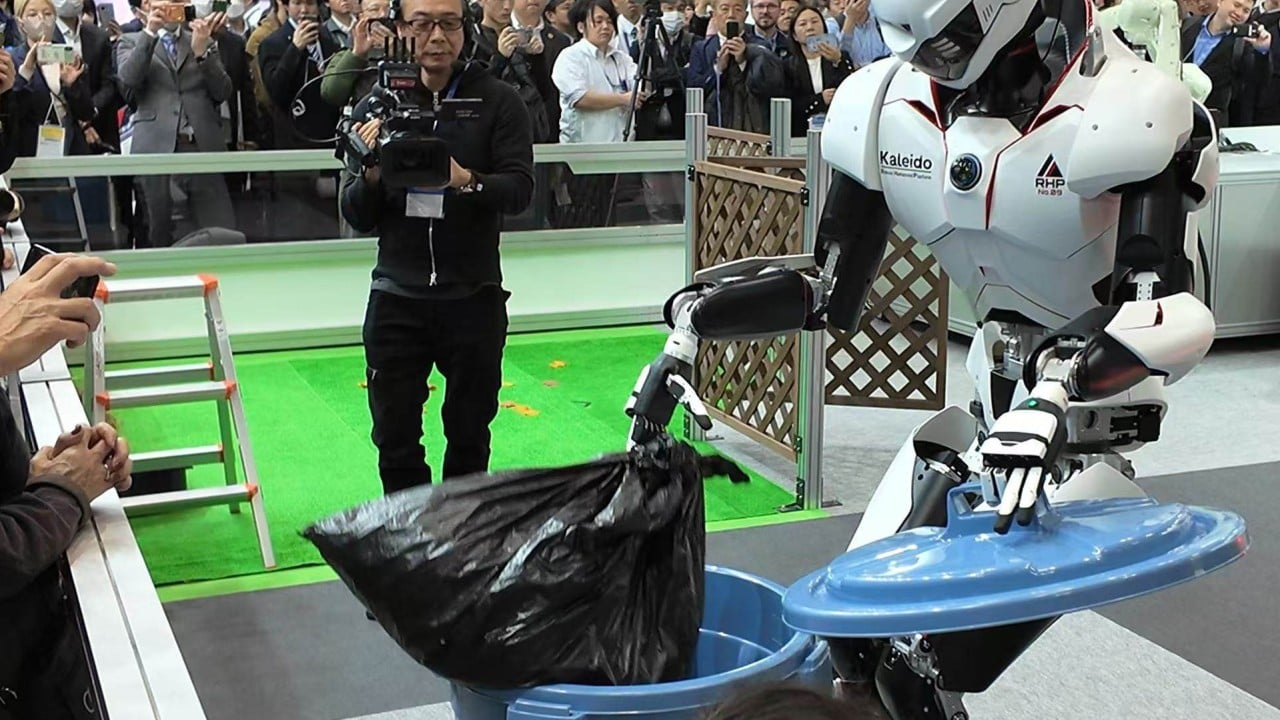
While humanoid robots from China and the US have captured the imagination of people for their skill at serving drinks, taking part in boxing matches and running marathons, and entertaining through dance moves on stage, their counterparts in Japan – the long-time leader of the robotics world – are mostly confined to factories.
Japan’s early forays into humanoids date back to the 1960s, so what happened along the way?
At the 26th International Robot Exhibition (IREX), a four-day, biennial industry showcase held early December at Tokyo Big Sight, Japan’s domestic industrial robotics heavyweights – including Kawasaki, Fanuc, Yaskawa and Nachi – still dominated, occupying the largest booths. Massive robotic arms could be seen swinging around with precision, simulating welding, assembly and material handling tasks in real-world factory operations.
Advertisement
That focus “highlights Japan’s ongoing emphasis on mature industrial applications, where integration, deployment and return on investment are well understood”, said industry research firm TrendForce in a recent note.
The event drew a record 673 exhibitors, including 140 companies from 13 countries and regions. Participation from China also hit an all-time high, with 84 exhibitors, despite the backdrop of an ongoing diplomatic row between Tokyo and Beijing.
Advertisement
Still, humanoids were the most eye-catching at the show, many of which came from relatively young Chinese start-ups seeking to present their products in an international setting. These included Galbot, AgiBot and Robotera – all founded in 2023 – as well as the more recently established Lumos. At the booth of Chinese robotics star Unitree, hosted by its Japanese distributor Techshare, robots boxed and danced in front of packed crowds.