
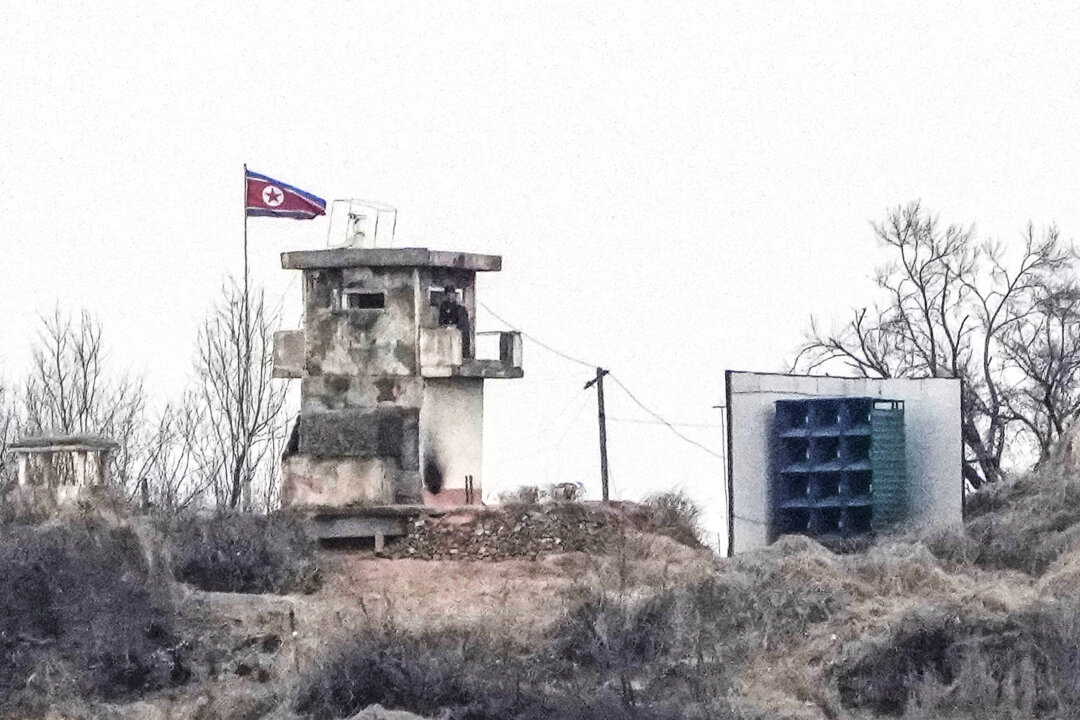
Seoul is still committed to establishing peace with Pyongyang after a recent mine blast, but it is prepared to do what is necessary to protect its borders, South Korea’s national security chief said.
The United Nations Command, the body that formally decides whether the armistice has been breached, determined that the Sept. 21 explosion in the demilitarized zone (DMZ) was Pyongyang’s fault. Two South Korean soldiers were injured in the blast.
“Our government will continue taking necessary measures in response to the DMZ mine blast incident based on clear principles,” the security chief said Friday, according to South Korean news agency Yonhap. “The government will focus its resources on creating peace that makes fighting unnecessary by consistently pursuing its policy of peaceful coexistence.”
Since the incident, Seoul has demanded an apology, de-mined the site, and test-fired a hypersonic missile to ensure its preparedness to respond to threats. It also proposed military talks with North Korea to de-escalate tensions.
Pyongyang has not yet acknowledged Seoul’s offer and dismissed the issue of the landmine explosion as a “farce.”
On Oct. 29, around 10 short-range ballistic missiles were launched from North Korea’s Wonsan area toward the East Sea, according to South Korea’s Joint Chiefs of Staff.
North Korea’s Defense Ministry said on Friday that U.S.–South Korean air defense drills were increasing tensions, saying that there was “no limit” to its option for maintaining a strong deterrent posture, KCNA reported. The ministry called the drills a “reckless demonstration of strength” that is becoming routine.
Although not actively involved in open conflict, North and South Korea technically remain at war.
The situation on the peninsula has been a particular concern to U.S. President Donald Trump during both his terms in office, and he hinted earlier this month that he might meet with Kim during his planned visit to Asia in November.
Trump also said in August that he planned to meet Kim later this year but gave no details.
“He has 57 very powerful nuclear weapons,” Trump told reporters on Aug. 19. “We should have never have allowed it to happen. If I were president, I wouldn’t have let it happen, but he’s got them.”
Trump met with Kim three times in 2018 and 2019 during his first term. Negotiations over Pyongyang’s nuclear program collapsed in 2019 because of disagreements over North Korea’s denuclearization efforts and the easing of U.S.-led sanctions.
We had a problem loading this article. Please enable javascript or use a different browser. If the issue persists, please visit our help center.