

[The content of this article has been produced by our advertising partner.]
Artificial intelligence (AI) is redefining the future-ready talent landscape, creating an urgent need for skills that blend technical fluency with critical and creative thinking. This shift calls for classrooms that move beyond traditional instruction toward skills-based learning, where teachers serve as designers of meaningful experiences that enable students to learn, think and apply AI knowledge across disciplines.
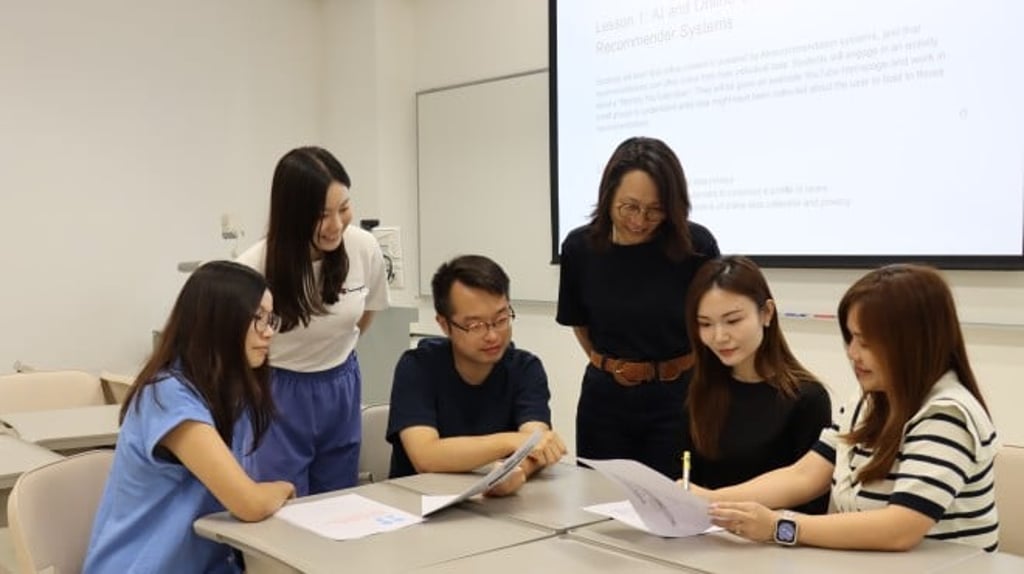
Against this backdrop, the JC GoAI Project is bringing together teachers and principals to jointly develop teaching and learning resources, with support from subject experts from CUHK. Coupled with advice from the government, leading institutions and industry experts, their insights are helping to ensure that lessons are responsive to students’ needs as well as aligning AI learning with broader educational goals.
Advertisement
Guiding, Not Guarding: School Leaders Empower Students Through AI
AI is already in classrooms, whether schools are ready or not. “Some teachers worry AI will make their children lazy,” said Dr Jessie Cheung Chok-fong, Chairperson of the Subsidised Primary Schools Council and Advisory Committee Member of the JC GoAI Project. “But what I see is, if students are going to use these tools anyway, not teaching AI literacy is far more dangerous than teaching it. Our role is not to restrict them, but to guide them to use it responsibly and ethically.”
Advertisement

Increasingly, schools are emphasising responsibility over restriction, nurturing an AI-wise generation that questions, analyses and applies technology thoughtfully.Mr Andy Li, Chairman of the Association of Computational Thinking InnoCommunity Teachers (ACTICT) and Advisory Committee Member of the JC GoAI Project, has long championed integrating technology into classrooms. “The foundations of AI education were laid years ago through the CoolThink@JC computational thinking education programme,” he says.

Computational thinking and AI are deeply connected. Computational thinking teaches students to break problems into steps, analyse data, and devise solutions. AI education builds on these skills to explain how computers learn from data, its limits and risks , and how to use AI responsibly and effectively.
AI as a Creative Partner in the Classroom
Advertisement
Beyond traditional textbooks and teaching methods, AI opens the door to innovative approaches that engage students in unexpected ways. Picture a classroom where students don’t just consume knowledge, but actively create and critique it with AI as their partner.
Dr Cheung once observed a Chinese lesson where the teacher introduced the idiom 畫蛇添足 (“ to ruin something by overdoing it”) and students used AI to generate visual interpretations. “They laughed at the absurd results,” says Cheung. “But the real lesson begins when we ask: Is this accurate? If not, why?”
Here, students are building their AI competency: the ability to question outputs, refine prompts and use AI tools thoughtfully and ethically. Through the JC GoAI Project, AI learning extends beyond coding, becoming a tool for enquiry, creativity and problem-solving across disciplines such as languages, science and the humanities.
Advertisement
Adaptive Learning Without Losing Human Understanding
With ethics at the core, AI education should evolve alongside students’ academic growth. Mr Dion Chen, Chairman of the Hong Kong Direct Subsidy Scheme Schools Council and Advisory Committee Member of the JC GoAI Project, emphasises that secondary education is where students truly engage with AI’s transformative potential.

“AI’s strength lies in its ability to support adaptive learning,” Chen explains. “Every student learns differently, but one teacher can only explain a concept in one or two ways. AI can offer ten or even twenty variations until one finally resonates.”
Advertisement
He recalls a student who struggled with a logic puzzle. Traditional methods fell flat, but an AI chatbot guided him to solve the problem using a reasoning tailored to his learning style.
“It wasn’t a lack of ability, he just needed an alternative explanation,” Chen notes. “Once he grasped the concept, his confidence soared.” Still, he cautions against over-reliance on technology. “We encourage students to use AI, provided they can articulate their reasoning afterward. If they can’t, then it’s the AI that’s driving them, not the other way around.”
Teaching What AI Can’t: Judgment, Ethics and the Human Insight
Advertisement
AI is transforming how teachers teach and how students learn. However, as AI takes root in classrooms, the focus must remain on students as decision-makers who apply technology with judgement, empathy and the human insight behind every choice – qualities that AI can support but hardly replace.
For this transformation to be sustainable, AI must be thoughtfully integrated into the curriculum practical for everyday teaching. The frontline experience of teachers is essential to turn technology into meaningful pedagogy, ensuring AI-driven learning remains effective, practical and grounded in ethics and human judgment. The future of AI in education will not be written by algorithms alone, but co-created by the educators who bring it to life.
The JC GoAI Project, funded and initiated by The Hong Kong Jockey Club Charities Trust and co-created by school educators with support from The Chinese University of Hong Kong (CUHK), is designed to build students’ literacy and capabilities in generative AI. It empowers them to learn effectively across disciplines through responsible use of technology. The project will be officially launched in late February 2026.
Advertisement
Advertisement