
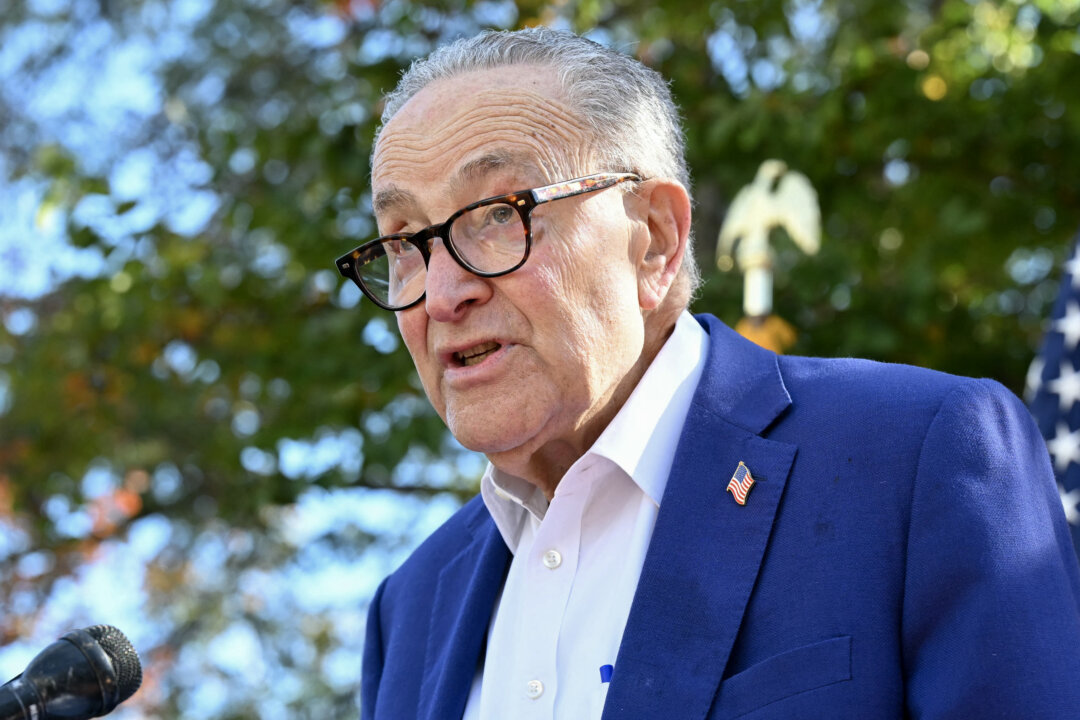
The top Democrat in the Senate said in a new interview that his party will not let President Donald Trump place a “right-winger” on the Supreme Court following the Democrats’ flipping control of the upper chamber in the midterm elections.
“The bottom line is we’re not going to allow a right-winger on the court,” Senate Minority Leader Chuck Schumer (D-N.Y.), who is expected to become majority leader early in 2027 as the new Congress is seated, told The Associated Press.
The White House did not respond to a request for comment by the time of publication.
Schumer declined to say in the interview whether he might keep any Supreme Court vacancy that arises open until after the 2028 presidential election, a strategy employed by former Senate Majority Leader Mitch McConnell (R-Ky.) ahead of the 2016 race. Schumer did say that Democrats would not allow “any crappy nominees” to be confirmed to any judicial posts, or Trump’s Cabinet.
Schumer told reporters during a post-election press conference on Wednesday that “the days of Trump’s supplicant Senate are over.”
He also said that Senate Democrats are open to judicial nominees “who obey the law, who have fidelity to the rule of law” and that “too many of Trump’s nominees did not have that at all.”
Judicial nominees require a majority vote. Democrats are projected to have at least 54 Senate seats in the next Congress, with two races still to be called.
Nine justices are on the Supreme Court. The two oldest—Justice Clarence Thomas, 78, and Justice Samuel Alito, 76—were appointed by Republican presidents. The third oldest, Justice Sonia Sotomayor, 72, is an appointee of former President Barack Obama.
Justices can choose to serve until death or retire at any time. Some retire as they age. The last vacancy opened up in 2022, when Justice Stephen Breyer stepped down.
Thomas has not outlined retirement plans, while Alito said in October that he will not retire during the court’s current term, which just started.
Trump was able to nominate three justices during his first term. Only Republicans voted for Amy Coney Barrett; one Democrat voted for Brett Kavanaugh; and three Democrats crossed the aisle to support Neil Gorsuch.
The Senate has confirmed 56 of Trump’s judicial nominees in his second term, following more than 230 in his first term. Democrats have cast votes for a number of the nominees, and Republican Senate leadership allowed Democrats to block some nominees from their home states through the so-called blue slip process.
There are 28 vacancies in federal courts at present.
Senate Majority Leader John Thune (R-S.D.) said on X this week that the accomplishments of Senate Republicans include placing “strong conservative judges on benches across the country faster than we have since the Reagan administration.”
He told Punchbowl News over the summer that confirming judges was a priority. Because senators who are leaving office due to retirement or losing reelection bids historically often don’t return to Washington after the midterms, he said that the goal was to confirm as many as possible before November.
We had a problem loading this article. Please enable javascript or use a different browser. If the issue persists, please visit our help center.