
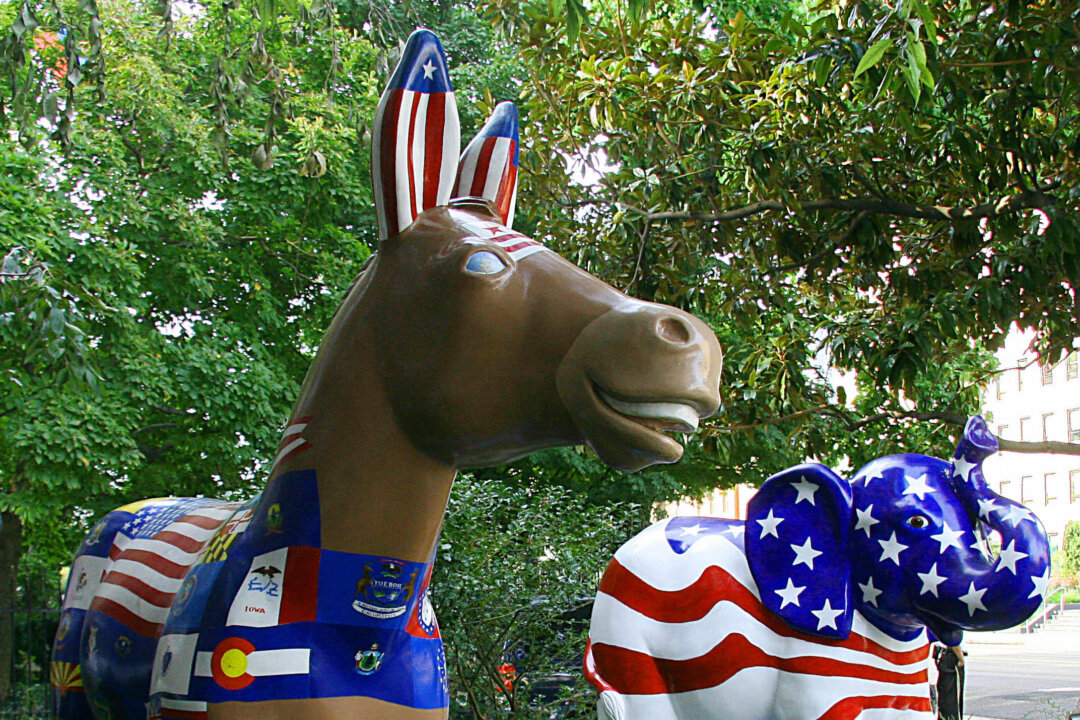
Democratic candidates hold 18 of the 20 top fundraising spots in the 2026 congressional races, according to Federal Election Commission rankings as of the morning of Friday, Oct. 23.
On the other hand, Republicans hold more than twice as much cash in their national party committees and allied super PACs, pre-general reports filed Thursday show.
All 10 of the cycle’s top Senate fundraisers are Democrats, counting only money from their main fundraising PACs. Sen. Susan Collins (R-Maine) is the top Republican at No. 11. In the House, Speaker Mike Johnson (R-La.) at No. 3, and Anthony Constantino—who seeks to fill the seat currently held by Rep. Elise Stefanik (R-N.Y.)—at No. 5, are the only Republicans in the top 10.
The reports cover Oct. 1 through Oct. 14, the last full filing period before the Nov. 3 election. They are the final complete look at where each side’s money stands. Anything raised after Oct. 14 won’t be reported in full until after Election Day, apart from large contributions that must be disclosed within 48 hours.
The split is consistent: Democrats lead where money goes straight to candidates, and Republicans lead in the party committees and outside groups that spend on their behalf.
Candidates
Texas Democratic Senate nominee James Talarico raised $17.6 million in those two weeks, bringing his campaign’s total to more than $146.3 million, his filing shows. Individual donors account for $139.8 million of that. In the latest period, $9.4 million came in unitemized contributions, the small donations that fall under the FEC’s $200 itemization threshold.
Talarico also spent heavily. His campaign paid out $22.2 million in the two weeks, and the cash it had on hand fell from $14.6 million at the start of the period to $9.9 million.
Sen. Jon Ossoff (D-Ga.) has raised $130.2 million and had $15.1 million in cash on Oct. 14. His campaign started the period with $26.3 million and spent $16.6 million, more than three times the $5.5 million it took in.
Maine is the only race where both candidates appear among the top Senate fundraisers. Democrat Troy Jackson, No. 10 in the FEC’s ranking, raised $5.2 million in the two weeks, nearly five times the $1.1 million Collins raised.
Jackson ended the period with $1.6 million in cash and $700,952 in debt, his report shows. Collins had $2.7 million and no debt, her report shows. Both campaigns spent more than they raised, and each roughly halved its cash.
Rep. Alexandria Ocasio-Cortez (D-N.Y.), the top House fundraiser, has raised $39.2 million. She had $17.6 million in cash on Oct. 14, the most of any candidate in this review.
The No. 2 House fundraiser, Democrat David Trone of Maryland, reported $26.2 million in receipts as of Sept. 30. Of that, $25 million is a loan he made to his own campaign. He did not file a pre-general report as he is not on the general election ballot after losing his primary to Rep. April McClain Delaney (D-Md.).
Johnson raised $355,509 in the period and ended it with $6.5 million in cash, his filing shows. His campaign’s cycle total includes $8.6 million transferred in from other committees authorized to raise money for him.
Party Committees
The party committees show the opposite picture. The Republican National Committee (RNC), National Republican Senatorial Committee (NRSC), and National Republican Congressional Committee (NRCC) held a combined $147.9 million on Oct. 14. Their Democratic counterparts held $73 million.
Every committee except the Democratic National Committee (DNC) ended the period with less cash than it started with, as both parties moved money into races. The Democratic Congressional Campaign Committee’s (DCCC) cash fell from $55.8 million to $30.7 million, and the NRCC’s from $61.3 million to $46.5 million.
Much of that money went into coordinated spending, which party committees make together with their candidates. The NRCC reported $28.8 million in coordinated expenditures over the two weeks, and the DCCC reported $28.1 million. The Democratic Senatorial Campaign Committee (DSCC) reported $16.1 million and the NRSC $4.8 million.
The RNC reported $5 million in coordinated spending during the period. The committee said in an Oct. 20 statement that it was running a $5 million coordinated ad buy with Rep. Ashley Hinson (R-Iowa), who is running for the Senate in Iowa.
Both Senate campaign committees are carrying debt. The DSCC took a $15 million loan during the period, its report shows, leaving it with $20.7 million in cash. The DSCC reported no debt at the end of September. The NRSC reported $20 million in debt against $25.2 million in cash. Its loan was received earlier in the year outside of this reporting period, the report shows.
The DNC ended the period with $21.6 million in cash and $15 million in debt, its filing shows. Throughout most of the earlier filings in the cycle, the DNC was the only national committee whose debt exceeded its cash. Its cash rose by $2.4 million over the two weeks, making it the only one of the six party committees to gain cash.
Super PACs
Some of the largest Republican-aligned super PACs held $337.6 million: Make America Great Again Inc. with $164.3 million, the Senate Leadership Fund with $88.4 million, and the Congressional Leadership Fund with $84.9 million. The Senate Majority PAC and House Majority PAC, the main Democratic groups, held a combined $154.1 million.
Those totals have dropped fast. The five groups spent a combined $419.3 million in those two weeks. Senate Leadership Fund’s cash fell from $155.4 million to $88.4 million, and Congressional Leadership Fund’s from $155.3 million to $84.9 million. Both reported more than $70 million in independent expenditures, which is spending for or against candidates without coordinating with them.
MAGA Inc., the main super PAC supporting President Donald Trump, spent $75.5 million and reported no contributions during the period, its report shows. House Majority PAC reported $72.4 million in independent expenditures and ended with $7.1 million in debt. The Senate Majority PAC’s cash fell from $112 million to $32.7 million. Most of its $108.7 million in spending was $81.4 million transferred to affiliated committees.
The cash gap doesn’t translate directly into airtime. During the 45 days before a general election, federal law requires broadcast stations to sell candidates ad time at the lowest rate they charge their best advertisers. Super PACs don’t get that rate.
What the Parties Say
RNC Chairman Joe Gruters said in a Monday statement that the committee had built the largest cash reserve in party history and is now spending it in battleground races. The RNC said it had transferred $21.6 million to the NRSC and $22.3 million to the NRCC. Its cash fell from $97.3 million to $76.2 million over the two weeks, its report shows. That includes $10.7 million in transfers to other Republican committees during the period.
“Our ability to spend that money is an absolute game changer,” Gruters said in a Newsmax interview the same day. He said the party’s spending, combined with the candidates it recruited, gives Republicans “a chance to defy history,” referring to the pattern of the president’s party losing congressional seats in midterm elections.
NRSC Communications Director Joanna Rodriguez said in a statement to The Epoch Times that the committee had raised record resources, kept one of the lowest burn rates of any committee, and moved quickly to coordinate spending with its candidates after the Supreme Court struck down limits on that spending.
“We’re going to throw everything we can at protecting our Republican Senate Majority, and we’re going to win,” she said.
DNC Chairman Ken Martin wrote in an Oct. 21 post that the party raised more than $10.2 million in grassroots donations in September, its best September in more than 15 years. He said Republicans were relying on “billionaire donors like Elon Musk to bail out their failed candidates.”
DCCC Chair Suzan DelBene said in an Oct. 20 statement that Democrats have the message, the momentum, and the candidates to win back the House. The DCCC said it raised $50.5 million from July through September.
DCCC spokesman Viet Shelton said in an Oct. 16 statement that Republicans were depending on “billionaire backers, praying they bail out their cash-starved campaigns.”
The Epoch Times reached out to the DSCC for comment but did not receive a response before publication.
We had a problem loading this article. Please enable javascript or use a different browser. If the issue persists, please visit our help center.