
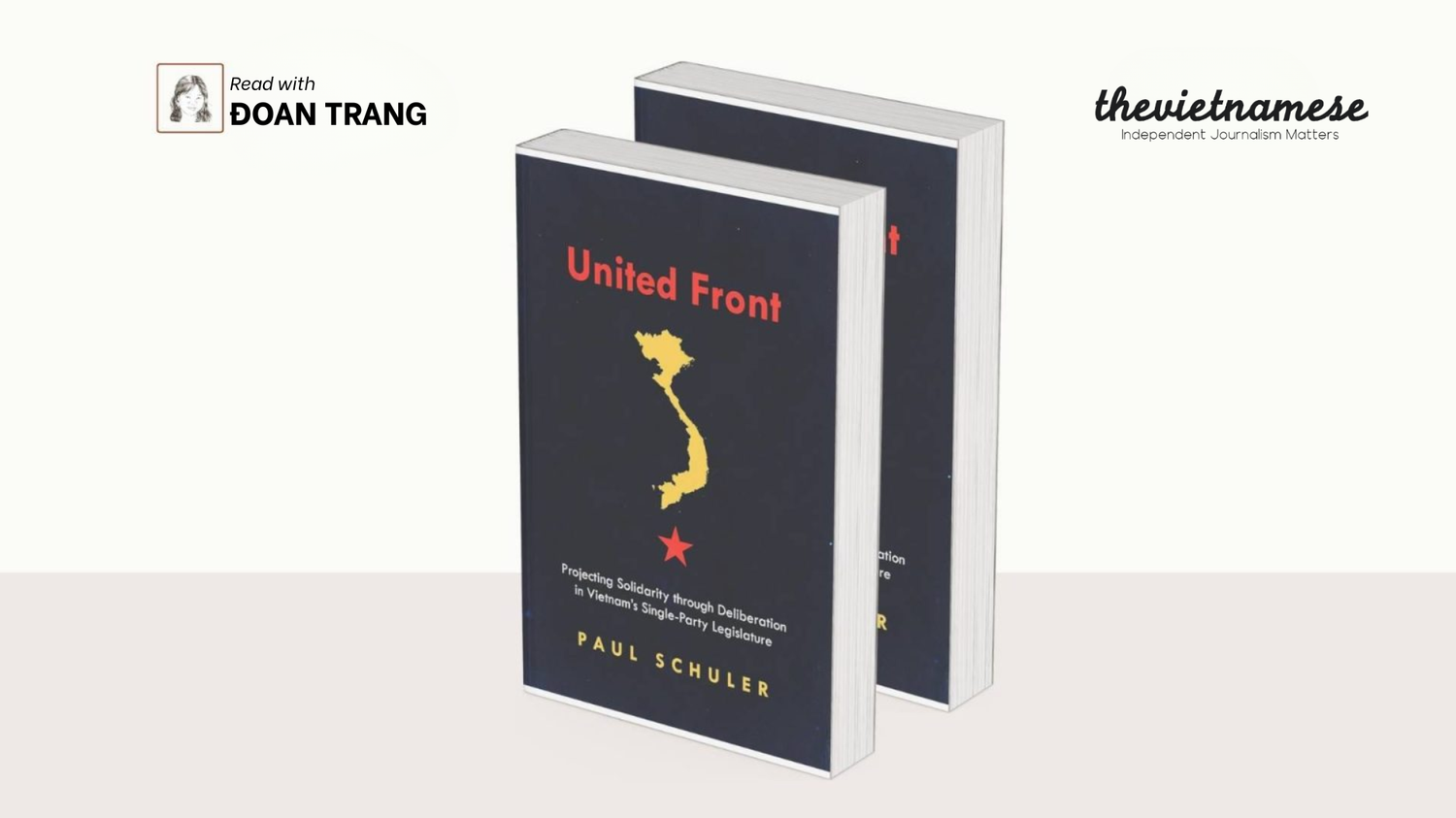
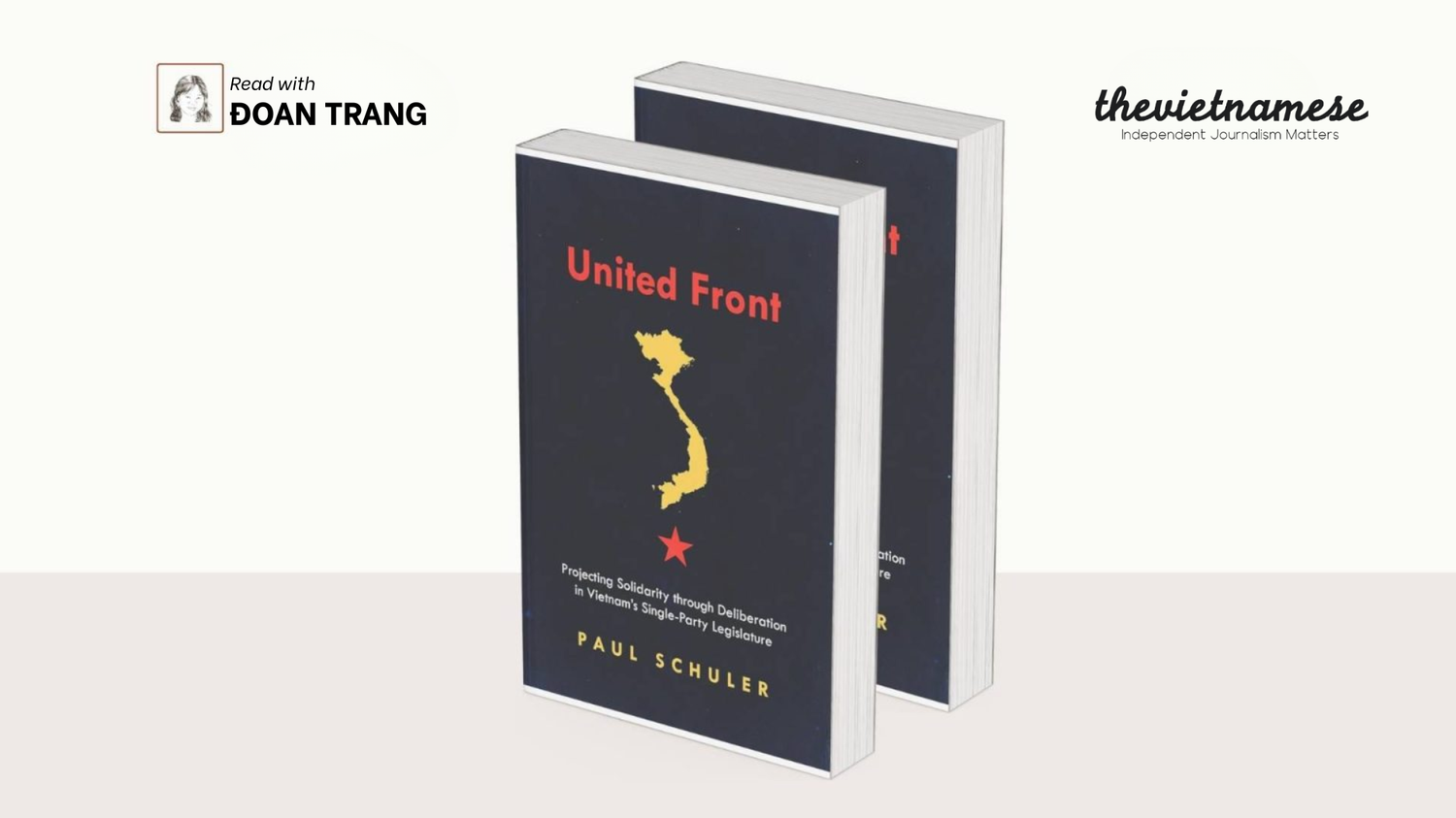
Paul Schuler, Associate Professor of Political Science at the University of Arizona, presents a systematic study of the National Assembly of Việt Nam in his book, “UNITED FRONT: Projecting Solidarity through Deliberation in Vietnam’s Single-Party Legislature.” [1]
Schuler examines the institution’s development under the control of the Communist Party, detailing its internal organization, member selection, and relationship with voters. He convincingly demonstrates that the primary role of the National Assembly of Việt Nam is not lawmaking, but propaganda. It is used to signal and project the strength of the Communist Party to the public. The compulsory nature of voter participation and the display of near-unanimity in legislative activities construct an image of legitimacy under the firm domination of the Communist Party. This image skillfully leads most Vietnamese to believe that the Party is invincible, effectively instilling hesitation in those who might contemplate opposing the regime.
According to Schuler, this propaganda function places the National Assembly of Việt Nam in stark contrast to democratic legislatures, which focus on lawmaking and representation. With only a few minor exceptions throughout history, the National Assembly has not made laws itself; it has largely passed legislation drafted by government agencies and pre-approved by the Party. Furthermore, legislators do not represent their constituencies, as they are selected by and held accountable to Party leadership.
Schuler characterizes the Assembly as a mere rubber stamp—confirming long-standing findings in the literature on communist regimes—and shows it has little impact on Việt Nam’s economic growth or citizen welfare. However, the novelty in his argument is the assertion that the legislature is not simply a façade for legitimizing authoritarian rule, but a signaling device that communicates Party strength to society. By integrating quantitative methods with empirical materials from Việt Nam, his analysis dispels the mistaken belief that public broadcasts of legislative sessions indicate that Việt Nam has become more democratic.
In reality, these proceedings are little more than political theater. While deputies occasionally ask tough questions, Schuler points out that these rare instances are utilized by senior Party leaders to restrain reformist tendencies among ministers or to deflect blame for policy failures and corruption scandals. As he writes, “the regime can adjust the temperature of debate in the National Assembly the way one turns a water tap.”
Schuler makes a significant contribution by challenging the dominant scholarly view that groups single-party legislatures with those in military dictatorships or personalist autocracies. In the latter regimes, opposition parties often operate legally, and legislatures serve to co-opt opposition groups or gather information on them. However, in China and Việt Nam where opposition parties are outlawed, legislatures cannot serve these functions.
Furthermore, Schuler rebuts the common view that authoritarian legislatures exist to provide patronage, noting that in Việt Nam, the Party and administrative state already fulfill that role. He is equally skeptical of claims that such legislatures can drive economic growth and produce other positive effects, noting that empirical evidence in Việt Nam runs in the opposite direction.
Although the National Assembly of Việt Nam is a rubber stamp, it remains a worthy object of study because it explains why the Government of Việt Nam spends millions of dollars annually to maintain it: to project strength and reinforce legitimacy. It is vital to understand how this propaganda apparatus functions and how it relates to democratization and regime change.
As Schuler argues (pp. 35–38), the National Assembly does not contribute to democratization and may in fact hinder it. Trapped by its own propaganda, the Communist Party must continue to resist democratic change. Nevertheless, should democratization occur, the Assembly could help stabilize the situation and facilitate a peaceful transition.
Finally, a justification for this research not explicitly mentioned by Schuler is that information about the National Assembly is relatively abundant and publicly available. While politics in Việt Nam is generally shrouded in secrecy, the National Assembly provides a rare glimpse into the system. The fable of “the naked emperor” may well apply to Việt Nam, and this institution offers a unique opportunity to see him.
I have only one minor criticism, which concerns the book’s title. The phrase “united front” is potentially misleading because the National Assembly of Việt Nam constructs an image of general unity, rather than a united front against a specific enemy. In the context of communist politics, a “united front” refers to a specific mobilization strategy handled by a different institution: the Việt Nam Fatherland Front. Despite this semantic critique, Schuler’s book is an outstanding work that deserves a wide readership among political scientists and Việt Nam specialists.
Editor’s note: This book review by Professor Vũ Tường was originally published in the Journal of Vietnamese–American Studies (University of Oregon) on Dec. 5, 2022. Luật Khoa republished it on June 4, 2024, with the permission of the Journal of Vietnamese–American Studies, with a revised headline and edited in accordance with Luật Khoa’s presentation standards, as part of the “Reading with Đoan Trang” column, published every Tuesday. Đàm Vĩnh Hằng translated it into English for The Vietnamese Magazine. [2]
References:
- UNITED FRONT: Projecting Solidarity through Deliberation in Vietnam’s Single-Party Legislature. Studies of the Walter H. Shorenstein Asia-Pacific Research Center. By Paul Schuler. Stanford: Stanford University Press, 2021. xv, 247 pp. (Tables, graphs, figures.) US$28.00, paper. ISBN 978-1-5036-1474-1.
- Điểm sách – “Quốc Hội Việt Nam làm công cụ tuyên truyền về vỏ ngoài đoàn kết trong thể chế độc đảng”, Trung tâm nghiên cứu Việt – Mỹ, Đại học Oregon. https://usvietnam.uoregon.edu/1357911-2/.