
Key Events
- Citizen Classification System Labeled “Urgent” by Ministry of Public Security, Pushed to be Issued as Government Resolution;
- Tô Lâm Orders Review of the 2013 Constitution;
- Fulbright University Draws Fire after Labeling Bảo Ninh Vietnam’s “Most Renowned” Author;
- Top Leader Warns of Internal Sources Feeding Leadership Rumors;
- Judges, Prosecutors, Lawyers Among 28 Defendants in Major Bribery Case.
Việt Nam Moves to Fast-Track a Digital Citizen Rating System via Government Resolution
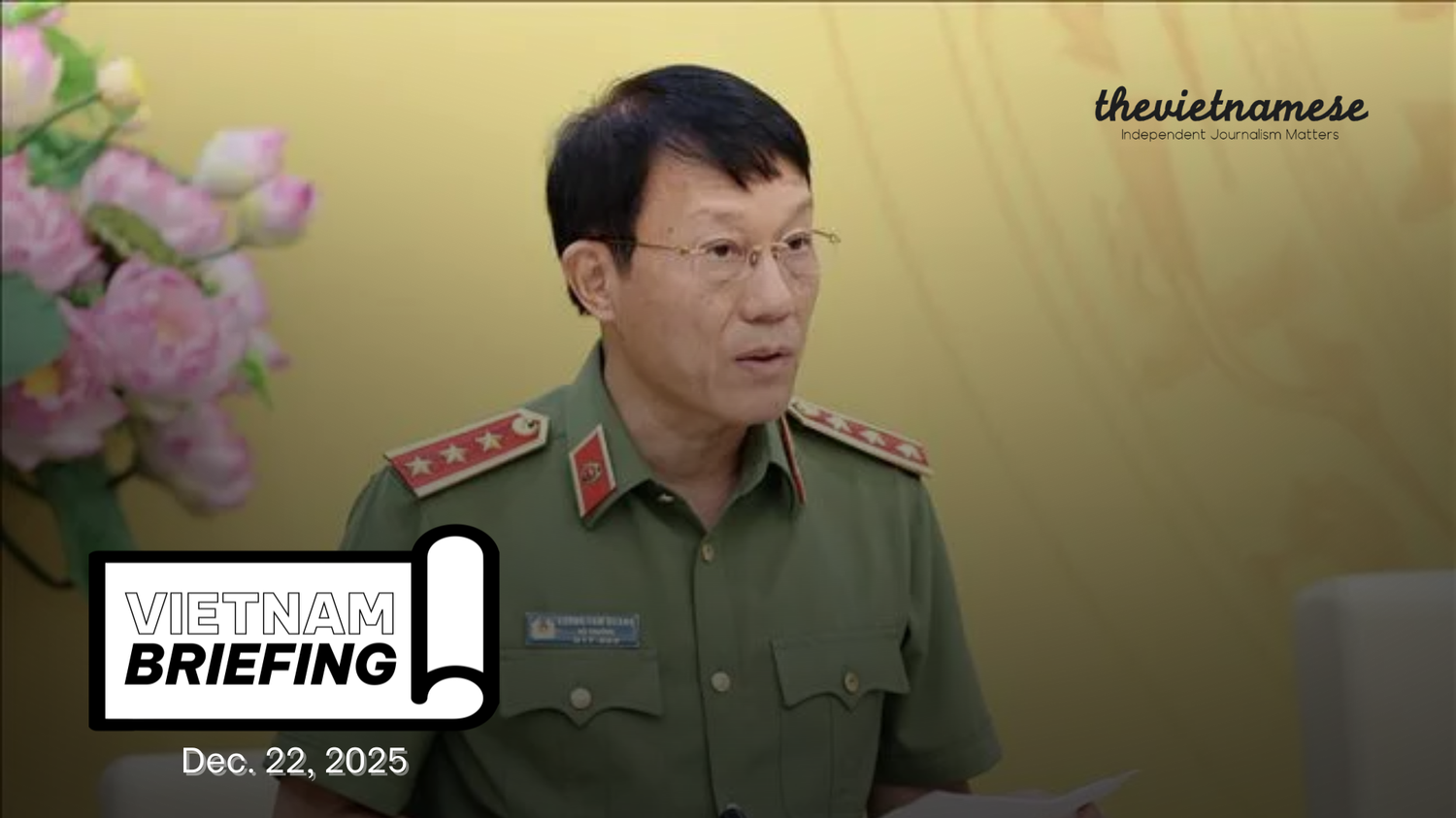
A draft government resolution on scoring and ranking citizens through the VNeID digital identification platform, proposed by the Ministry of Public Security (MPS), has been classified as an “urgent and important issue,” according to the explanatory memorandum released alongside the draft.
Rather than being introduced as a law—normally requiring passage by the National Assembly—the regulation is being proposed in the form of a government resolution.
In its explanatory memorandum, the MPS cites National Assembly Resolution 206/2025/QH15, which authorizes the government to issue its own resolutions to “address difficulties and obstacles arising from legal provisions while awaiting amendments or supplements to the law.”
The drafting body also invokes the 2025 Law on the Promulgation of Legal Normative Documents, arguing that the policy qualifies as an “urgent and important issue,” thereby justifying its adoption through a government resolution.
Another legal basis referenced is the 2025 Law on the Organization of the Government, which allows the government to implement “measures different from those stipulated in laws, ordinances, or resolutions” adopted by the National Assembly. The explanatory memorandum remains in draft form and is expected to be signed by Minister of Public Security Lương Tam Quang.
The draft resolution on citizen scoring and ranking was released for public consultation on Dec. 12, just one day after the National Assembly concluded its session on Dec. 11. During that session, lawmakers passed a record 51 laws, all under expedited procedures.
Government resolutions were formally introduced as a new category of legal normative documents under the 2025 Law on the Promulgation of Legal Normative Documents, which takes effect on July 1. Before that date, government resolutions functioned primarily as executive or administrative instruments, typically outlining action plans or guiding the implementation of existing laws.
The draft proposes a system for scoring and ranking citizens based on their level of participation and activity on the VNeID application.
Under the proposal, citizens would be classified into three tiers based on their “digital citizen score”: “Active,” “Basic,” and “Unrated.” Citizens in the “Active” category—those scoring 350 points or higher—would receive discounts ranging from 10% to 100% on taxes, fees, and administrative charges when completing procedures via VNeID. Those in the “Basic” category, with scores between 100 and 349, would receive only partial benefits, while citizens scoring below 100 would receive no incentives.
Beyond the scoring system, the Ministry of Public Security also signals its intention to transform VNeID into a nationwide “super app,” featuring functions such as a unified e-wallet and the provision of an official email address for every citizen.
Members of the public may submit comments on the draft via the Ministry of Public Security’s website until Dec. 31. The draft will then be revised before being submitted to the government for adoption.
Party Leadership Moves to Reassess the 2013 Constitution
The head of the Communist Party, Tô Lâm, has instructed the Party Committee of the National Assembly to conduct a comprehensive review of the implementation of the 2013 Constitution.
On the morning of Dec. 17, Communist Party General Secretary Tô Lâm chaired a meeting of the Central Steering Committee on institutional and legal reform. Prime Minister Phạm Minh Chính and National Assembly Chair Trần Thanh Mẫn attended the meeting.
At the meeting, Tô Lâm tasked the Party Committee of the National Assembly with adding a formal review of the implementation of the 2013 Constitution and proposing solutions to ensure constitutional alignment with the Communist Party’s major political reviews during the upcoming 14th Party Congress term.
These include a review marking 100 years of Communist Party leadership and a 40-year assessment of the 1991 Platform on National Construction during the Transition to Socialism.
At the same time, Tô Lâm called for the timely institutionalization of major viewpoints and policy directions outlined in the documents of the 14th Party Congress. He also urged the completion of laws and resolutions already passed at the National Assembly’s 10th session, the issuance of implementing guidelines, and the removal of legal bottlenecks and inconsistencies.
In May, Tô Lâm publicly left open the possibility of a “fundamental constitutional revision” in the next term. It remains unclear whether the newly ordered review of the 2013 Constitution is directly linked to that prospect.
Scholars and observers often describe Việt Nam’s National Assembly as a largely symbolic legislature within a one-party system. Between May and June 2025, the Assembly amended the Constitution at remarkable speed—within just 43 days—to serve a policy of streamlining the political apparatus. That process followed Conclusion No. 127, issued by the Communist Party’s Politburo on Feb. 28.
During its 10th session—lasting 40 days from Oct. 20 to Dec. 11—the National Assembly passed 51 laws and 39 resolutions aimed at translating Communist Party policies into state legislation. At least 50 of the 51 laws were adopted under expedited procedures, underscoring the pace at which the legislature has been mobilized to formalize Party directives.
Together, these developments suggest that the review of the 2013 Constitution is unfolding within a broader push to align Việt Nam’s legal framework more closely with the Communist Party’s long-term political agenda, as the country approaches a pivotal leadership transition.
ComCom Targets Fulbright University Over Praise of Writer Bảo Ninh
Continuing a wave of denunciations of writer Bảo Ninh and his novel Nỗi Buồn Chiến Tranh (The Sorrow of War), the popular Facebook page ComCom has recently criticized Fulbright University Vietnam for once describing Bảo Ninh as “Việt Nam’s most renowned writer.”
On the morning of Dec. 18, the Facebook page “Đơn vị Tác Chiến Điện Tử Comrade Commissar” — commonly known as ComCom — posted an image of Bảo Ninh posing with Fulbright University Vietnam students.
The image carried the caption: “Bảo Ninh appears at Fulbright University. Fulbright’s website published an article calling Bảo Ninh ‘Việt Nam’s most famous writer’”, overlaid with a red strike-through mark.
ComCom accompanied the post with a stark headline: “In the past, the Soviet Union collapsed in part because it loosened control over culture and education.”
By 4:30 p.m. on Dec. 18, the post had garnered roughly 2,500 interactions, including hundreds of comments echoing the page’s criticism and harshly attacking Fulbright University. According to a report by Luật Khoa Magazine, the photo in question was taken during a talk between Bảo Ninh and Fulbright students in May 2019.
The controversy follows an earlier backlash after The Sorrow of War was honored at an event organized by the Ministry of Culture, Sports, and Tourism. Several veterans publicly condemned the decision, accusing the novel of “distorting history.”
ComCom is a long-standing, influential Facebook page with approximately 478,000 followers. It is widely regarded as pro-regime and pro-military, frequently attacking voices perceived as critical of the Communist Party. The individuals or institutions behind the page remain unknown, though many Vietnamese social media users label it part of the Party’s so-called “public opinion force.”
This is not the first time Fulbright University Vietnam has come under coordinated attack.
On Aug. 21, 2024, Việt Nam’s Military Television aired a report titled “Do Not Let ‘Color Revolutions’ Recolor Education,” citing social media comments alleging that “color revolutions infiltrate countries through education.” Soon after, pro-regime online groups launched a campaign of insults, accusations, and even threats against Fulbright faculty and students, branding the university as a breeding ground for “color revolution” forces.
Fulbright University Vietnam responded by stating that these claims were “manipulative misinformation” aimed at spreading false narratives about the institution. Việt Nam’s Ministry of Foreign Affairs later expressed its hope that Fulbright would “continue making practical contributions to the growing friendly and cooperative relationship between Việt Nam and the United States.”
When Fulbright University was established in 2016, it faced intense controversy over the appointment of Bob Kerrey — a former U.S. senator and Vietnam War veteran — as chair of its Board of Trustees, prompting official comment from the Foreign Ministry at the time.
Bảo Ninh, whose real name is Hoàng Ấu Phương, was born in Nghệ An Province. He is the son of linguist Hoàng Tuệ, a former director of the Institute of Linguistics, and a veteran who fought in the Central Highlands. In 2017, Bảo Ninh appeared in a U.S. documentary describing the war against the United States as a “civil war,” a remark that sparked significant controversy within Việt Nam.
Party Chief Admits Internal Leaks Amid Leadership Rumors Ahead of 14th Party Congress
Amid a surge of social media rumors surrounding personnel arrangements for the 14th Party Congress, Communist Party chief Tô Lâm has publicly acknowledged that information has been leaked by individuals “from within the system.”
Speaking to voters in Hà Nội on the morning of Dec. 15, Tô Lâm—currently a National Assembly delegate representing the Hà Nội delegation—made the remarks during a voter meeting. Video footage of his comments was later published on the website of Vietnam Television, and appears to have aired during the 7:00 p.m. national evening news broadcast the same day.
Referring to the once-notorious blog “Quan Làm Báo,” which was widely believed to have leaked internal Communist Party information in 2012, Tô Lâm said that “now there are several new individuals like that, and recently they have had to be dealt with and disciplined.”
Lâm added that authorities have had to “take action even against individuals within the system who provide false information or supply information that sustains foreign-based actors.”
Addressing voters directly, Tô Lâm warned that people who follow such outlets are effectively “paying them money,” claiming these actors survive by spreading sensational and destabilizing rumors that sow public anxiety.
The former police general—who spent his entire career working within the security apparatus—did not specify who these alleged internal or foreign-linked actors are. Nor did he explain the basis for his assertion that accessing such information online amounts to financially supporting its sources.
Social media platforms and several news sites are currently rife with unverified rumors about top leadership arrangements for the next party term.
Tô Lâm himself is widely regarded as a leading contender to retain the post of general secretary. Born in 1957, he is 68 years old—three years beyond the Party’s age limit for re-election to the Politburo. He could only remain in office under a “special case” exemption, similar to that granted to late party chief Nguyễn Phú Trọng.
The timing of the decisive Central Committee plenum—Central Committee Meeting 15—remains unknown, though the opening of the 14th Party Congress has been set for January 19, 2026.
On the same morning, Minister of Public Security Lương Tam Quang issued similar remarks to Tô Lâm’s.
In an article published on the government’s electronic news portal, Quang stated that in 2025 the police had “intensified effective struggles” against key targets accused of spreading false information, including sources “from outside national borders and from deep within the system.”
The Ministry of Public Security has recently initiated criminal proceedings, issued arrest warrants, and scheduled trials for Dec. 31 against Lê Trung Khoa and Nguyễn Văn Đài, charging both under Article 117 of the Penal Code for allegedly disseminating anti-state materials.
Khoa, editor-in-chief of Thoibao.de based in Berlin, is accused of publishing “internal sources” describing factional disputes and purges within the Party.
Authorities have also charged Phạm Quang Thiện, a former director at the Government Information Portal, as an alleged accomplice. No independent source has confirmed whether Thiện was in fact a source for Khoa, nor whether he has been detained.
Việt Nam Opens Landmark Trial Over 20 Case-Fixing Schemes Involving Judges, Prosecutors, and Lawyers
On Dec. 15, the Hà Nội People’s Court opened a first-instance criminal trial involving 28 defendants charged with bribery, receiving bribes, and acting as intermediaries in bribery, stemming from misconduct linked to 20 separate case-fixing schemes across multiple provinces and cities.
This is being described as the largest judicial corruption scandal ever brought to trial in Việt Nam.
Among the defendants are 10 former judges and judicial officials; three prosecutors and prosecutorial staff; two civil judgment enforcement officers; four lawyers and law-office employees; and nine litigants involved in various cases. The underlying cases span criminal proceedings as well as civil, commercial, business, and inheritance disputes.
Prosecutors have sought prison sentences ranging from two to 10 years. The most severe penalty has been requested for Lê Phước Thạnh, former deputy head of the Administrative, Commercial, and Business Prosecution Department under the High-Level People’s Procuracy in Đà Nẵng.
The first-instance trial is scheduled to last 10 days, from Dec. 15 to Dec. 26. According to the indictment, the defendants shared a common objective: securing favorable outcomes in their cases. To that end, they allegedly bribed judges and prosecutors directly or indirectly through lawyers acting as intermediaries.
The violations were found to have taken place over an extended period—from March 2022 until May 2024—before being uncovered. The total value of seized evidence and illicit payments in the case exceeds 11 billion đồng (approximately $418,000).
Prosecutors allege that not all of the 20 attempts at case-fixing were straightforward or successful. In many instances, defendants encountered intermediaries who lacked sufficient authority to influence proceedings.
As a result, they were compelled to increase both the amount of money offered and the number of intermediaries involved. In rare cases, up to five separate intermediaries were allegedly required for a single case-fixing effort to succeed.
In 16 of the 20 prosecuted cases, prosecutors say the bribe-givers, intermediaries, and recipients transferred money to one another via electronic banking. Individual transfers reportedly ranged from several hundred million to several billion đồng.
The case has drawn particular attention for exposing how deeply entrenched corruption has become within Vietnam’s judicial system, implicating actors across courts, procuracies, legal services, and enforcement bodies.
Observers say the trial could test the government’s stated commitment to judicial integrity, while also raising broader questions about accountability, transparency, and the independence of the legal system itself.
Quick Takes:
Man Fined for Facebook Comment Criticizing Traffic Police Amid Security Crackdown
On Dec. 17, police in Kim Liên Commune, Nghệ An Province, imposed an administrative fine of 7.5 million đồng on a resident for posting a Facebook comment deemed insulting to traffic police.
State-run newspaper Công an Nhân dân (The People’s Police) reported that on Dec.10, a man identified as P.V.C. commented on a post about a driving test organized by Nghệ An’s traffic police, allegedly harming the reputation of the police force. Authorities did not disclose the content of the comment. The penalty was issued under Decree 15/2020.
The case comes amid a nationwide security campaign ahead of the 14th Party Congress and elections. Vietnam’s online expression remains tightly controlled, with Freedom House rating the country “Not Free” on internet freedom (22/100).
Zero Women Left as Provincial Party Chiefs After Administrative Shake-Up
Before the merger of provinces and cities, women accounted for 11.11% of provincial party secretaries; after the merger, this figure fell to 8.82%. It has now dropped to zero.
On the morning of Dec. 16, VnExpress updated profiles of current party secretaries and chairpersons across 34 provinces and cities. None are women. The only female party secretary previously in office was Bùi Thị Minh Hoài, former Hà Nội party chief, who was reassigned on Nov. 4, 2025.
After the National Assembly approved the merger of 63 provinces into 34, effective July 1, three women were appointed as party secretaries—none remain in those roles today. No provincial chairpersons are women. Women remain largely absent from Vietnam’s political leadership. Only 9.5% of the Communist Party’s 13th Central Committee members are women. Research by Oxfam also shows a persistent preference for male leaders in Vietnam.
Việt Nam Opens Candidate Registration as Election Coverage Stays Muted
Việt Nam has opened candidate registration for the upcoming National Assembly election, requiring applicants to submit initial forms online via the National Election Council before filing full nomination dossiers.
According to observations by Luật Khoa Magazine, as of 3 p.m. on Dec. 15, state media appeared to give low priority to election-related news. Major outlets, including Tuổi Trẻ, VnExpress, VTV, and VOV, carried little to no prominent coverage, and the Government Information Facebook page posted nothing on the process.
Under Resolution 41/NQ-HĐBCQG, candidates must complete online applications and submit full dossiers by Feb. 1, 2026. The 16th National Assembly election is scheduled for March 15, 2026, in a tightly controlled one-party political system.
Việt Nam Confirms Naval Transit Through Taiwan Strait, Citing Freedom of Navigation
On Dec. 11, Việt Nam’s Foreign Ministry spokesperson Phạm Thu Hằng confirmed that Vietnamese naval vessels transited the Taiwan Strait this year, according to Taiwan’s CNA.
Responding to CNA, Hằng said Việt Nam exercised its right to freedom of navigation under the UNCLOS, noting that passage through the strait is permitted by international law. Taiwan’s National Security Bureau director Tsai Ming-yen earlier said warships from eight countries—including Vietnam—made 12 transits in 2025.
As of Dec. 19, no domestic media coverage was observed. Analysts in Taiwan say the move signals Hanoi’s strategic recalibration amid U.S.–China rivalry. Chinese scholars criticized the transit as provocative.