
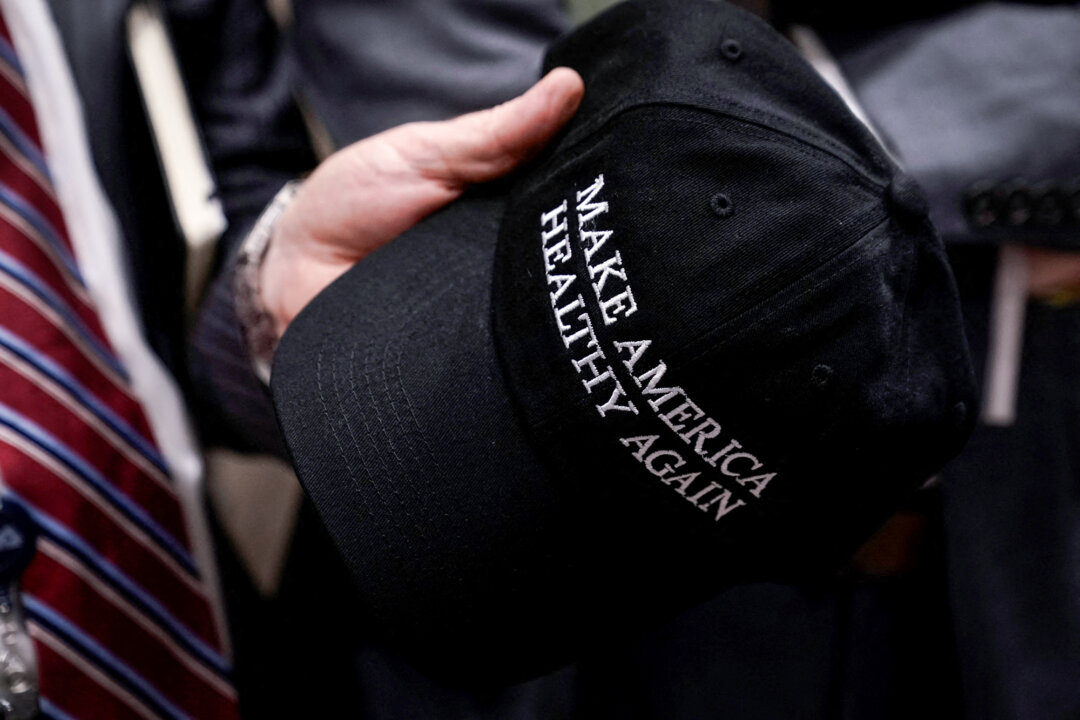
Ohio Republican Kathleen Wilson and Georgia Democrat Katie Wiggs are among many Americans who want unhealthy additives removed from food.
But the two voters expressed divergent views when asked about the Make America Healthy Again (MAHA) movement—a multipronged effort “to reform America’s food, health, and scientific systems,” the Department of Health and Human Services (HHS) website states.
Wilson and Wiggs, who spoke to The Epoch Times at October political events in their respective states, said issues such as immigration and the economy outranked the MAHA agenda as they considered how to vote in the midterms.
Their responses highlight the challenge MAHA-promoting candidates and other MAHA advocates face as they look to woo voters in this hard-to-define voting bloc.
This election season, a leading advocacy group, MAHA Action, has endorsed 24 candidates—all Republicans except Rep. Kevin Kiley (I-Calif.), who left the GOP in March.
MAHA derives its name from President Donald Trump’s “Make America Great Again” (MAGA) slogan, his staple since he launched his first presidential run in 2015.
At an Oct. 23 get-out-the-vote rally in Fort Myers, Florida, the president touted one of his MAHA-related initiatives—reducing prescription drug prices—and said, “That alone should give us a win in the midterms.”
MAHA candidates all face the challenge of translating MAHA motivations into votes.
During the past few weeks, Trump and Vice President JD Vance have barnstormed at least 17 states, seeking to retain slim Republican majorities in both chambers of Congress.
Republicans face headwinds from voters disgruntled over high prices, including gasoline costs that many people blame on the war against Iran.
About 65 percent of respondents said they disapprove of how Trump is handling U.S. military action in Iran, the Pew Research Center reported in early October. In addition, 73 percent of people polled said they were “extremely concerned” or “very concerned” about higher gasoline and fuel prices.
The administration also faces opposition from some MAHA advocates. Some say they expected to see more successes by now. Others have accused the Trump administration of actions that contradict MAHA principles.

Stakes High, Path Unclear
Losing either chamber of Congress in the midterms to Democratic control would likely stall many aspects of Trump’s agenda, including MAHA initiatives.
This election season, some MAHA-endorsed candidates made health-related issues major planks in their campaign platforms. All face the challenge of translating MAHA motivations into votes.
The outlook is blurry because some people don’t even know what MAHA is, based on The Epoch Times’ interviews with voters across several states, and polls indicate that parts of MAHA’s agenda are more popular among Americans than the movement itself.
At the same time, signs of discontent have emerged within MAHA’s ranks. A “MAHA Promises Scorecard” criticizes the Trump administration’s record on food safety, pesticides, agriculture, and environmental health.
“Tensions between MAHA and the administration have steadily risen. … This could cause significant issues for Republicans, who see MAHA as a key electoral constituency,” an Oct. 8 statement reads.
The outlook is blurry: Some people don’t even know what MAHA is, and parts of its agenda are more popular than the movement itself.
Dr. Irene Mavrakakis, who is heavily involved in the MAHA movement, asserted that the conflicts are overblown and that legal and political hurdles still must be overcome to make more progress.

Mavrakakis, a board-certified interventional pain specialist in Delaware, sees meaningful changes happening under the leadership of Trump and Robert F. Kennedy Jr.
Before Kennedy became the Republican president’s health secretary, he broke ranks with his storied family pedigree in the Democratic Party by switching his party affiliation to independent during his 2024 run against Trump and others.
Stronger? Or Fractured?
Now Kennedy faces opposition from people who were once in his corner.
Former Kennedy campaign adviser Tiffany Cianci released the MAHA Promises Scorecard, whose website calls her “a leading critic of the Trump administration’s food, agriculture, and environmental health policies.”
After two years of revolving-door appointments, lobbyist influence, and roadblocks to meaningful reform, this Scorecard is me keeping my end of that bargain.
Tiffany Cianci, author, MAHA Scorecard
The scorecard states that the Trump administration partially kept its promise on five items and broke 37 out of 42 total promises tracked.
The Epoch Times contacted the HHS for comment but received no response.
“I believed deeply in the promise that MAHA represented, particularly the possibility of confronting chronic disease and building a healthier future for America’s children,” Cianci said in a statement. “After two years of revolving-door appointments, lobbyist influence, and roadblocks to meaningful reform, this Scorecard is me keeping my end of that bargain.”
However, Mavrakakis told The Epoch Times: “Those of us who have been in the movement know that Secretary Kennedy knows what to do and what is wrong. The movement is not splintering.
“The movement is growing stronger.”

The trend toward supporting a healthier America started long before the MAHA movement.
“It is really about the American people demanding that basic aspects of our lives are healthy,” Mavrakakis said, “and that we have the freedom to know what is in our food, water, and air.”
The movement also calls for Americans to be free to make their own health-related choices.
Independent Iowa voter Mike Sassman wants to see progress toward MAHA’s objectives continue.
“[Heading into the 2028 presidential contest,] we’re going to need a good, strong replacement for Trump that can keep these things going, or we’re going to go right back into the hole that we were in,” he said.
Sassman spoke to The Epoch Times while attending a campaign event for Zach Lahn, whom MAHA Action has endorsed for Iowa governor.
Health Issues Stoke Iowa Race
For Iowa voters like Sassman, MAHA issues rose to the forefront this campaign season.
The Hawkeye State, which has long prided itself as a top agricultural producer, also holds an unwelcome distinction: home of the nation’s second-highest rate of new cancer diagnoses, behind Kentucky.
That’s according to national data that the University of Iowa further explored with a report identifying factors that could be fueling rates of five common cancers. Demographic and behavioral factors accounted for 76 percent of cases of the five common cancers in the state.
Lahn and his Democratic opponent, State Auditor Rob Sand, have sparred over ways to address the cancer rate and tamp down potential causes, including agricultural chemicals that end up in Iowans’ water supplies.

During an Oct. 6 debate with Sand, Lahn said, “This is the crisis of our generation.”
The two candidates are also at odds over vaccination, which has arguably emerged as the most polarizing MAHA issue, several recent polls have shown.
An October poll from the University of Minnesota’s Center for Infectious Disease Research and Policy showed an almost even split among MAHA supporters over reducing the number of childhood vaccines. An October KFF poll shows MAHA supporters differing widely regarding changes to the childhood vaccine schedule; although almost 60 percent of non-MAHA adults agreed that it would have a negative impact.
Sand has said that he wants to keep school vaccine requirements unchanged, the Des Moines Register reported.
In contrast, Lahn said he opposes vaccine mandates overall.
Sassman, the independent voter, didn’t clarify how he feels about all vaccines, but he saw it as “ridiculous” that people lost jobs because they didn’t get COVID-19 vaccines.
He expressed “zero faith in the pharmaceutical companies,” saying that they’re “in it for profit” and therefore might be against changes that would improve Americans’ health.
“If we are truly healed and healthy, they have no business to operate on,” Sassman said.
Health insurance tends not to cover natural supplements, so people must pay for those out of pocket. Sassman sees this as more evidence of a “corrupt” system that needs fixing.

Agreement on Food, Disagreement on Vaccines
Sassman shared Wilson’s and Wiggs’s concerns about returning to a more natural food supply.
“We’ve got these large monopolies that are genetically modifying the plants that we grow,” he said. “We have to control our food sources.”
Wilson said the nation’s obesity rate is “over the top,” saying she would listen to any candidate who promotes reducing Americans’ reliance on processed foods.
Wiggs said that she supports “healthier, cleaner, safer” food, without dyes and other chemicals.
At the same time, she is in favor of vaccines because they “keep us healthy.” Wiggs opposes the “anti-vaccine” stance she associates with MAHA.
Large monopolies … are genetically modifying the plants that we grow. We have to control our food sources.
Mike Sassman, MAHA supporter
But many leading MAHA advocates, including Kennedy, say that description does not accurately reflect their position.
Kennedy has described his vaccine stance as “pro-safety” and not anti-vaccine. He and MAHA Action emphasize medical freedom—allowing patients to decide on vaccines instead of imposing government mandates.
Many people misperceive that the COVID-19 pandemic launched the MAHA movement, Mavrakakis said.
The pandemic did “wake many people up” and caused them to join MAHA’s cause, she said, noting that MAHA-type advocacy predates that era for many people, including her.

Mavrakakis, who says a vaccine injured her in 2012, founded the Vaccine Injury Treatment Center of Excellence and Research Clinical Trial Association.
Division within MAHA can occur when those new to the movement believe that COVID-related issues are the only ones of concern, she said.
Pushing for ‘More Freedom’
MAHA is “about telling the truth” and focusing on measures that promote physical and mental well-being, Mavrakakis said.
The answer for Americans is more freedom … as well as a government that is transparent and no longer captured by the industrial complexes.
Dr. Irene Mavrakakis, MAHA supporter
Advocates want to reduce or remove chemicals and contaminants found in America’s food and water supply, soil, consumable products, and the overall environment. They are also seeking changes in governmental influence and curricula taught to medical professionals.
“The answer for Americans is more freedom … as well as a government that is transparent and no longer captured by the industrial complexes,” Mavrakakis said.
As far as the movement’s presence in the two most prominent U.S. political parties, MAHA has found a place in the Republican Party, she said, asserting that “Democrats are not allies of MAHA.”
Only 8 percent of Democrats and Democratic-leaning independents said they were MAHA supporters, according to Annenberg Public Policy Center. In contrast, 51 percent of GOP-identifying or -leaning respondents said they support MAHA.
Many people who say they don’t support the movement nonetheless share its concerns about additives, chemicals, and highly processed foods.
Laura Gibson, senior data analyst, Annenberg Public Policy Center
“[The same report found] favorability is high for all six of the MAHA agenda issues about regulating chemicals and additives in foods and processed foods,” Annenberg reported.
On average, 73 percent of all respondents favor these issues.

Policies about vaccines are far less popular than the food-related ones, Annenberg noted.
“Even among MAHA supporters, most get barely a majority in favorability,” it stated.
53
PERCENT –
of MAHA supporters favor reducing the number of recommended childhood vaccines.
While 53 percent of MAHA supporters favor reducing the number of recommended childhood vaccines, only 7 percent of non-MAHA supporters support that concept. Ending vaccine mandates in schools was even less popular, with only 35 percent of MAHA followers supporting that idea.
“The findings suggest that it’s important to distinguish support for MAHA from support for specific MAHA policies,” Laura Gibson, an Annenberg research analyst, said in a statement. “Many people who say they don’t support the movement nonetheless share its concerns about additives, chemicals, and highly processed foods.”
Republican or Democrat?
When it comes to policymakers, “MAHA has a seat at the table with Republicans, and they are the lesser of two duopoly evils,” said Mavrakakis, who serves on the national board of the Republican Liberty Caucus, a grassroots organization that promotes “individual rights, limited government and free markets” within the GOP.
“Republicans are not perfect, and we have a lot of work to do, but they have given MAHA a seat at the table,” she said.

A few Democrats point out that they, like Mavrakakis, have pursued healthier policies for Americans for many years.
Among them is Rep. Chellie Pingree (D-Maine).
People advocating for healthy-living issues have a tough time making gains, she said, “whether it’s the Democratic side or Republican side.”
Republicans are not perfect, and we have a lot of work to do, but they have given MAHA a seat at the table.
Dr. Irene Mavrakakis, MAHA supporter
“Sometimes, it’s just that nobody sort of cares about this, or we’re up against huge lobbying entities that we can never beat,” Pingree said on a podcast by the Environmental Working Group, a private advocacy organization.
Pingree, who has questioned the Trump administration’s sincerity in pursuing MAHA-type goals, said that “in some ways, you could say the jury’s still out.”
Jacki Thrapp, Troy Myers, and Nathan Worcester contributed to this report.

We had a problem loading this article. Please enable javascript or use a different browser. If the issue persists, please visit our help center.