
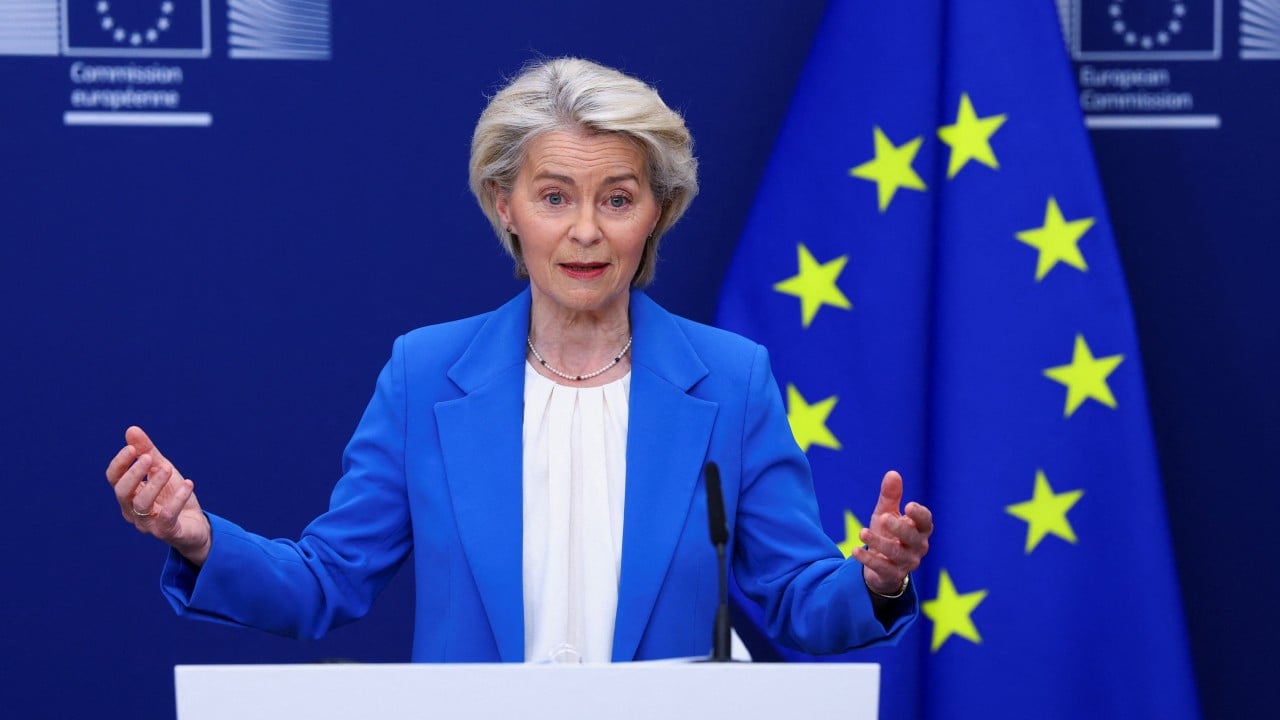
Amid the trade war with the United States, the last thing China needs is an economic confrontation with the European Union – Beijing’s major export destination. But with the EU seemingly determined to protect its market by introducing measures that many see as controversial, an economic stand-off appears inevitable.
When European Commission President Ursula von der Leyen blamed China last June for showing an “unwillingness to live within the constraints of the rules-based international system”, it was a clear indication that the 27-nation bloc was dissatisfied with relations with Beijing. In 2024, the EU imposed tariffs of up to 35.3 per cent on Chinese electric vehicles (EVs), citing unfair state subsidies that allow China to position itself as a key player in the European car market.
Although Brussels and Beijing agreed in January to take steps towards resolving their dispute, things have not returned to normal. The European Commission is pushing a “Made in Europe” law – formally known as the Industrial Accelerator Act – designed to bolster local industries against competition from China. The legislation also aims to strengthen the EU’s industrial base in response to rising global economic rivalry and a growing reliance on non-EU suppliers in key sectors.
Advertisement
China, however, sees Brussels’ initiative as institutional discrimination. It has urged the EU to remove what it sees as discriminatory requirements against foreign investors, local content requirements, mandatory intellectual property and technology transfer requirements, and public procurement restrictions from the legislation.
From a Chinese perspective, the EU’s move can certainly be regarded as discrimination. But non-EU European countries may also have grounds to view it as unfair treatment.
Advertisement
French liberal Christophe Grudler, a member of the European Parliament, will lead negotiations on the Made in Europe law. He argues that it should include closely integrated countries such as Iceland, Liechtenstein, Norway and Switzerland. But what about the Balkan nations that have spent decades in the EU’s “eternal waiting room”, hoping to join the bloc? And why does Made in Europe not include countries such as Ukraine, Moldova or Belarus?

09:10
Can the Middle East war turbocharge China’s global EV ambitions?
Can the Middle East war turbocharge China’s global EV ambitions?