
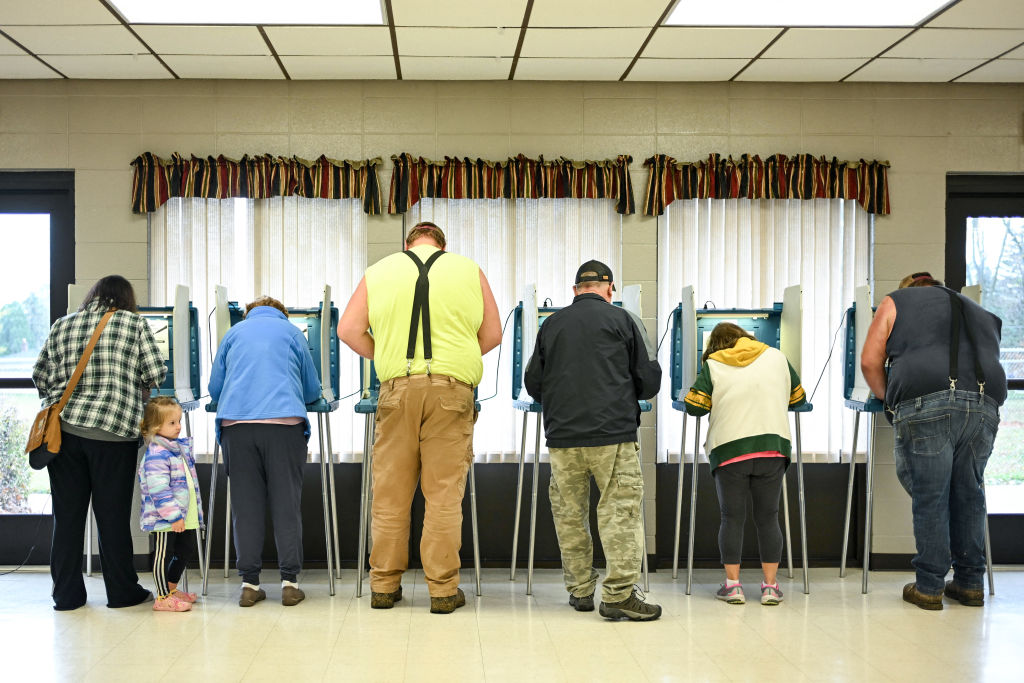
A handful of key voter blocs determined the outcome of the 2024 presidential election, propelling President Donald Trump to a sweep of the swing states and a popular vote win: Generation Z, independent, and Hispanic voters.
Now, polls show these blocs are swinging against the president and Republicans.
“The president’s standing has declined with virtually every demographic across the board, it’s just a question of how far he’s fallen,” Inside Elections editor and publisher Nathan Gonzales told The Epoch Times in an Oct. 21 email.
According to RealClearPolitics, just 38.8 percent of Americans approve of Trump across an average of polls. An Oct. 12 poll by Fox News placed approval for Trump at just 36 percent, a record-breaking low in Fox News’ polls.
Those numbers are translating over to congressional races, as Democrats are projected to reclaim control of the House while the Senate remains contested, with warning signs that Republicans are losing ground.
In polls, Americans’ top concern is the economy, and by a wide margin. According to Emerson College’s September survey, 41 percent of voters say the economy is their top concern, while 16.7 percent of voters cite threats to democracy, making it the second-highest concern.
Analysis of polling data by The Epoch Times shows that key demographics that determined the 2024 election have shifted toward Democrats.
Breaking of the Fellowship
Gonzales said that this year, though Republicans hope to rebuild the 2024 coalition, “Trump is in a fundamentally different—and weaker—political position than he was just two years ago.”
“President Trump tells people to pretend like he’s on the ballot this fall, but if he actually was on the ballot, he would lose. And it wouldn’t be close. This ain’t 2024,” he said.
The data suggest as much. Across those three core groups, support for Trump and the GOP has declined steeply.
Political science professor Marty Cohen of James Madison University said in an Oct. 22 phone interview with The Epoch Times that any one of these groups could shift the balance of power this cycle.
“Every group has the potential to be pivotal when the margins are so slim,” Cohen said, predicting “a national swing toward the Democrats that will sort of … transcend demographic boundaries. Although each group will have its own reasons.”

Gen Z Looks Left
Polls—and the observations of America’s youngest voters—indicate that Generation Z voters are becoming more favorable to Democrats than they were in 2024.
According to Emerson College’s September poll, only 19.5 percent of Gen Z voters approve of Trump today—a roughly 23.5 percentage point drop in his support from the group in 2024.
“I’ve seen a lot more people turning Democrat,” said Cruz, an 18-year-old first-time voter in Des Moines, Iowa, who didn’t provide his last name.
Cruz said he cast a ballot for Democrats.
Asked why he thought this shift was happening, Cruz cited a mix of state issues and, on a broader level, “the blatant misconduct from our government that has really shifted people’s opinion.”
He also said Gen Z voters were unhappy about “the way [Republicans] have been targeting certain groups of people.”
Shawn Donahue, a political science professor at University at Buffalo (SUNY), told The Epoch Times that young voters—particularly young men motivated by podcasters such as Joe Rogan and opposition to “Woke 1.0”—had been instrumental to Trump’s 2024 victory.
“They went to Trump, but we’ve seen that some of those gains, most of those gains, seemed like they’re being wiped out, and then even more,” Donahue said.
Isaac, a Democratic college student at Iowa State University in Des Moines, also declined to provide his last name. He said people often vote “the way of their parents” but acknowledged that some of that seems to be changing.
“In my experience, I just found that my peers, based on how they grew up, their opinions on politics are formed from their parents. … I think it has been changing over time. Recently, more Democrat, but there’s still—in Iowa, at least—a strong conservative amount of people.”
In 2024, 54 percent of 18- to 29-year-old voters—mostly Generation Z and some younger millennials—backed Harris, compared with 43 percent who backed Trump. Still, such a high minority share was unusual for the youngest age bracket, which had backed him by 36 percent in both 2016 and 2020.
Hispanic Support Dips to 2016 Levels
There are signs that Hispanic Americans are pulling back on their support for Republicans this year.
“What we have seen is that his approval rating among Latinos has just cratered,” Donahue said.
He argued that these voters can be described as “maybe not going towards Democrats, but going more against Trump and Republicans”—meaning, ultimately, that more Hispanic Americans will be voting Democratic this year.
The Trump administration’s sweeping immigration enforcement efforts have had noticeable effects in many of these voters’ communities.
“I think the enforcement of immigration laws and the draconian measures that have been taken and the violence that has accompanied [immigration enforcement] activities certainly will, I think, boomerang against the Republicans among this group,” Cohen said.

In 2024, 46 percent of Hispanic voters backed Trump, compared with 51 percent who backed Harris.
“Trump [did] really, really well for a Republican among Latino voters in 2024,” Donahue said.
In 2016, Trump had won just around 30 percent of the Hispanic vote. Now, approval for Trump has dipped to similar levels among Latinos.
According to Emerson College, 30.9 percent of these voters approve of the administration.
Only 1 in 4 Independents Back Trump
Independents are always a critical bloc, and in 2024, Trump locked down their vote with a promise to improve the economy and close the border.
In 2024, 46 percent of them backed Trump, against 49 percent who broke for Harris. Now, only around one in four of these swing voters approve of the president’s job performance.
“The independents … tend to decide elections, especially when elections are this close. And independents are probably of all of the groups most susceptible to conditions, economic conditions, and the current climate,” Cohen said. “They don’t have the background of being a solid partisan, and so they’re most likely to go back and forth when the incumbent party is blamed.”
According to Emerson College, only 28.5 percent of independents approve of Trump, while 67.4 percent disapprove. On the generic congressional ballot, only 30.9 percent of independent voters favor Republicans, while 59.9 percent favor Democrats.

Independent voters in Ohio who were backing Democrats mentioned the Iran war—and its effects on gas prices—as a key point of contention with the administration.
“There’s no reason for gas prices to be this high, except for a reckless and ill-considered war that Trump has started, which has no end, and the problem is that there’s no one in Congress that will stand up to him on his own side,” said Ellen Brown, an independent voter who resides in a Cleveland suburb.
According to the most recent report by the Bureau of Labor Statistics, the price of gasoline rose 9.1 percent in September—a consequence of the Iran conflict.
Brown, who works with the leadership team for Mobilize the Vote for Northeast Ohio, is worried that it’s just going to lead to higher prices in other domains.
“With diesel prices the way they are, everything is going to get hit, and companies are going to raise their prices even more and jack up their profits,” she said.
Independent voter Dan Shadrake, an IT consultant in Cleveland, also mentioned the Iran conflict in an interview with The Epoch Times.
“We’re six months into this battle, and there’s no plan discernible as far as what the end game is in Iran. If anything, it’s made matters worse in the Middle East rather than better,” said Shadrake, a veteran of the U.S. Navy who said he served during the Vietnam era but didn’t go to Vietnam.
We had a problem loading this article. Please enable javascript or use a different browser. If the issue persists, please visit our help center.