
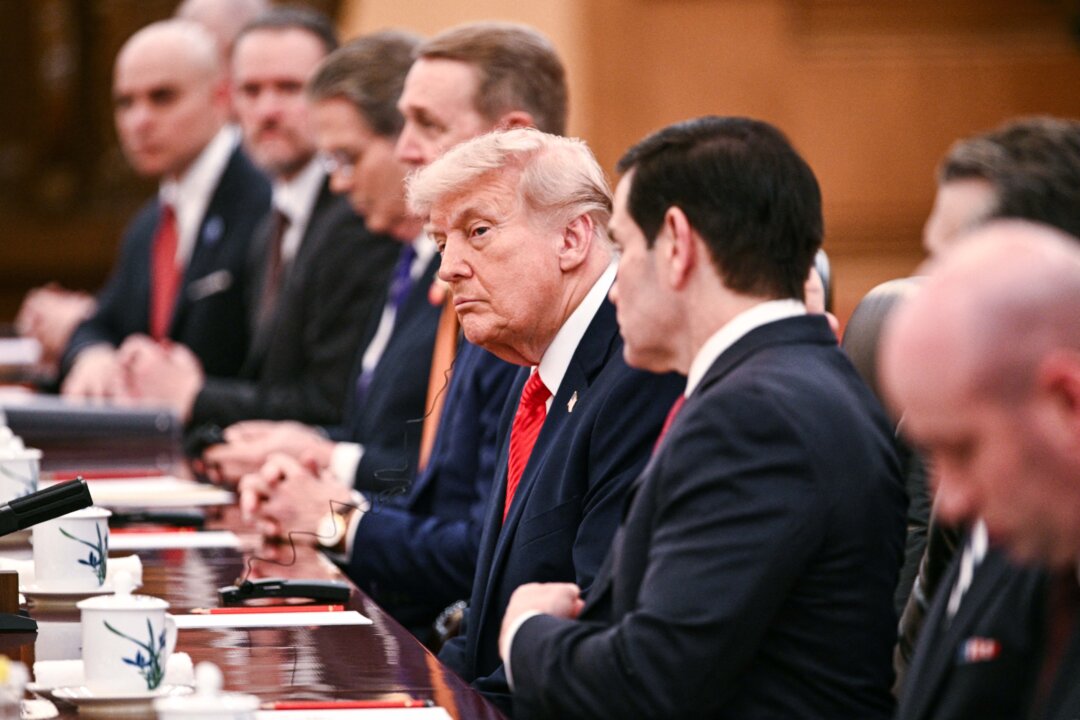
House China Committee Chairman John Moolenaar (R-Mich.) is urging President Donald Trump to resist concessions to Beijing at next week’s summit with China’s Xi Jinping.
In a Sept. 18 letter to the president, Moolenaar said the meeting should be used to “reassert and vigorously defend critical American interests,” with the expectation that China will “continue acting as an increasingly hardened adversary.”
The congressman urged Trump to press Xi on a range of issues, including China’s ties to Iran, U.S. arms sales to Taiwan, and Chinese automakers seeking access to the American market.
“As we know all too well, the [Chinese Communist Party] does not honor its commitments, and deals with the [People’s Republic of China] are only as good as our will to enforce them,” Moolenaar wrote.
Trump and Xi are scheduled to meet in Washington on Sept. 24, their second face-to-face meeting this year.
China Enabling Iran
Moolenaar noted reports alleging that Chinese entities provided Iran with satellite imagery of U.S. military bases in Jordan before a July missile strike that killed three U.S. service members. China’s Foreign Ministry has denied such accusations.
Asked about the report last week and whether he intended to raise the issue with Xi, Trump did not commit to doing so, instead saying that China and the United States conduct espionage against each other.
Moolenaar urged Trump to “make it crystal clear” to the Chinese Communist Party that providing lethal assistance that enables attacks on U.S. forces would be treated as a major escalation and met with “the most severe consequences.”
“The United States does not help third parties kill Chinese soldiers, and we should expect the CCP to continue this murderous treachery unless consequences are imposed,” Moolenaar wrote.
Taiwan Arms Sales
Taiwan was another major focus of the letter.
A proposed U.S. arms package for Taiwan worth as much as $14 billion has been awaiting Trump’s approval for months. After meeting Xi in Beijing in May, the U.S. president said the package was being held “in abeyance” and later described it as a “very good negotiating chip.”
Moolenaar urged Trump to reject Chinese objections to U.S. weapons sales and security cooperation with Taiwan and other American partners in the region.
“The CCP understands that its unprecedented buildup of nuclear and conventional forces and its escalating hostility towards its neighbors are the true causes of regional instability—not the longstanding practice of U.S. arms sales,” he wrote.
Chinese Automakers
Moolenaar also warned against allowing Chinese automakers to gain access to the U.S. market by establishing domestic assembly plants.
His warning follows Trump’s comments that he would be open to Chinese automakers building vehicles in the United States if they employed American workers.
“If China wanted to come in and open a plant to build their cars here, I’d be okay with that,” Trump told Fox News last week. He said he remained opposed to Chinese companies making cars in Mexico and selling them into the United States.
Moolenaar argued that allowing heavily state-subsidized Chinese automakers to establish U.S. factories could allow them to circumvent existing restrictions meant to protect the domestic auto industry.
“Any such projects should be subject to the highest scrutiny, and their negotiating value should be heavily discounted given their [China’s] longstanding refusal to honor its agreements,” he wrote.
Moolenaar also called for tighter restrictions on China’s access to advanced U.S. artificial intelligence technology, including cloud computing resources and semiconductor manufacturing equipment.
Moolenaar also urged the administration to continue pressing Beijing over the detention of Americans in China, which he described as “hostage diplomacy.”
The Sept. 24 summit comes at a critical point in relations between the world’s two largest economies. China’s suspension of expanded rare-earth export controls and the broader U.S.–China tariff truce are both set to expire on Nov. 10.
Treasury Secretary Scott Bessent and Chinese Vice Premier He Lifeng are holding talks ahead of the leaders’ meeting, with AI, trade, and critical minerals among the issues on their agenda.
We had a problem loading this article. Please enable javascript or use a different browser. If the issue persists, please visit our help center.