
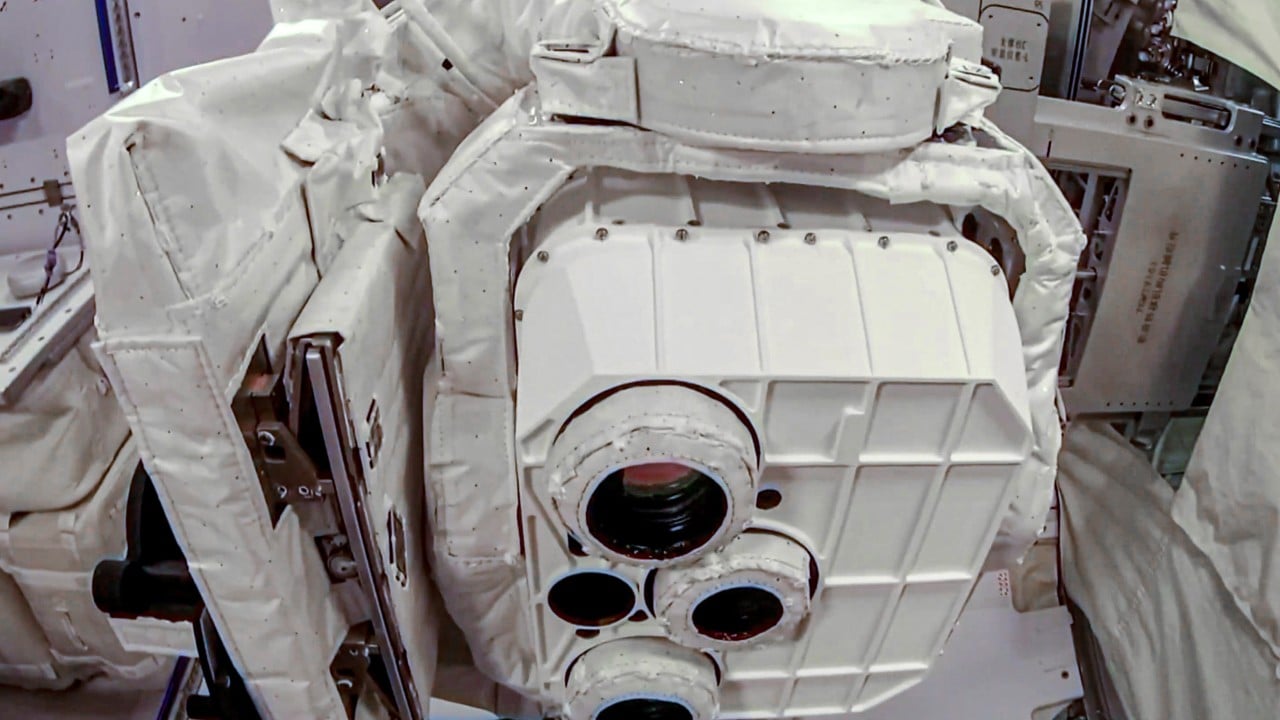
A greenhouse gas monitoring instrument developed by a university in Hong Kong is operating successfully aboard the Tiangong space station and is expected to contribute to sustainable development, the city’s technology minister has said.
Secretary for Innovation, Technology and Industry Sun Dong also revealed more details in a blog post on Saturday about the life of the city’s first astronaut, Lai Ka-ying, who he said had a busy schedule at the space station.
The Multi‑Spectral Imaging Carbon Observatory (Musico), developed by a team led by scientists at the Hong Kong University of Science and Technology and funded by the city government, has been deployed to China’s space station.
“Musico is equipped with four sensors for detecting carbon dioxide, methane, oxygen, and aerosols. They have all successfully captured images with clear imaging quality and demonstrated good overall performance,” he said.
“Over the next two years or more, the instrument will provide autonomous, controllable, and highly accurate greenhouse gas (carbon dioxide and methane) emission monitoring data, contributing to efforts to address climate change and promote global sustainable development.”
Musico is considered the world’s first lightweight, high-resolution, high-precision synergistic observatory for carbon dioxide and methane.