
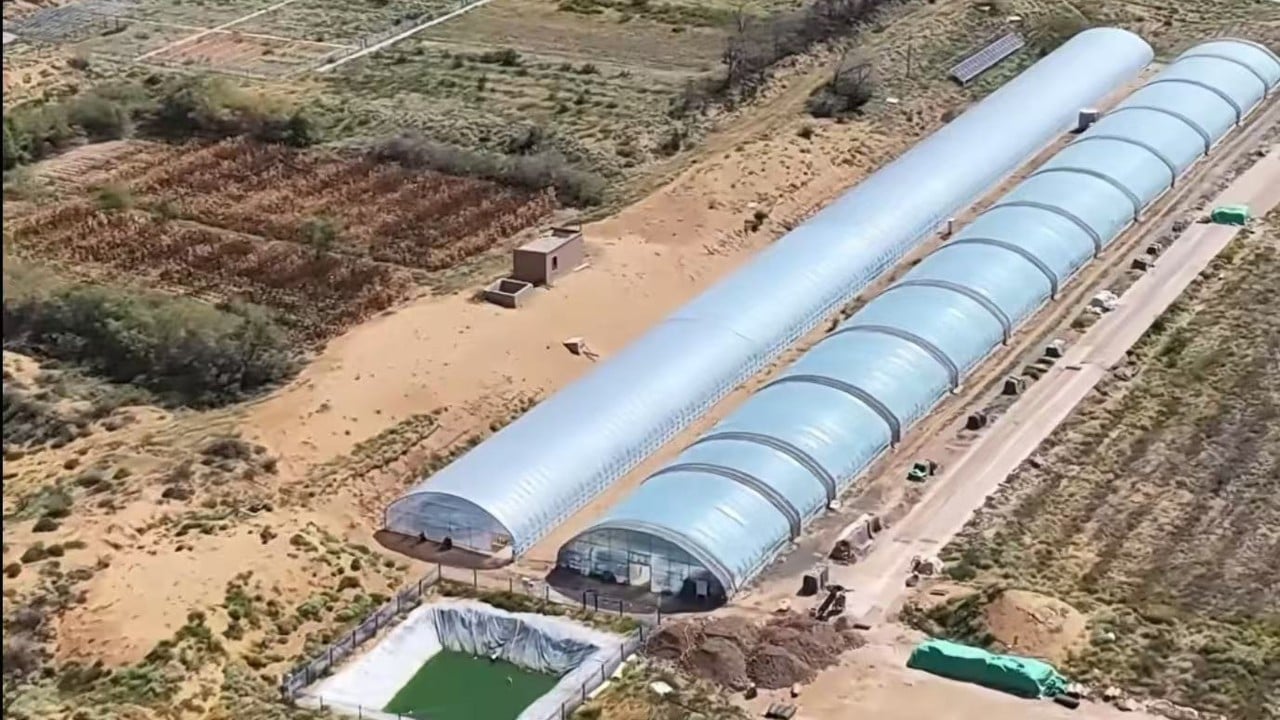
Deserts are hard to reclaim because plants cannot survive on shifting sand, but scientists in northwest China are changing that – by dropping vast amounts of blue-green algae onto the dry terrain.
These specially selected strains of cyanobacteria can survive extreme heat and drought for long periods, according to China Science Daily on Thursday. When rain finally comes, they spring to life, spreading rapidly and forming a tough, biomass-rich crust over the sand. This living layer stabilises the dunes and creates the perfect foundation for future plant growth.
This is the first time in human history that microbes are being used on a massive scale to reshape natural landscapes. As the “Great Green Wall” – China’s massive multi-decade initiative to plant trees and fight desertification – expands to include efforts in Africa and Mongolia, the unprecedented geoengineering technology could one day transform the face of our planet.
Advertisement
This artificial “crusting” technique was developed by scientists at a research station in Ningxia Hui autonomous region, located in northwest China on the edge of the Tengger Desert, according to China Science Daily.
Ningxia has adopted the technique as part of its sand control strategy under the Great Green Wall. The technique is expected to be used on a massive scale to treat around 5,333-6,667 hectares (13,178-16,475 acres) of desert over the next five years.
Advertisement
It was developed over more than a decade of efforts by the Shapotou Desert Experimental Research Station, affiliated with the Chinese Academy of Sciences (CAS), in the city of Zhongwei in Ningxia.