
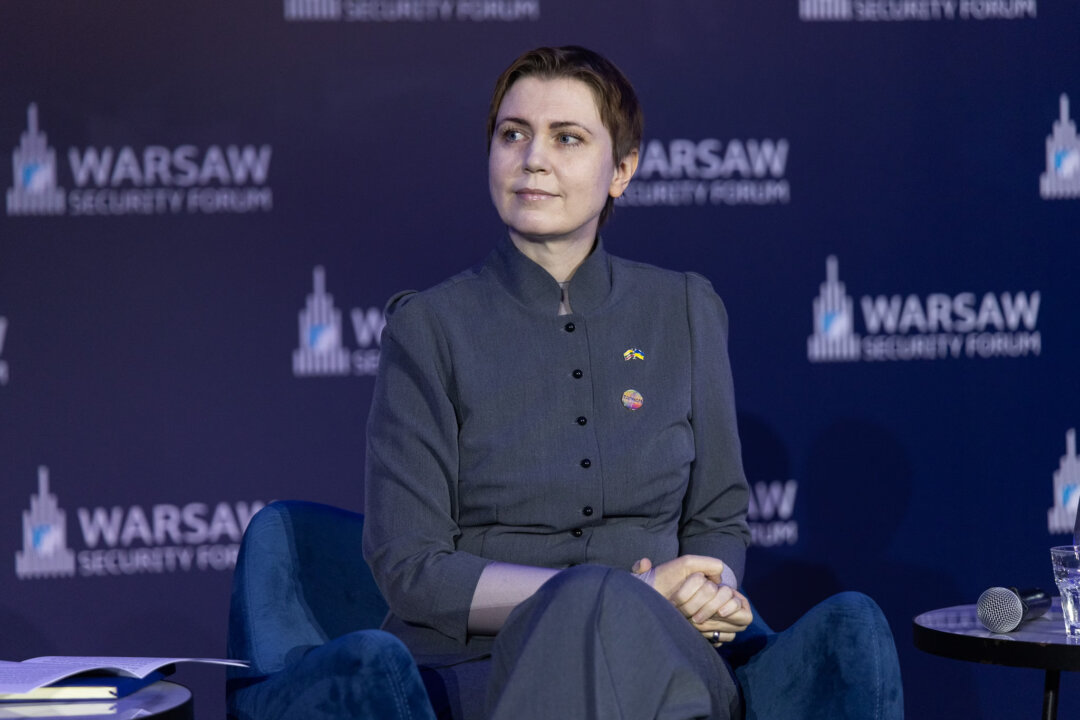
Lithuania’s former defense minister warned that Europe and the Indo-Pacific region could face simultaneous security crises involving China and Russia, citing similarities between threats in the Baltic Sea and the South China Sea.
Dovile Šakalienė said on Tuesday that threats to undersea cables and pipelines, online systems, and maritime security were no longer confined to individual regions. She called for closer cooperation between European and Asian countries on intelligence sharing, military exercises, and defense production.
“This is already becoming one war on two front lines,” she told a panel at the Warsaw Security Forum.
Lithuania, a NATO member bordering Russia’s Kaliningrad exclave and Belarus, has expanded defense ties with Japan and the Philippines, including joint cyber exercises, military training, and cooperation on maritime security.
Defense Cooperation With Philippines
In June 2025, while serving as defense minister, Šakalienė signed a defense cooperation memorandum with Philippine Defense Secretary Gilberto Teodoro.
The agreement covers maritime security, threats involving Russian and Chinese shadow fleets, protection of undersea infrastructure, cybersecurity, intelligence sharing, military exercises, civil defense, and defense-industrial cooperation, according to Lithuania’s Defense Ministry.
The memorandum sets out a framework for cooperation, but it remains unclear how far its provisions have been implemented.

Defense Cooperation With Japan
Lithuania’s partnership with Japan has produced more tangible results.
In April 2026, Lithuanian and Japanese specialists formed a joint team for Locked Shields 2026, a NATO-organized cyber defense exercise testing responses to large-scale attacks on critical infrastructure.
The exercise involved approximately 40 countries. Japanese personnel participated remotely from Japan, while the exercise’s command element was based in Estonia.
Japan has also supported a Lithuania-led multinational initiative to train Ukrainian military personnel in detecting and clearing mines and unexploded ordnance.
In October 2025, Japan’s Defense Ministry announced plans to send two instructors to Lithuania for a training course involving Ukrainian personnel and several Nordic countries.
Šakalienė said she had initiated an intelligence-sharing agreement with Japan while serving as defense minister, and expressed hope that the process was advancing. Publicly available official announcements do not establish that the agreement has been finalized.
The Epoch Times sought clarification from Lithuania’s Defense Ministry on the status of the Japan intelligence-sharing initiative and what projects have been implemented under the Philippines memorandum. No response was received by publication time.
Lithuania’s cooperation with Indo-Pacific countries extends beyond Japan. In July, Defense Minister Robertas Kaunas said Lithuanian cyber specialists had trained with counterparts from Australia, Japan, South Korea, and New Zealand.
Lithuania has also authorized possible participation in allied military operations in the Indo-Pacific. Under a parliamentary mandate extending through 2027, it may contribute up to 10 military or civilian defense personnel to qualifying operations. The authorization does not establish that personnel have been deployed under that mandate.
Joint Efforts to Protect Undersea Infrastructure
Lithuania has also joined a broader international initiative addressing one of the principal threats Šakalienė raised in Warsaw.
At the Shangri-La Dialogue security conference in Singapore in May, Lithuania joined 16 other countries—including Australia, France, Singapore, and the United Kingdom—in the Guiding Principles for Underwater Infrastructure Defense Exchanges (GUIDE) Framework.
According to Lithuania’s Defense Ministry, the framework establishes guidelines for cooperation among participating defense institutions to protect strategically important undersea cables and pipelines.
The participating countries emphasized that geographic distance should not prevent cooperation against threats to critical infrastructure.
Lithuania’s Defense Ministry said the country intends to prioritize Indo-Pacific security cooperation when it assumes the rotating presidency of the Council of the European Union in 2027.
We had a problem loading this article. Please enable javascript or use a different browser. If the issue persists, please visit our help center.