
Nearly all states allow early in-person voting or mail-in ballots before Election Day. This year’s early turnouts in many states have surpassed their 2022 early voting totals, which reflects high voter engagement for the 2026 midterm elections.
In this survey, readers shared their perspectives on voting habits, election integrity, polls, and the media’s political influence.
How They Vote
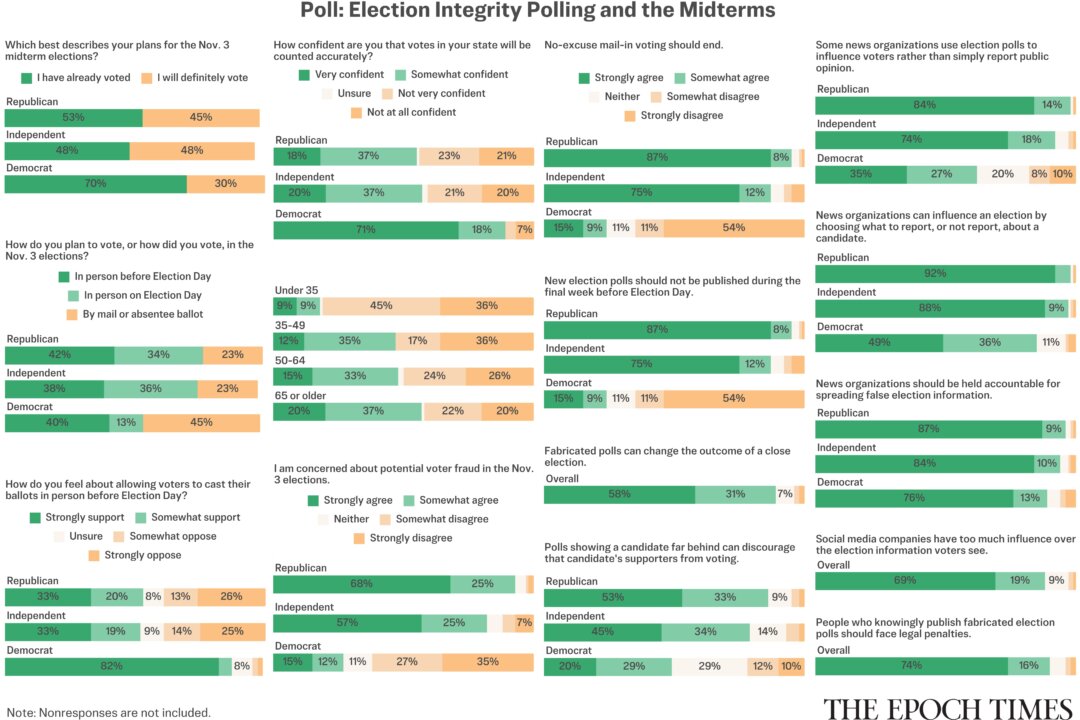
A majority of survey takers have already voted for the midterm elections five days ahead of Election Day. Almost all said they would vote in the Nov. 3 elections.
Readers affiliated with different parties tend to have different voting habits. Democrat respondents (70 percent) appeared to vote earlier than Republicans (53 percent) did.
While more Democrats vote by mail or absentee ballot, Republicans and Independents vote in person on Election Day at a higher rate. Two in 5 readers across parties vote in person before Election Day.
Just over half of Republicans and Independents said they support early voting, while 40 percent opposed. In contrast, more than 80 percent of Democrats strongly support early voting.
Most respondents vote for candidates from the same party in nearly all races. Fewer than 1 in 5 Independents voted for candidates from different parties.
Election Integrity
Concern over election integrity splits along party lines.
Nearly 90 percent of Democrats expressed confidence in accurate vote counting, with more than 70 percent very confident. Fewer Republican and Independent voters felt the same, with 3 in 5 feeling confident in accurate vote counting and 2 in 5 not confident.
A majority (82 percent) of Democrats believed election officials in their county run elections honestly and competently. Republicans and Independents expressed mixed feelings, with less than half agreeing with election officials’ honesty and competency, more than 20 percent disagreeing, and one-third remaining unsure.
Most (93 percent) Republicans were concerned about potential voter fraud. More than 60 percent of Democrats felt unconcerned. More than 80 percent of younger adults were strongly concerned.
A hefty 95 percent of Republicans agreed that requiring a passport or birth certificate to register to vote is worth it, even if it makes registering harder for some eligible citizens, while 65 percent of Democrats disagreed.
Ninety percent of Republicans said no-excuse mail-in voting should end, while 82 percent of Democrats disagreed and three-quarters strongly disagreed.
Notably, young people surveyed were less confident in election integrity when it came to accurate vote counting and honest election officials.
When asked about how confident they were in votes being counted accurately in their states, more than 80 percent of readers below age 35 said they were not very confident or not at all confident. About 50 percent of older adults were not confident.
Another, larger percentage (72 percent) of younger adults aged 35 or less disagreed that election officials in their county run elections honestly and competently. Older voters were mixed, with 2 in 5 agreeing, about one-quarter disagreeing, and one-third saying they were unsure.
Election Polls
Readers were somewhat more united on election polls affecting results.
More than 70 percent of Republicans and 53 percent of Democrats agreed that new election polls should not be published during the final week before Election Day.
Nearly 90 percent of respondents said fabricated polls can change the outcome of a close election.
Eighty-six percent of Republicans said polls showing a candidate far behind can discourage that candidate’s supporters from voting, with nearly 50 percent of Democrats saying the same.
Just over half (56 percent) of Democrats agreed that most election polls are honest attempts to measure public opinion, even when their results are inaccurate. Two-thirds of Republicans disagreed.
Media’s Influence
The survey results showed broader agreement that the media have a political influence on elections.
Nearly all Republicans (98 percent) agreed that some news organizations use election polls to influence voters rather than simply report public opinion. A majority (62 percent) of Democrats agreed.
When asked whether news organizations can influence an election by choosing what to report about a candidate, majorities of both Republicans (98 percent) and Democrats (85 percent) agreed.
Ninety-six percent of Republicans and 89 percent of Democrats agreed that news organizations should be held accountable for spreading false election information.
Another majority (88 percent) of survey takers agreed that social media companies have too much influence over the election information voters see.
Ninety percent said people who knowingly publish fabricated election polls should face legal penalties.
The Epoch Times conducted this reader survey on Oct. 28 and 29, 2026, by email and social media, generating 5,264 responses.
We had a problem loading this article. Please enable javascript or use a different browser. If the issue persists, please visit our help center.