
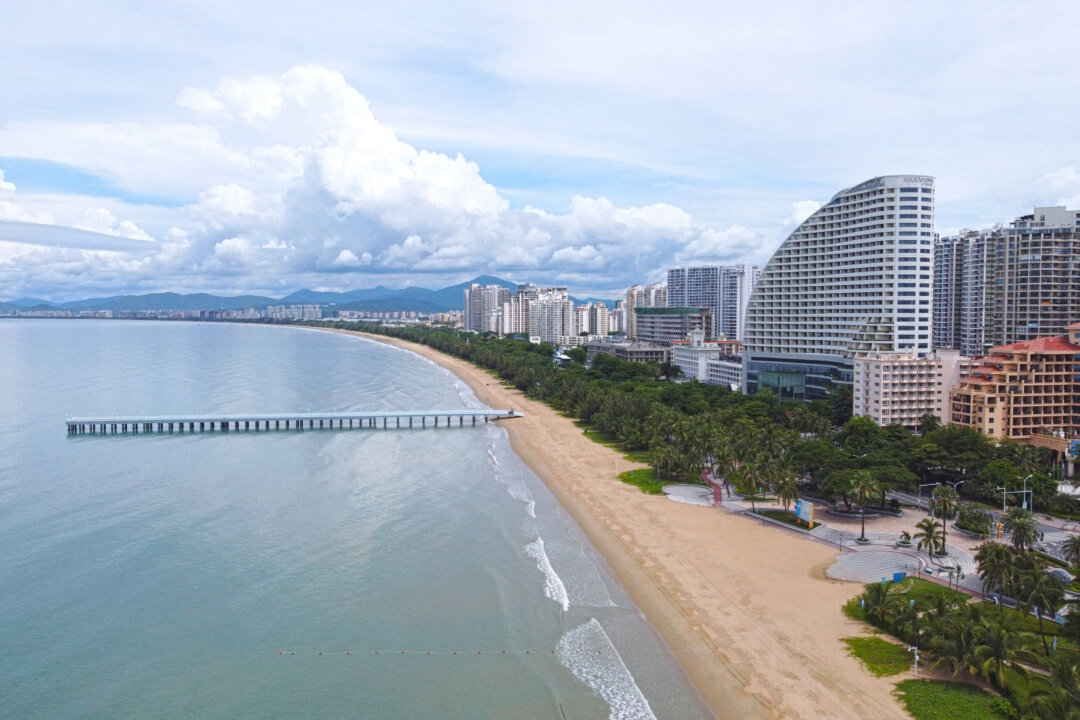
An outbreak of dengue fever at several high-end residential construction sites in Sanya city in Hainan, China’s southernmost island province, has resulted in thousands being quarantined, according to Chinese media and local workers who spoke with The Epoch Times.
State-controlled Chinese media outlet The Beijing News reported on Oct. 31 that a dengue fever outbreak recently hit construction sites in Sanya, the famous tourist site located on the southern tip of Hainan island. According to the report, some of the workers have been relocated to local hotels or residential complexes for quarantine and testing—a move that has sparked discontent among residents who were not informed beforehand.
Local construction workers told The Epoch Times the outbreak occurred at “Sanya Poly Tianjun,” a high-end residential project in the Jiyang District of Sanya city. Multiple construction sites within the project were affected, impacting thousands of workers, they said, and construction at several sites has been suspended, with both living quarters and construction areas placed under lockdown.
The CDC defines dengue fever as an acute infectious disease caused by the dengue virus and transmitted through the bites of infected “Aedes” mosquitoes. It is not transmitted directly from person to person. Following infection, the incubation period typically ranges from 1 to 14 days. Symptoms include sudden onset of fever, headache, pain behind the eyes, and muscle and joint pain. In severe cases, it may progress to dengue hemorrhagic fever or dengue shock syndrome, both of which can be life-threatening.
Sun Zhiyong, a worker still at the construction site who uses a pseudonym for fear of reprisal from the Chinese regime, told The Epoch Times the site had previously been placed under lockdown for about a week due to an outbreak of dengue fever, affecting approximately 1,000 people.
“Some of us are under quarantine within the living quarters at the construction site, while all personnel who were living off-site have been moved to the Beauty Crown Hotel,” a landmark resort in Sanya.
Sun said nearly 20 busloads of workers have been sent to the hotel, with each construction site relocating about 800 to 1,000 people. He added that the situation is not limited to a single site, as several construction projects are clustered in the same area, though they are managed by different contractors.
“When an outbreak occurs at one site, operations at all the surrounding sites are halted. In total, there are about 4,000 to 5,000 workers affected,” Sun said, adding that following the outbreak, the workers were instructed to remain in their living quarters for quarantine.
“There must be dozens of infected cases at my construction site; otherwise, the measures wouldn’t be this strict,” he said.
Sun also said that some infected workers were sent directly to the hospital, though the exact number remains unknown to outsiders.
“The authorities haven’t released any figures,” he said.
He said his construction site is not the only place where an outbreak has occurred, and other areas in the city have also implemented epidemic prevention and control measures.
In the early stages of the outbreak, the project developers did not attach sufficient importance to the situation, according to Sun.
“After the Sanya municipal government took over, the developers began to take it seriously. Police were stationed at the entrance 24 hours a day, preventing workers from entering or leaving. The mayor of Sanya even visited the site in person to give instructions.”
Meanwhile, various construction sites have initiated environmental disinfection and mosquito and pest control measures, according to Sun.
Zhou Dafu, another worker from the Hainan branch of China Construction Second Engineering Bureau Co., Ltd., who uses a pseudonym for fear of reprisal, told The Epoch Times that the site where he was working had been placed under lockdown for two days because of the dengue fever outbreak.
“We were all quarantined within the living quarters,” he said.
In addition to spraying disinfectant on the ground, drones flying below rooftop level were deployed to spray chemicals at the site, Zhou said.

Repeated Blood Tests
During the quarantine, Sun said he underwent three blood tests, while Zhou said he was tested five times.
Zhao Jianguo, another worker who has since left the construction site and uses a pseudonym out of fear of reprisal, told The Epoch Times that hundreds of workers at his site were required to line up for blood tests following the outbreak. Then, due to mandatory repeated testing, excessive wait times, and the fact that they received no wages while work was suspended, he ultimately decided to leave, Zhou said.
“I’ve already left. I didn’t dare to stay or go to work there anymore,” he said. Workers are worried about getting infected and are unwilling to continue taking the risk of showing up for work, Zhao said. “With the outbreak this severe, who would still dare to work there?”
Relocated to Residential Complex for Quarantine
Hundreds of workers from a nearby construction site have been relocated to the “Sanya Evergrande Beauty Crown” residential complex in the Jiyang District of Sanya because of the dengue outbreak, according to The Beijing News’ report.
A homeowner surnamed Fan told The Beijing News that neither the property management nor the relevant authorities provided advance notice—nor did they seek input from residents—regarding the arrival and stay of these workers. Concerned that her family might become infected—especially given that she has an infant at home—she has not dared to open her doors or windows for several days, not even those equipped with screens, according to the report.

A staff member at the Sanya Center for Disease Control and Prevention told The Beijing News that all workers have been moved out of the residential complex. The Health Commission of Jiyang District also said that all test results for the workers during their period of isolation were negative.
However, because of the Chinese communist regime’s record of publishing unreliable data and downplaying situations it deemed unfavorable to its rule, such as the COVID-19 infections and related deaths since early 2020, the Chinese public lacks trust in the official statements.
Social media posts about the dengue fever outbreak in Sanya have continued to circulate, with some of them saying that centralized quarantine measures were being implemented in Sanya’s Jiyang District, and workers who had already left have been called back for quarantine.
Li Jing and Gu Xiaohua contributed to this report.
We had a problem loading this article. Please enable javascript or use a different browser. If the issue persists, please visit our help center.