
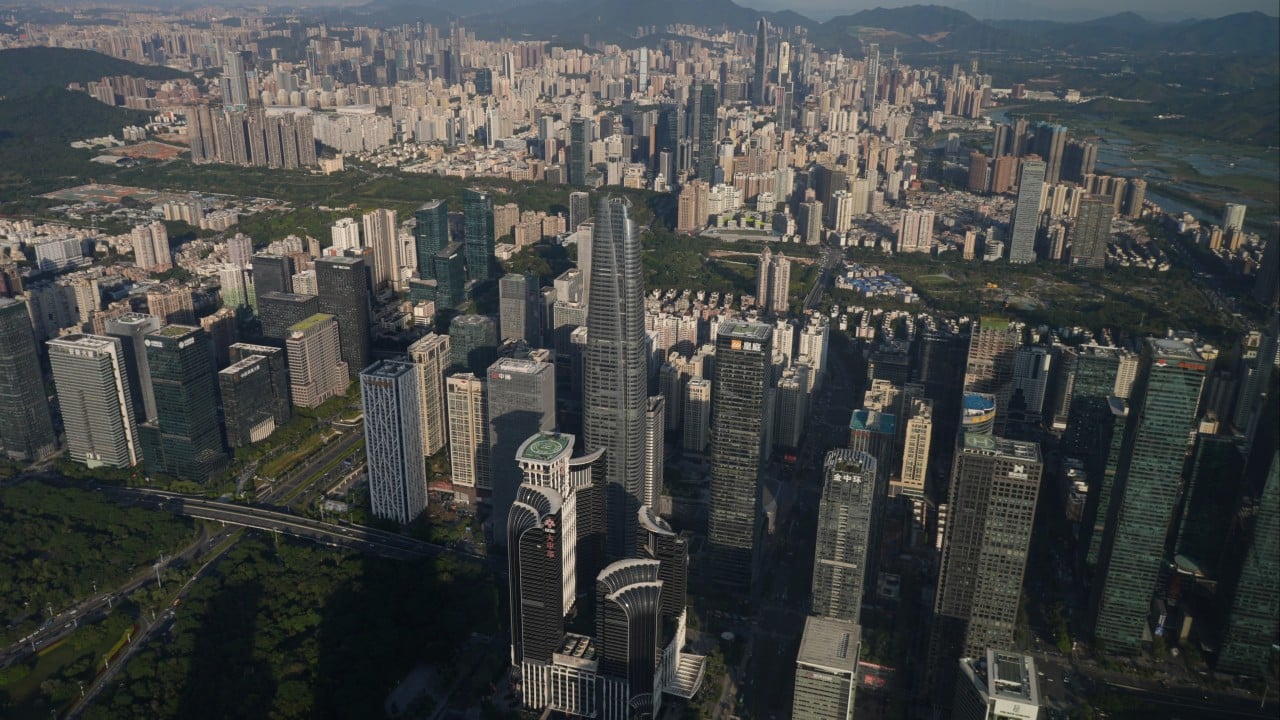
The southern Chinese megacity of Shenzhen, a symbol of the country’s rapid urbanisation and development, has spent decades transforming urban villages and tenement blocks into dense public housing estates and massive industrial and office parks.
Now, in a move that speaks volumes about its scarcity of land, the tech hub is relocating an enormous landfill from the city centre, an act that could allow for the development of floor space totalling more than 1 million square metres (10.76 million sq ft) on 30 hectares (74 acres) of newly open land.
Work is in full swing to move and detoxify more than 2.55 million cubic metres (90.05 million cubic feet) of waste materials buried for decades in a landfill in Shenzhen’s Luohu district, not far from the border with Hong Kong.
Advertisement
The 2.17 billion yuan (US$307 million) project will free up and transform the land, now occupied by municipal and construction waste, so that it can house artificial intelligence servers, biotech labs and art and design studios for modern manufacturing, according to the city’s government.
Home to tech giants Tencent, Huawei Technologies, BYD and DJI, Shenzhen’s area of about 2,000 sq km (772 square miles) is less than a third of Shanghai’s and only 12 per cent of Beijing’s.
Advertisement
But the gross domestic product of the city, which is home to 18 million people, was 3.68 trillion yuan (US$520.6 billion) last year, ranking third among all mainland Chinese cities, and a lack of space is constraining its further development.
The landfill being vacated was in use between 1983 and 1997, with the site originally chosen because it was on the fringe of what was then a young city. But Shenzhen’s exponential expansion over the decades has far exceeded urban planning boundaries, turning the landfill into an eyesore at the heart of the city and a potential hazard.