
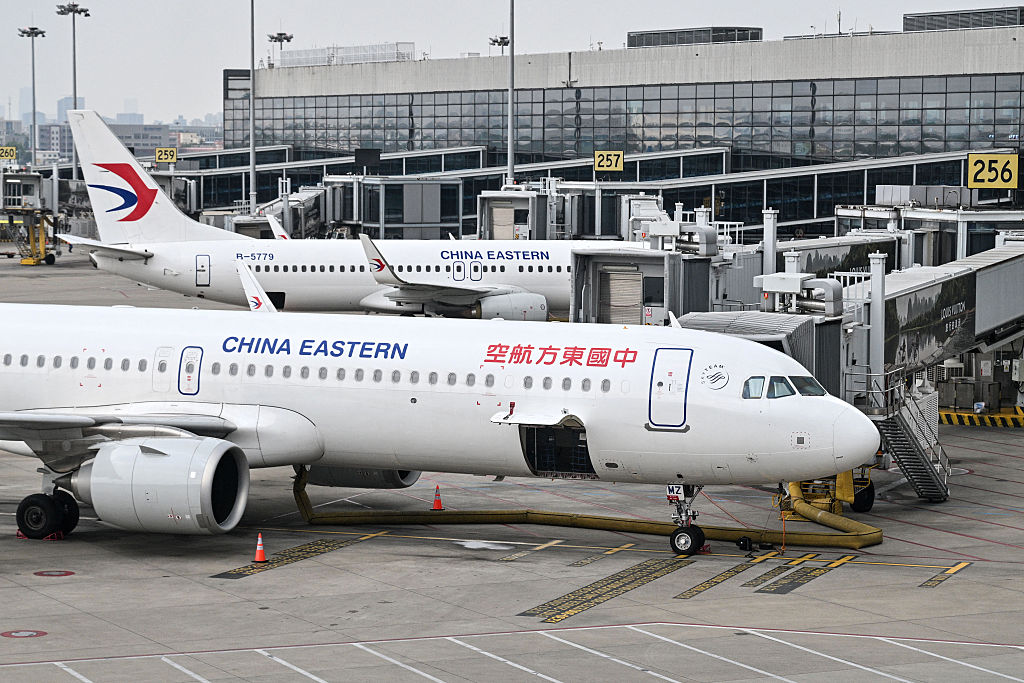
China’s three biggest state-owned airlines lost money over the first nine months of the year and are heading for full-year losses after even the peak summer season failed to lift them, according to their latest quarterly reports and analyst estimates.
Air China’s third-quarter net profit fell 92.6 percent from a year earlier to 270.6 million yuan ($40.6 million), and China Eastern’s fell 98.2 percent to 64 million yuan. China Southern swung to a 609 million yuan loss from a 3.84 billion yuan profit a year earlier. All three lost money from January through September, a period in which they were profitable last year, the filings show.
Together, the three lost about 8.4 billion yuan ($1.3 billion) over the nine months, according to the filings. That works out to roughly 23 yuan ($3.40) lost on every passenger flown, the state-run financial outlet Yicai calculated, based on the roughly 372 million passengers the three carried.
The carriers cited fuel costs as the main culprit. Middle East tensions have kept crude prices high and driven up jet fuel prices, one of the airlines’ highest costs.
The losses come as Beijing gives border officers broader discretion to stop residents from leaving the country, adding a new risk for the airlines in the coming quarters. The new exit rules, issued by the State Council under the Chinese Communist Party (CCP), officially took effect on Sept. 15. They require travelers to give “true and lawful” reasons for going abroad and let officers bar anyone deemed to have made a false statement.
They also let authorities stop citizens who break export-control or technology-trade rules in ways that “may” endanger China’s industrial or technological security.
Fuel and Fares
All three airlines blamed fuel in their quarterly reports. China Eastern cited Middle East tensions; Air China said rapidly rising oil prices sharply increased its fuel bill; and China Southern cited swings in oil prices.
Domestic fares were also weak amid fierce competition, including from high-speed rail, and typhoons disrupted flights during the summer peak. State-backed brokerage Huatai Securities estimated that Air China’s yields, a gauge of airfares, fell 5 percent in the quarter, leaving the carrier unable to recoup its higher fuel bill.
Analysts expect more losses. HSBC forecast in August that the three would lose a combined 16.8 billion yuan ($2.5 billion) this year,and estimates compiled by the London Stock Exchange Group, a financial data provider, point to a seventh straight annual net loss for Air China and China Eastern.
Shares of Air China, China Eastern, and China Southern have fallen 38 percent, 46 percent, and 39 percent this year.
Chinese airlines are also the intended customers of a Boeing order announced after President Donald Trump’s summit in Beijing in May, when the White House said China had approved an initial purchase of 200 Boeing aircraft, its first commitment to buy American-made Boeing jets since 2017.
Uncertainty at the Gate
In the weeks before and after China’s new travel rules took effect on Sept. 15, accounts on Chinese social media spread stories of travelers being questioned for hours, made to unlock their phones, or turned back at the gate, often without being told why. Many cannot be independently verified, but some match what people in China described to The Epoch Times recently.
Chinese officials on Sept. 10 called claims that citizens would find it harder to leave a “misreading,” saying tourists, business travelers, and students would not be affected.
So far, holiday travel has held up, according to official data. Mainland residents made 4.44 million trips abroad during the October National Day holiday, up 9.3 percent from a year earlier, according to the National Immigration Administration. During the Mid-Autumn Festival holiday in late September, the first after the rules took effect, border crossings by mainland residents rose 5.3 percent, while crossings by foreigners rose 37.7 percent.
Meanwhile, Washington has warned Americans about traveling to China.
The State Department’s advisory urges increased caution in mainland China, citing the arbitrary enforcement of local laws, exit bans imposed without a fair and transparent legal process, and the risk of unjust arrest or detention. It says security services and investigative agencies have imposed exit bans “using non-transparent CCP-led processes outside of the court system.”
Rep. John Moolenaar (R-Mich.), who chairs the House Select Committee on the CCP, recently said in a statement to The Epoch Times that he urges “every American to seriously reconsider any travel to China, because they could be arbitrarily taken hostage by the CCP under groundless charges.”
Reuters contributed to this report.
We had a problem loading this article. Please enable javascript or use a different browser. If the issue persists, please visit our help center.