
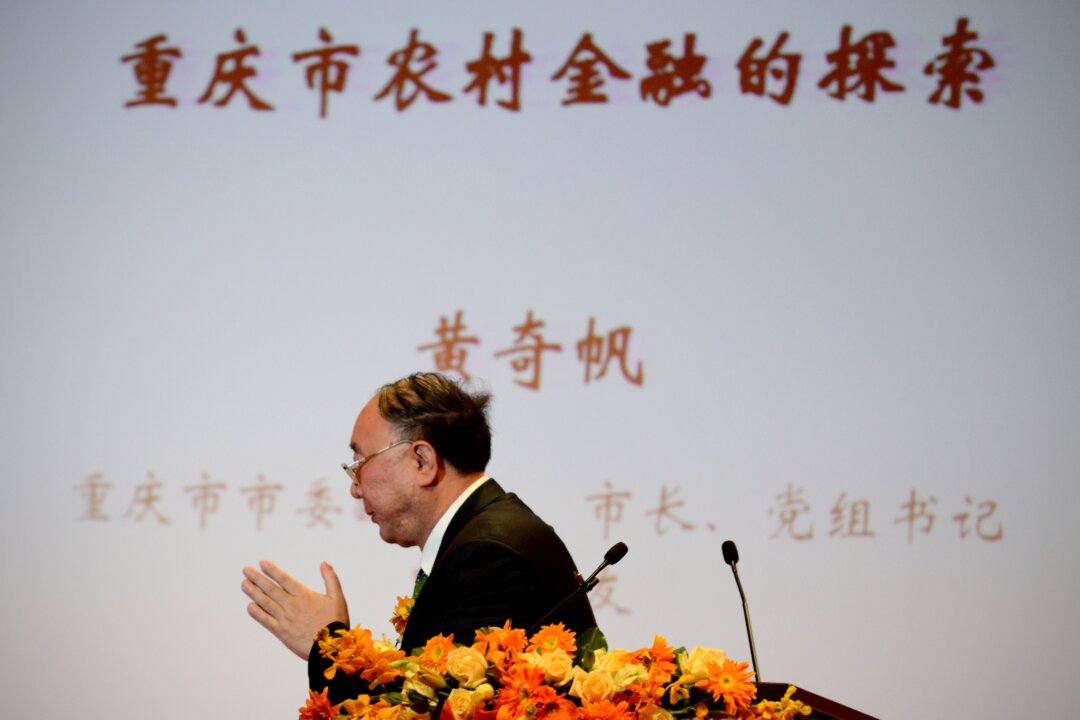
Huang Qifan—former mayor of the southwestern megalopolis of Chongqing who survived the major political scandal that ousted his boss—has been placed under investigation ahead of a major conclave this month.
Huang was suspected of “serious disciplinary and law violations,” the Chinese Communist Party’s (CCP) top anti-graft agency said on Oct. 13, using a description often deployed by the regime for alleged corruption or disloyalty.
The brief statement from the Central Commission for Discipline Inspection gave no further details about the allegations.
Huang, 74, is widely known as a henchman of Bo Xilai, the former Party chief of Chongqing, who was once seen as a rising political star.
In 2010, during the country’s largest annual political conferences, Huang described his working relationship with Bo “as fish to water.”
In February 2012, Bo’s close associate Wang Lijun, then Chongqing’s police chief, defected to the U.S. Consulate in Chengdu, setting off a political crisis that dashed Bo’s chances of joining the Politburo Standing Committee, a group of seven Party elites who rule China.
Shortly after Xi Jinping came to power in late 2012, he launched a sweeping anti-corruption campaign. His political enemies were brought down one by one, particularly those loyal to former CCP leader Jiang Zemin.
A Chinese court sentenced Bo, a key ally of Jiang, to life imprisonment for taking bribes and abusing power in 2013—a downfall precipitated by the conviction of his wife in the murder of British businessman Neil Heywood.
Huang moved quickly to denounce his boss. At a January 2013 meeting, he declared the legacy of Bo and Wang had been “banished,” and that he would “firmly support all actions of the central authorities,” according to state media China News Service.
Weeks later, Huang secured another term as Chongqing mayor, despite the widening purges that ousted several of Bo’s backers.

When Xi made a state visit to the United States in 2015, Huang was among the six provincial-level leaders picked to join the trip.
At the time, Huang served under Bo’s successor, Sun Zhengcai, who had once been groomed by the Jiang faction to be China’s next leader.
Sun was fired in July 2017, and at a major Party conclave later that year, the Chinese regime named him and other key Jiang faction members, including Bo, as co-conspirators “in a plot to usurp the Party leadership and seize power.” In 2018, Sun was sentenced to life imprisonment for graft.
Huang, who left his post as Chongqing mayor in late 2016, survived another wave of purges following the fall of his second boss.
After a brief stint as vice-head of a financial committee in the National People’s Congress, China’s largely symbolic legislature, Huang moved into academic and economic advisory roles. His comments on economic affairs often appeared in Chinese-language media.
Huang’s fall from grace came as Beijing prepares for its fifth plenary session of the 20th Central Committee, set to begin on Oct. 26.
The closed-door meeting will bring together about 200 senior officials at the Party’s Central Committee to discuss how to advance internal discipline, according to China’s state media. Personnel changes are also expected to be on the agenda.
The conclave is likely to be one of the most important political gatherings before the next Party Congress in late 2027, during which the CCP is set to reshuffle its leadership.
We had a problem loading this article. Please enable javascript or use a different browser. If the issue persists, please visit our help center.