
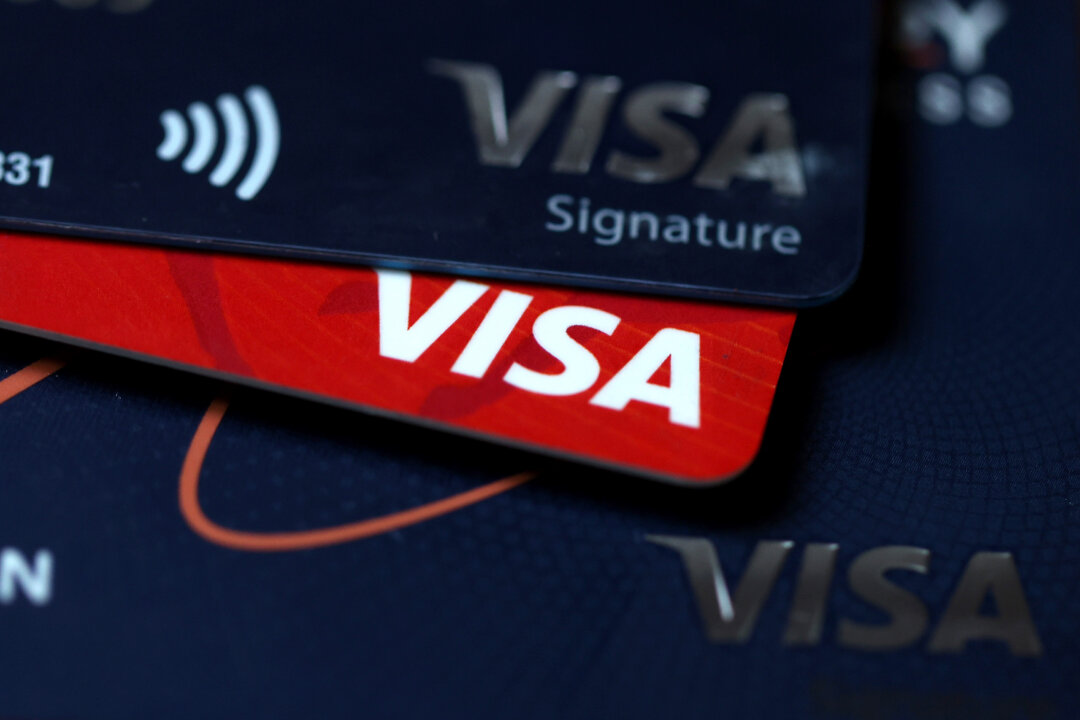
China’s central bank has granted preliminary approval to Visa, the American credit and debit card payment network, to establish a domestic card-processing business after years of delays.
The decision came months after President Donald Trump personally pressed Chinese leader Xi Jinping over the company’s restricted market access.
Visa announced on Oct. 13 that the People’s Bank of China (PBOC) had approved its application to begin preparations for a domestic bank-card clearing operation.
The company must still obtain a separate operating license before processing domestic transactions.
The decision follows nearly a decade of efforts by Visa to enter a market dominated by state-backed China UnionPay, which benefited from restrictions Washington repeatedly challenged.
In its 2026 National Trade Estimate Report, the Office of the U.S. Trade Representative (USTR) accused Beijing of maintaining market-distorting practices favoring Chinese companies despite adverse World Trade Organization rulings.
The report said UnionPay used revenue from its protected domestic market to expand internationally, including into the United States.
Visa Chief Executive Ryan McInerney welcomed the approval, thanking the leaders of the United States and China for their role in pursuing a constructive bilateral relationship.
Visa spokesperson Fletcher Cook told The Epoch Times in an Oct. 13 email that he could not speculate on a target launch date.
Under China’s bank-card clearing regulations, Visa must complete preparations and submit an Application to Operate within one year of receiving preliminary approval.
An operating license would allow Visa to compete directly with UnionPay in processing yuan-denominated card transactions between Chinese banks and merchants.
Visa would enter a market where consumers also widely use Alipay and WeChat Pay for everyday purchases.
Trump Raised Visa With Xi
Trump said he personally raised Visa’s restricted market access during his May visit to Beijing.
“We have Visa, which is not allowed to trade,” Trump said during a May 14 interview with Fox News host Sean Hannity.
“I said, ‘What about using Visa in China?’ For some reason they were blackballed, and maybe that’ll come off,” Trump said, noting that Visa’s chief executive was part of the U.S. business delegation.
McInerney subsequently attended the Sept. 24 White House state dinner for Xi, alongside Mastercard CEO Michael Miebach.
The approval comes ahead of Trump’s expected meeting with Xi at the Asia-Pacific Economic Cooperation (APEC) summit in Shenzhen, China, in November.
Neither side has publicly established that their earlier discussions directly led to the regulatory decision.
Beijing-Protected UnionPay
The United States has challenged China’s restrictions on foreign payment networks for more than a decade.
In 2012, a World Trade Organization panel ruled that several Chinese requirements discriminated against foreign electronic-payment providers and favored UnionPay, including restrictions involving payment-card branding, acceptance, and transaction processing.
Subsequently, China maintained that it had complied with the ruling, but U.S. trade officials continued to challenge restrictions on foreign providers.
According to USTR, Beijing did not allow foreign companies to apply for domestic clearing licenses until June 2017, years after the WTO decision.
In January 2020, during Trump’s first administration, Washington and Beijing signed the Phase One trade agreement, under which China committed to improving and accelerating licensing procedures for American electronic-payment companies.
Yet USTR’s 2026 report said the PBOC continued delaying Visa’s application even after competing U.S. networks obtained operating licenses.
Visa Pursued Wholly Foreign-Owned Operation
Visa’s approach differed from those of its American competitors.
American Express received authorization to operate through a Chinese joint venture in June 2020. Mastercard’s joint venture obtained its operating license in November 2023.
Visa instead pursued domestic operations through a wholly foreign-owned subsidiary, rather than forming a joint venture with a Chinese partner.
Cook confirmed that China’s central bank approved Visa’s application to prepare its domestic clearing business under that ownership structure. The company must still obtain a separate operating license.
Chinese corporate records identify two shareholders in Visa Information Technology (Beijing) Co. Ltd.: Singapore-registered Visa Worldwide Pte. Limited and U.S.-registered Visa International Service Association.
Both are Visa-affiliated companies.
Visa told U.S. lawmakers that it had submitted a bank-card clearing application in July 2017.
In written testimony, the company also sought greater transparency and a time-bound process for any national security review of its application.
Chinese central bank officials subsequently said Visa had withdrawn its earlier application in January 2018 and resubmitted one in April, but that the revised paperwork still lacked required materials, according to a Chinese financial outlet, Caixin, in 2019.
Visa later disclosed in a Securities and Exchange Commission filing that it had submitted another application in May 2020.
Although Visa’s ownership structure distinguishes it from Mastercard and American Express, Chinese regulators have not publicly established that it caused the prolonged delay.
We had a problem loading this article. Please enable javascript or use a different browser. If the issue persists, please visit our help center.