
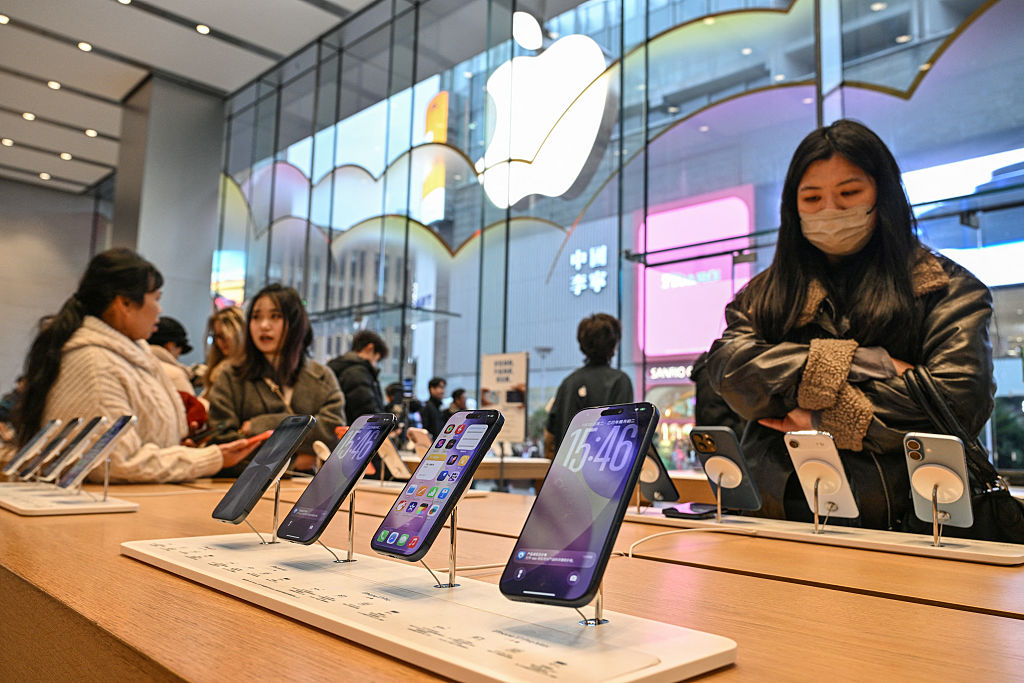
Apple Executive Chairman Tim Cook said on Oct. 15 that Apple Intelligence has been approved in China. The China version comes with artificial intelligence (AI) models from Alibaba, which the Pentagon designated a Chinese military company in June.
Cook told The Paper, a Chinese state-run outlet, that a test version will roll out later this month. Initial features include live translation, writing tools, and a photo cleanup tool. The AI-powered Siri is not part of the release.
He said Apple was “very pleased” to have approval to bring the first core features to Chinese users. Apple Intelligence launched in the United States in 2024 but has not been available on iPhones sold in mainland China.
Records from China’s Ministry of Industry and Information Technology show that a number of iPhone models, including Apple’s new foldable iPhone Duo, were updated on Sept. 29 with registration numbers for the AI models they carry, The Paper reported. For the iPhone Duo, the records list three: Apple Intelligence and Alibaba’s Tongyi Qianwen and Tongyi Wanxiang.
Qianwen, known outside China as Qwen, is Alibaba’s large language model. Wanxiang generates images and video.
Beijing’s Rules
Under the Chinese Communist Party (CCP), generative AI services offered to the public must be registered with regulators. China’s internet regulator, the Cyberspace Administration of China, said in July that Apple Intelligence had been registered for use on iPhones.
Rules issued by the agency and six other departments in 2023 require such services to uphold “core socialist values.” They bar content that incites subversion of state power or damages China’s national image.
Providers must also report users who engage in illegal activities to authorities and give inspectors technical and data support upon request.
Cook also met Commerce Minister Wang Wentao on Oct. 15. The two discussed U.S.–China trade, AI development, and Apple’s business in China, according to the ministry.
Wang told Cook that Beijing wants AI development to be “safe and controllable.” He also asked Apple to act as a bridge for steadier U.S.–China trade ties, the ministry said.
Cook told Wang that Apple is optimistic about China’s prospects and will further expand its business there, according to China’s Commerce Ministry.
The Pentagon List
The Pentagon added Alibaba to its list of Chinese military companies on June 8, along with search giant Baidu and automaker BYD. The list is known as the 1260H list, after the section of the defense policy law that requires it. Tencent was added in 2025.
In its notice, the Pentagon called Alibaba a “military-civil fusion contributor” to China’s defense industrial base because of its affiliation with the Ministry of Industry and Information Technology. Military-civil fusion is the CCP’s policy of incorporating private companies and civilian research into military endeavors. The same ministry’s records now list Alibaba’s models on the iPhones.
The label does not bar U.S. companies from doing business with Alibaba. Since June 30, however, U.S. law has prohibited the Pentagon from entering into or renewing contracts directly with any of the listed companies. Starting in 2027, it will also be prohibited from purchasing their products or services via third parties.
Pressure From Congress
Rep. John Moolenaar (R-Mich.), who chairs the House Select Committee on the CCP, has pressed U.S. companies to cut ties with Alibaba. Last November, he said Alibaba “has no choice but to give up sensitive data on its customers” and hand cybersecurity vulnerabilities to the CCP or face serious consequences.
In July, the committee asked the owner of the Washington Capitals hockey team and the Washington Wizards basketball team to explain his company’s partnership with Alibaba, which it called a Chinese military company.
When the Pentagon released the list in June, Moolenaar called it a warning to American businesses and urged U.S. companies to “stop doing business with these threats to our national security.”
Apple and the House Select Committee on the Chinese Communist Party did not respond to requests for comment by publication time.
We had a problem loading this article. Please enable javascript or use a different browser. If the issue persists, please visit our help center.