
CCP’s Hainan ‘Free Trade Port’ Attracts Residents’ Complaints, Experts’ Skepticism
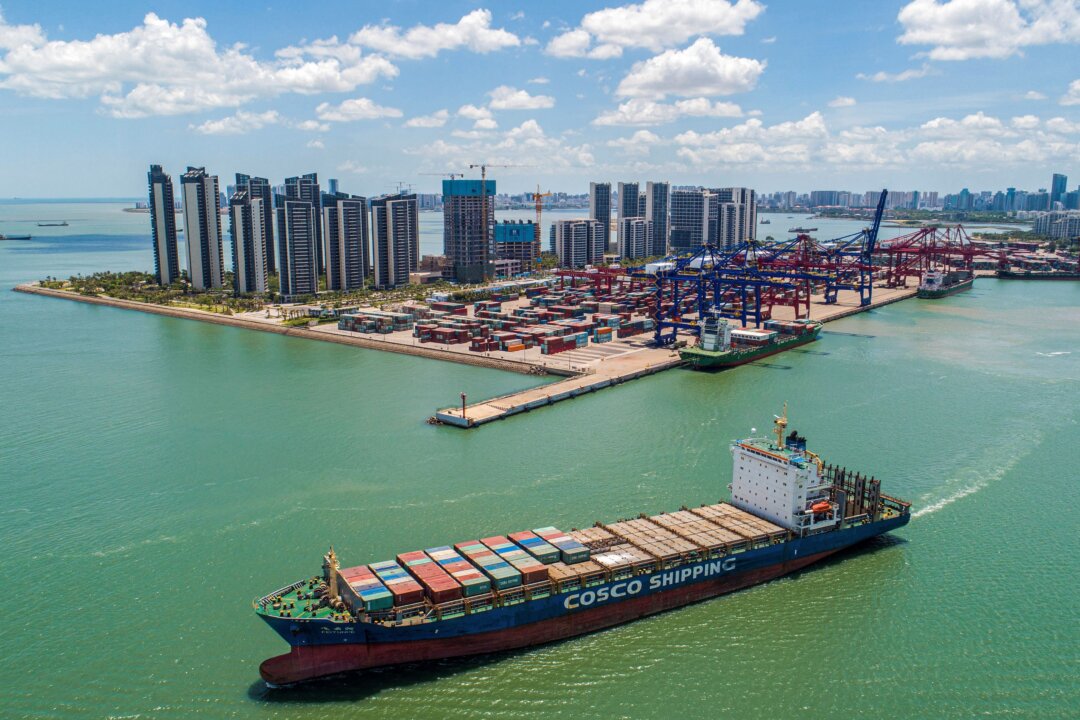
Since the Chinese communist regime officially launched the Hainan Free Trade Port (FTP) on Dec. 18, local residents have said on social media that new policies surrounding the port have driven up the cost of living, while analysts have expressed skepticism over whether the trade port is truly free while under the Chinese Communist Party’s (CCP) control, with some pointing out the military agenda in launching the port.

The Chinese regime has designated Hainan, a southern Chinese island province, as a duty-free zone, separating it from mainland China, in an attempt to attract foreign investment amid the sluggish economy and wave of withdrawals of foreign companies from China. The regime also aimed to establish a new Hong Kong-style commercial hub, after the international port city lost its de facto status as the only true free trade zone under the CCP’s control.

Despite characterizing the new Hainan trade port as “free,” the CCP’s state-run media stressed that the FTP “must adhere to the centralized and unified leadership of the Party Central Committee.”

The Hainan FTP is open to the outside world but closed off by a tariff barrier from other regions within China. The CCP claims that the port is centered on enabling institutional innovation and more foreign involvement, and will serve as a pilot program for trade facilitation, investment liberalization, and financial opening.

The Chinese regime has designated 22 such free trade zones since 2013, but those zones have been located in specific areas within provinces or municipalities, and none of them covers an entire  province as does the Hainan venture.

However, Hainan is relatively underdeveloped in China. In 2024, Hainan Province’s gross domestic product (GDP) was 793.57 billion yuan ($113 billion), ranking fourth from the bottom among mainland China’s 31 provinces and regions, despite the fact that the CCP started to build the FTP in 2020.

Chen Bo, a researcher at Hainan University and Liaoning University, told Hong Kong-based media Ming Pao that Hainan cannot achieve its GDP goal this year, which is 6 percent growth: “On the one hand, the sluggish domestic economic environment has a greater impact on Hainan, whose economy is already relatively weak. On the other hand, there are strained international trade relations. This juncture is not favorable for Hainan’s development, despite that the CCP hopes to attract global resources through Hainan’s opening-up.”

‘Free Trade Port’ Not Really Free

Apart from its land area, the Hainan FTP has no advantages compared to other free trade zones established previously in China, U.S.-based China observer Heng He wrote in a column for the Chinese language edition of The Epoch Times on Dec. 24. “Hainan doesn’t have the strong industrial foundation or comprehensive supply chains as Shanghai.”

Heng pointed out that these so-called free trade zones or ports are not really free, as they are under the same political and economic control within the CCP’s system.

People in Hainan still don’t have unrestricted access to all websites on the internet, just like people in other parts of China. According to Chinese media outlet South Reviews, Hainan uses a “whitelist” system to grant less restrictive access to the internet, which is only open to companies and high-level talents within the technology parks. Those who are eligible for the “whitelist” need to apply through the related management agency of the CCP, be approved by the agency, and receive an account assigned by the agency. They can then log in with that account to access information on the internet.

Heng wrote that there is no “free trade zone” in China where the internet is not monitored by the Chinese regime, including the Hainan FTP. “None of the free trade zones has an independent judicial system; and no free trade zone has freedom of the press and freedom of speech. Based on these points alone, Hong Kong’s former advantages as an international free trade hub cannot be replaced and will never be surpassed.”

Heng said that after the handover of Hong Kong’s sovereignty from the British to the CCP in 1997, the only true free trade zone within the territory ruled by the CCP was Hong Kong, “possessing and far surpassing all the advantages of the free trade zones designed by the CCP.”

The CCP suppressed the mass Hong Kong democratic protests in 2019 and imposed its National Security Law in Hong Kong in 2020, stripping Hong Kong’s judicial independence and various human rights that the CCP promised Hong Kong citizens would continue to enjoy for 50 years after the handover under the regime’s “one country, two systems” framework.

Heng wrote that Hong Kong once had a legal system and freedoms independent of the CCP, which is why the CCP brutally suppressed Hong Kong with the National Security Law. “This means that the Hainan Free Trade Zone will absolutely not have any systemic reforms, and therefore is not a pilot project for political system reform,” he said.

This aerial photo shows an empty beach of an area that was closed off and restricted due to an outbreak of COVID-19, in Sanya in southern China's Hainan Province on Aug. 6, 2022. (CNS/AFP via Getty Images)
This aerial photo shows an empty beach of an area that was closed off and restricted due to an outbreak of COVID-19, in Sanya in southern China’s Hainan Province on Aug. 6, 2022. CNS/AFP via Getty Images

Hainan is not free of restrictions in terms of capital flows, either. Hainan has established a special multi-functional trade account, which features a so-called “cross-border capital highway.” This system allows for very rapid movement of funds entering Hainan from overseas, without any limits or approval requirements. However, once account holders want to transfer funds from their account to a mainland Chinese bank account, they will face strict controls. Transactions will need to have a confirmed trade background and are subject to restrictions based on the CCP’s negative list of foreign investment sources, and funds must be used for “trade settlement” and not for other purposes, in addition to other restrictions.

Hainan also lacks a basic legal and political system and environment suitable for free economic development, Frank Xie, a professor at the University of South Carolina Aiken School of Business told The Epoch Times.

“The money invested by early investors has already been wasted. With the downturn in the Chinese economy, the bursting of the Hainan FTP bubble is also predictable,” he said.

Rising Prices

After the opening of the FTP, local residents in Hainan complained on social media that the cost of living has been driven up while their incomes remained the same.

Singer Zhao Rourou posted on Weibo, saying that Hainan’s free port policy had not benefited local residents, with prices, especially for vegetables, meat, dining, and takeout, rising sharply, while monthly local wages remained only 1,800 to 3,000 yuan ($256 to $427), leading to significant financial pressure. This post was subsequently deleted. She then posted another message, calling for lower prices and higher wages to truly benefit ordinary Hainan residents, and criticizing the inconsistent policies and the discrepancy between propaganda and actual results. This post was also deleted.

Some local residents have posted on social media photos of vegetable prices in Hainan after the launch of the port, showing that spinach costs 32 yuan per jin ($4.14 per pound), and celery costs 25 yuan per jin ($3.24 per pound).

One post showed that bananas in Haikou city in Hainan cost 4.68 yuan per jin ($0.62 per pound), while bananas in mainland China cost only 1.68 yuan per jin ($0.22 per pound), with comments questioning why the price at the place of origin, which is Hainan itself, is higher than the price after being transported to other provinces.

Military Purpose

A map showing waters disputed by China in the South China Sea. (UNCLOS and the CIA)
A map showing waters disputed by China in the South China Sea. UNCLOS and the CIA

The CCP’s original design for the Hainan FTP had both economic and military aspects, but with changes in the international and domestic situation, the economic aspect has become completely unfeasible, U.S.-based current affairs commentator Lan Shu recently said on his talk show, co-hosted by military commentator Mark—who does not use his surname.

The only reason the CCP is rehashing this idea now is to use free trade as “a pretext to build Hainan into a military support base for controlling the South China Sea,” Lan said. The CCP is “laying the groundwork for a southward expansion in the South China Sea.”

Mark pointed out that Hainan has direct deep sea connections and has strategic maritime importance. “It’s ideal for the CCP’s nuclear submarines to operate.”

The CCP has already built the Yulin submarine military port in Hainan. The CCP’s two aircraft carriers—Shandong and Fujian—are both deployed in Hainan. There are also many related supporting craft stationed there, making Hainan an important naval port for the CCP.

People gather at the beach as they watch the Long March 5B Y3 carrier rocket, carrying Wentian lab module, lift off from the Wenchang Space Launch Center in Wenchang in southern China's Hainan Province on July 24, 2022. (Zhang Liyun/Xinhua via AP)
People gather at the beach as they watch the Long March 5B Y3 carrier rocket, carrying Wentian lab module, lift off from the Wenchang Space Launch Center in Wenchang in southern China’s Hainan Province on July 24, 2022. Zhang Liyun/Xinhua via AP

In addition, Mark said, “The CCP is also trying to build its space base in Hainan, moving it from north western China, as Hainan is close to equator and is easier and has shorter distance to launch rockets and missiles towards the east.”

The CCP is building Hainan into a strategically important military port to strengthen its threatening posture toward the United States, Lan said.

“The most intense military conflicts that the CCP has had with neighboring countries have concentrated in the South China Sea, and the Chinese regime is trying to make the South China Sea into its own territorial waters,” he said.

Lan added that the CCP has been militarizing small islands in the South China Sea and strengthening its control over neighboring international waters.

Ning Haizhong and Luo Ya contributed to this report.

We had a problem loading this article. Please enable javascript or use a different browser. If the issue persists, please visit our help center.


Read More

Leave a Reply