
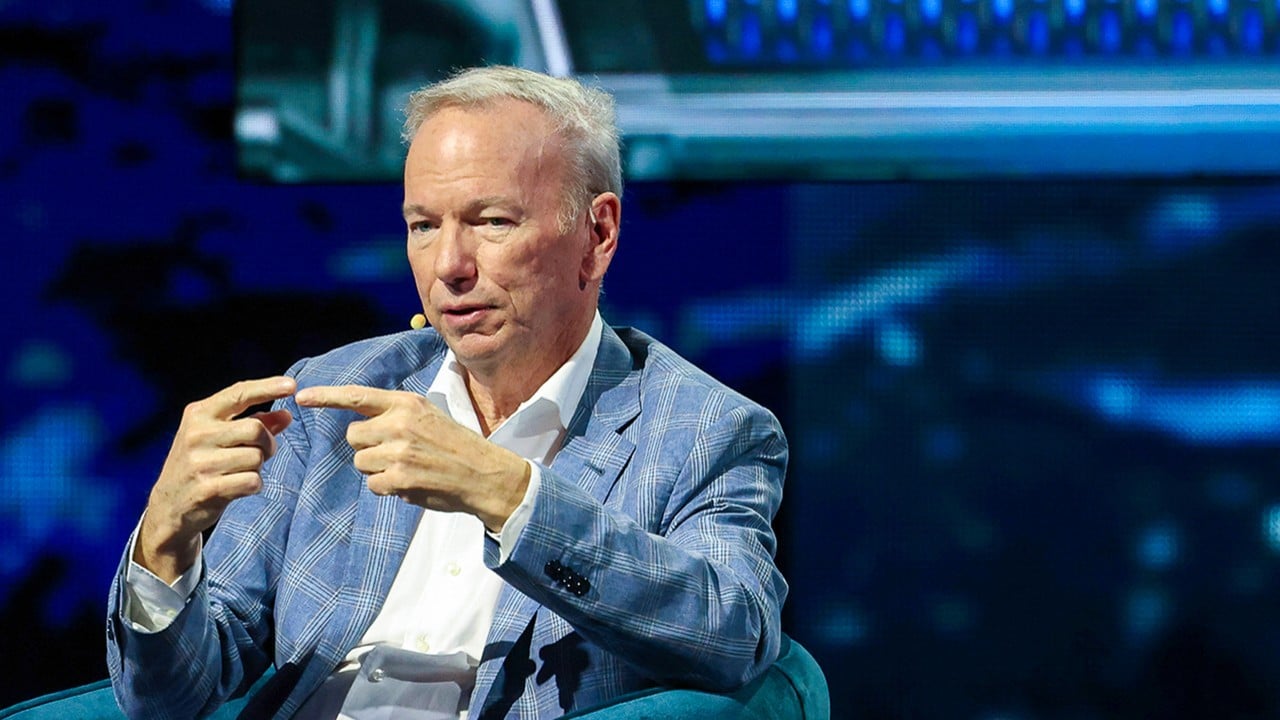
China’s designs on supremacy in artificial intelligence could be hindered by a funding gap in the sector, according to former Google CEO Eric Schmidt, who gave a grim assessment of the country’s AI prospects as China and the US lock horns for dominance.
However, analysts said that funding would not be a concern for China’s AI development given the deep pockets of the country’s private and state investors – particularly as Beijing, Big Tech firms and investors were united in their determination to accelerate AI development from chips to applications.
Schmidt said that compared with the US, which had the world’s “most extraordinary capital market”, China lacked the same “depth of the financial market”, adding that Chinese start-ups literally “cannot get the money” to keep up in the AI race.
Advertisement
“Without that access to capital, it’s very hard to do these large models with this complicated training,” Schmidt said at a forum hosted by the Harvard Kennedy School on Monday, according to a video published on the school’s YouTube channel.
Schmidt’s remarks reflected how a challenging Chinese economy and evolving start-up scene had already dampened the appetite of market-driven venture capital funds in recent years.
Advertisement
This trend has since been compounded by US restrictions that have prevented venture capital funds – historically among the largest sources of capital making lucrative bets on China’s tech and internet growth – from backing key Chinese sectors including AI, citing national security concerns.
However, capital from the government and Big Tech firms had flowed in to make up for the lack of market-driven venture capital, according to analysts at PitchBook, a global start-up and venture capital data service firm.