
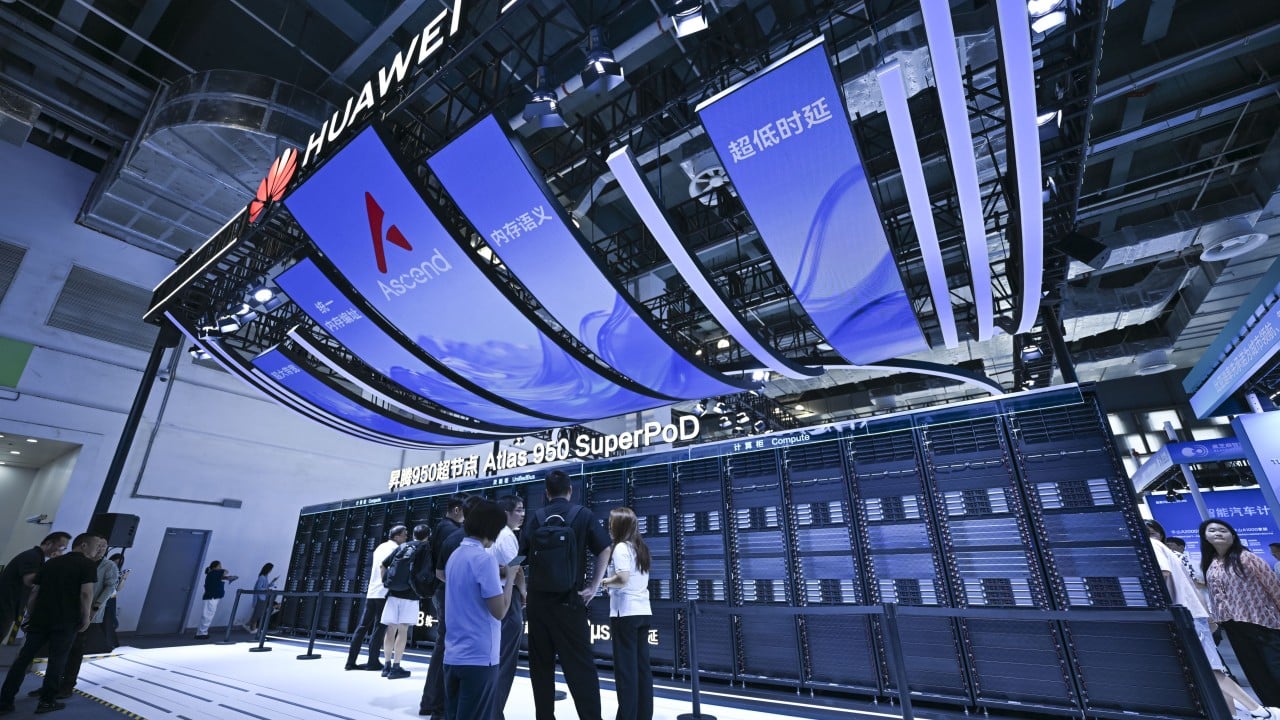
China’s ability to set its own technological course in the face of sustained US export restrictions may be the key factor in the two countries’ contest over artificial intelligence (AI), a prominent analyst has argued.
Zheng Yongnian, dean of the school of public policy at the Chinese University of Hong Kong (Shenzhen), made the case in his preface to The Rise of Atlas, a new book about the development of Huawei Technologies’ Atlas 950 SuperPoD computing system.
The system, which Huawei showcased at the 2026 World Artificial Intelligence Conference in Shanghai last month, has been described as the industry’s largest AI supernode, a type of high-powered supercluster capable of linking more than 1,000 processors.
Zheng argued that the main importance of such projects lay in showing how China was adapting to external pressures.
He described them as part of a broader Chinese effort to build the institutional and industrial capacity needed to set standards, shape ecosystems and coordinate hardware, software and applications.
“True technological autonomy is not simply about ‘having chips’, but about ‘having the ability to define the technological path’,” he wrote in the preface, which was published online last week.