
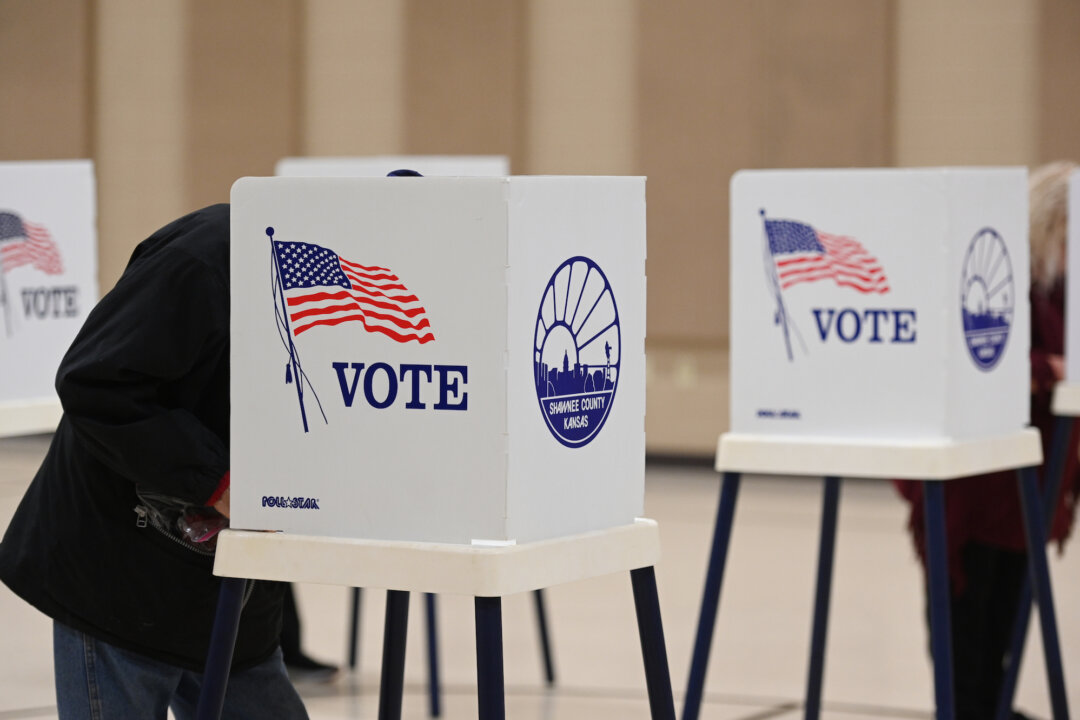
KANSAS CITY, Kan.—Kansans have long been known for their strong pro-Republican voting tendencies in national politics, but there are signs that’s changing as Democratic candidate Adam Hamilton, a United Methodist megachurch pastor, gains ground in the polls against incumbent Sen. Roger Marshall.
It comes amid a national environment that’s shaping up to be deeply unfavorable for Republicans. Democrats lead in Senate races in states such as North Carolina and Georgia, and Republicans face competitive battles in South Carolina, Mississippi, and Texas.
Kansas Republicans aren’t escaping the growing backlash in the polls.
Hamilton currently leads in an average of four recent polls, 46 percent to Marshall’s 45 percent, with President Donald Trump recently traveling to the state to campaign for the Republican.
Kansas hasn’t sent a Democrat to the Senate in 94 years.
“It’s been a long time that we’ve waited to flip,” Rachel Smith, a voter in Johnson County, Kansas, and lifelong Democrat, told The Epoch Times when asked about the polling.
None of the voters who spoke to The Epoch Times in Johnson County or nearby Shawnee County said they were backing Marshall this year.
The fight for the governor’s mansion looks more secure for Republicans but remains close, as state Senate President Ty Masterson, a Republican, faces off against state Sen. Cindy Holscher, a Democrat.
Masterson is in a stronger position than his Senate Republican counterpart, with polls showing he leads Holscher by around 5.7 percentage points on average.
Many of Hamilton’s backers in the state told The Epoch Times they are or used to be Republicans. Here’s what some critical swing voters said about Republicans’ position in the state.
‘Who’s Going to Show up on Election Day?’
Andrew Howell, Shawnee County election commissioner, told The Epoch Times that even though Kansas is still in early voting, county turnout is high.
Shawnee County—home to the Kansas state capital, Topeka—is one of a handful of key eastern counties in Kansas that have voted for Democrats in recent cycles.
Turnout here is critical to Democrats winning statewide. So far, Howell said, they’re seeing it.
“We’re seeing pretty good numbers of folks showing up to vote,” he said.
In his 2020 election, which Marshall won by about 11 percentage points, Shawnee County and Riley County—home to Manhattan, Kansas—backed the Democrat in the Senate and presidential races.

Howell told The Epoch Times that Democrats seemed to be coming out in stronger numbers than Republicans so far.
“Of course, we have no way of knowing how they’re voting,” he said.
Howell said that about 70 percent of voters show up to cast their ballot on the first Tuesday in November.
“So the real question is: Who’s going to show up on Election Day?”
East Versus West
For analysts, a key question is also where they show up.
Democrats’ most important target is Johnson County, the state’s most populous. The largely suburban county within the Kansas City metro area, just west of the Missouri border, accounts for about one-fifth of the state’s population.
In 2012, the historically Republican-voting county supported GOP nominee Mitt Romney by about 17 percentage points. But in 2020, it backed Democrat Joe Biden by about 8 points. In 2024, Vice President Kamala Harris won by about 8.5 points.
In 2024, Trump gained just one percentage point more support in Kansas than in 2020, despite a highly favorable national environment for Republicans in 2024.
Several voters in Johnson County who spoke to The Epoch Times said they were reluctant to vote for Democrats but condemned the national party’s direction under Trump.
Voters in the western parts of the state tend to favor Republicans more, and turnout here will be a top priority for the party.
Kansas Republicans are matching the national party’s strategy to turn out these voters, accusing Democrats of crypto-socialist intentions after self-described Democratic Socialists and those aligned with them have garnered a handful of Democratic nominations in other states.
The few blue eastern counties, because of their population and growing distance from Republicans, could be pivotal in the coming election.
‘I Have to Vote Democrat’
Several Kansas voters spoke to The Epoch Times.
Debbie Severson of Johnson County said she opposes the two-party system entirely.
“I have to be Democrat,” the recently retired massage therapist said when asked which party she’s more aligned with.
“About six months to a year ago, I would have voted differently for Senate, but I’m not a fan of who we have right now,” she said, referring to Marshall. “I was questioning the other person that was running. … But he has proven to stand for what my beliefs are.”

Severson criticized Trump’s handling of the Iran war and international affairs.
“I think we continue to tear our relationships with other countries, and that’s hurting us in every direction,” she said.
Asked about the signs the state may be shifting toward Democrats, Severson said she thinks “people are finally realizing that you know you have to do your due diligence.”
‘Not a Trumper’
Several Republicans said they were particularly unhappy with Trump.
Johnson County voter Deborah Brand is a registered Republican and former Republican committee chairperson, but has recently voted largely for Democrats since Trump’s election.
“Don’t like the man. I find him a sad representation of who we are,” Brand said.

She said she voted for Democrats in the gubernatorial and Senate elections this year because she felt the state “needs checks and balances we don’t have.”
The former chairperson said she had been moving away from Republicans since the Tea Party movement grew.
She hasn’t lost faith in the party entirely. Brand said she thinks that the state could swing back with a more moderate Republican.
“Kansas has always been very Republican. I think if there were a decent candidate, they would remain Republican. I have not changed my affiliation,” she added, saying this allows her to vote in the Republican primary.
Dennis, a voter from Overland Park who declined to share his last name, told The Epoch Times that he is a Republican but voted for Democrats in both the Senate and governor races.
“I’ve been voting Democratic ever since Trump was elected,” Dennis said. “I’m a Bob Dole, Dwight Eisenhower Republican, not a Trumper.”
Asked if he was aware of his state’s shift to the left, the part-time Republican said he believes it’s because of Trump’s policies.
Dennis said he believes Hamilton is a “man of principle.”
As for his governor pick, the voter said he is specifically concerned about needing more balance in state leadership.
“We need some Democratic representation in Topeka. And dominance by the Trump Republicans is bad for our state,” he said.
He accused Republicans of being too closely aligned with Trump at this point, calling for the president’s impeachment.
We had a problem loading this article. Please enable javascript or use a different browser. If the issue persists, please visit our help center.