
Key Events
- Việt Nam Enacts New Extradition Law, Reshaping Cross-Border Legal Cooperation;
- Ministry of Public Security Announces Wanted Notices; Dissidents Lê Trung Khoa and Nguyễn Văn Đài Vow to Continue their Activities;
- Hà Nội Ranks Among the Most Polluted Cities in the World;
- Government Expands Punishments for “Misleading” Content on Fatherland Front During Flood Crisis;
- “88-Page Document” Sparks Online Frenzy as Lạng Sơn Authorities Detain Đoàn Văn Sáng on Murder Charges
Việt Nam’s National Assembly Enacts New Extradition Law, Reshaping Cross-Border Legal Cooperation
On the morning of Nov. 26, the National Assembly passed the Extradition Law and three related laws, with 426 lawmakers voting in favor.
New law sets one-year minimum sentence for extraditable offenses
Hoàng Thanh Tùng, chair of the National Assembly’s Committee on Legal and Judicial Affairs, said that this minimum threshold is based on existing legislation and from Vietnam’s international commitments on extradition.
However, Tùng added that the Extradition Law contains flexibility in various cases and is not limited to “serious criminal acts.”
Compared to regulations enacted from nearly 20 years ago, the new law expands state powers by allowing authorities to arrest and detain foreign nationals for up to 45 days in urgent cases at the request of a foreign government, pending a formal extradition request.
The Ministry of Public Security is designated as the agency directly responsible for carrying out extradition procedures.
This marks the first time Việt Nam has enacted a standalone extradition law. Previously, extradition regulations were scattered within the 2007 Law on Mutual Legal Assistance and the amended 2025 Law on the Organization of the People’s Courts.
Also during the Nov. 26 morning session, the National Assembly approved three additional laws:
- The Law on Transfer of Persons Serving Prison Sentences
- The Law on Mutual Legal Assistance in Civil Matters
- The Law on Mutual Legal Assistance in Criminal Matters
Extradition became a prominent issue during the leadership of the late General Secretary Nguyễn Phú Trọng, whose sweeping anti-corruption campaign—known as the “blazing furnace”—has been unprecedented in scale.
This anti-graft campaign has brought down numerous officials and well-connected businesspeople. Many sought to flee abroad, including Nguyễn Thị Thanh Nhàn (chair of AIC Group), Trịnh Xuân Thanh (former chair of PetroVietnam Construction Joint Stock Corp.), and Hồ Thị Kim Thoa (former deputy minister of Industry and Trade).
Beyond corrupt officials and politically connected figures, the law also has implications for government critics. In a recent development, dissident Y Quỳnh B’Đăp was extradited to Việt Nam shortly after a Thai appellate court ruling on Nov. 28.
From 2018 to 2024, Việt Nam received and processed 41 extradition requests from foreign governments, while sending 95 extradition requests to other countries.
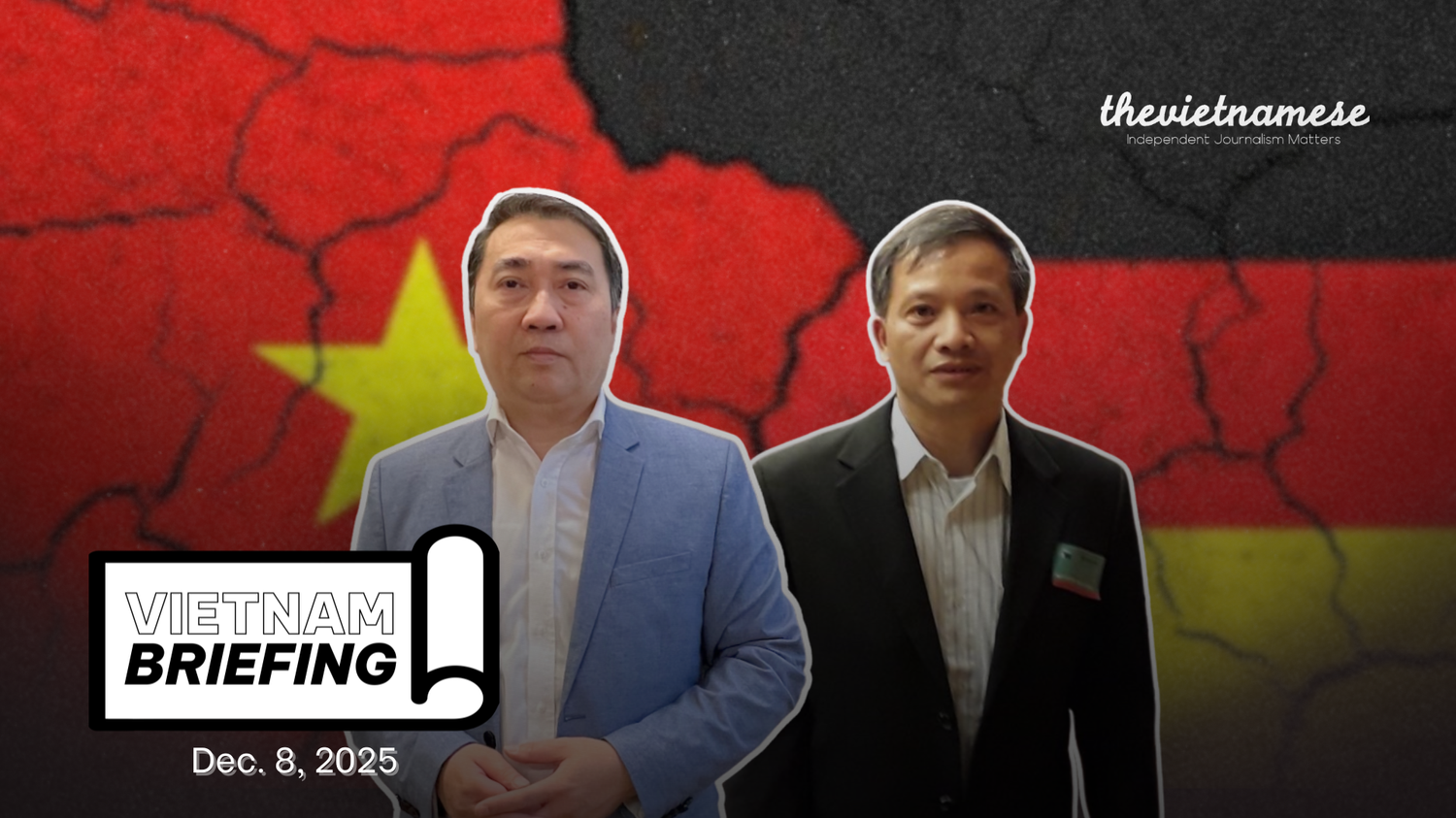
Ministry of Public Security Launches Manhunt as Lê Trung Khoa and Nguyễn Văn Đài Pledge to Press On
On the evening of Dec. 5, the Ministry of Public Security (MPS) issued a wanted notice for Lê Trung Khoa and Nguyễn Văn Đài.
This is the latest move in two criminal cases under Article 117 of the 2015 Penal Code for “making, storing, disseminating, or propagandizing information, documents, or items against the state”—which the ministry opened the case on Nov. 18.
The MPS urged Khoa and Đài to turn themselves in so they could be investigated, prosecuted and tried, and to qualify for any leniency available under the law. “If anyone discovers the whereabouts of suspect Nguyễn Văn Đài, that person has the right to arrest him and immediately hand him over to the nearest police station, procuracy, or People’s Committee,” the MPS notices said.
Both men face possible sentences of 10 to 20 years in prison under Clause 2 of Article 117.
There has been no official update regarding Đỗ Văn Ngà, who was charged in the same case as Khoa.
These two cases targeting prominent dissident figures come just ahead of the 15th Central Committee Plenum, which is expected to decide key personnel matters for the 14th National Party Congress.
What are the responses of these activists?
Speaking to Luật Khoa Magazine shortly after news of the wanted notices broke, both Nguyễn Văn Đài and Lê Trung Khoa, who are currently living in Germany, said they would not return to Việt Nam and continue their work.
Nguyễn Văn Đài said he was on a work trip in the United States when he received news of the warrant.
“They opened the case, issued the warrant like they did with Nguyễn Thị Thanh Nhàn before, and if they cannot arrest me, I expect they will try me in absentia. Recently they even issued an inter-ministerial circular to strengthen their trials in absentia,” Đài claimed.
When asked whether he feels safe in Germany, Đài said that after the indictment he received many anonymous threatening messages.
“They told me that if I don’t stop, they will use strong measures,” he said. “I don’t know what they mean by ‘strong’.”
The former lawyer said Việt Nam might request Germany to extradite him, but “it is very likely that Germany and Interpol will reject such a request.”
He added that German police are currently protecting him and that, “I will definitely continue my activities, but in more diverse ways rather than spending 90% of my time on media work like before.”
Lê Trung Khoa said he feels “very assured by the security and protection measures” of German law enforcement.
“They have increased protection for me and for Thoibao.de after the Vietnamese authorities announced the indictment and now the warrant,” he said.
“I will continue my journalistic work in Germany and globally so that people in Việt Nam and abroad can know the truth,” Khoa added.
Both men said the Vietnamese authorities have not contacted them since the investigation was launched.
Lê Trung Khoa and Nguyễn Văn Đài are among the most prominent voices in Việt Nam’s democracy and dissident community.
Khoa, editor-in-chief of Thoibao.de in Berlin, confirmed he holds dual Vietnamese and German citizenship.
He believes the reason for the indictment and warrant is that “we have been continuously publishing internal information describing the fierce disputes and purges unfolding in Vietnam’s political scene, right before the 15th Plenum and the 14th Party Congress. This exposed and affected their personnel arrangements, revealing poor governance capacity, so they became angry and targeted me.”
Đài, formerly a lawyer in Hanoi, has twice been imprisoned in Vietnam for “propaganda against the state” and “activities aimed at overthrowing the people’s government.” In 2018, he was released and came to Germany while still serving his prison sentence after Việt Nam and Germany negotiated on his political asylum case.
Đài said he is a permanent resident in Germany and plans to apply for German citizenship next year.
Hà Nội Ranks Among the World’s Most Severely Air-Polluted Cities
Over the past week, Hà Nội has consistently ranked among the most air-polluted cities in the world.
Since Nov. 28, Hà Nội’s air quality has deteriorated sharply due to high levels of fine particulate matter (PM2.5) and adverse weather conditions.
- On Dec. 2, the recorded AQI reached 283 — a “very unhealthy” level that poses serious health risks.
- On Dec. 3, PM2.5 concentrations hit 65 µg/m³ — nearly five times higher than the World Health Organization (WHO) guideline.
- That same day, all monitoring stations across Hà Nội — both urban and suburban — reported severe air pollution, with some areas reaching “very unhealthy” or even “hazardous” AQI levels.
- Pollution is more severe in the inner city, where traffic accounts for 46–56% of PM2.5 emissions.
Several northern provinces — including Bắc Giang, Hải Dương, and Hưng Yên — are also facing dangerous air-pollution levels.
The recent pollution spike in Hà Nội has exposed residents to a health damage equivalent to passive smoking of two cigarettes a day. According to WHO, PM2.5-related fatalities in Hà Nội account for as much as 32% of all deaths in Việt Nam — around 5,800 deaths every year.
From 2020 to 2025, Hà Nội has experienced persistently severe air pollution, with annual average PM2.5 levels exceeding national standards by 1.1 to 2.1 times. Pollution typically peaks in winter due to thermal inversions and the accumulation of emissions.
In response, Hà Nội authorities have urged residents to limit outdoor activities — especially children, the elderly, and those with respiratory illnesses — and to wear masks when outside.
The city is also considering adjusting school schedules, restricting outdoor activities for students, and spraying water on major roads to reduce dust levels.
The current pollution situation is expected to continue until the end of Dec. 5.
More Individuals Penalized for Posting “Distorted” Information About the Fatherland Front After Central Việt Nam Floods
After Đắk Lắk and Hồ Chí Minh City, Vĩnh Long Province has now joined in sanctioning social-media users accused of posting “false information” about the recent floods in the South Central Coast.
On Dec. 2, Vĩnh Long Provincial Police summoned two account holders for posting what authorities described as “false information” online. However, police did not disclose the legal basis for penalizing these alleged violations.
Specifically:
- L.P.A.T (46, residing in Phước Long Commune) was accused of sharing false information about flooding in Đắk Lắk on his TikTok account.
- N.L.T.N (29, living in An Hội Ward) was accused of posting and distributing false, “distorted” information about relief efforts for flood-affected communities in central Việt Nam, allegedly harming the reputation of the Vietnam Fatherland Front (VFF).
Earlier, police in Đắk Lắk and Hồ Chí Minh City had “processed” dozens of account holders accused of spreading “fake news” about the floods.
- In Đắk Lắk, police summoned, questioned, warned, or required written commitments from 17 individuals; issued administrative fines to 5 people totaling 37.5 million đồng (approximately $1.5 million USD); and ordered 30 accounts to remove posts deemed “false.” Police urged the public to “choose positive information to avoid misunderstanding.”
- On Nov. 25, the Hồ Chí Minh City Police began investigating cases of “unverified information.”
According to the government, the flooding in the South Central Coast resulted in 108 deaths and also missing persons (as of the night of Nov. 25) and caused more than 13,000 billion đồng in damages (as of Nov. 24).
- The Vietnam Fatherland Front is the sole organization authorized to receive disaster-relief donations in Việt Nam. As of 5 p.m. on Nov. 25, it had collected nearly 2,100 billion đồng from individuals, businesses, and organizations for victims of the floods.
- However, questions remain about how the VFF actually uses these funds. Earlier, the organization was criticized for attributing a 20 billion đồng donation made by citizens to “Leaders of the Party, the State, and the Vietnam Fatherland Front” when distributing aid to Lâm Đồng Province.
Restrictions on freedom of expression:
- Articles 109, 117, and 331 of Việt Nam’s 2015 Penal Code are widely viewed as tools that restrict citizens’ freedom of expression. In particular, Article 331 (“abusing democratic freedoms”) allows broad interpretation and is frequently used to suppress dissent.
- According to a 2025 report by The 88 Project, freedom of expression in Việt Nam has become increasingly restricted. Over the past five years, numerous independent news outlets, publishing houses, and anti-corruption groups have been forced to shut down.
- Online, the 2018 Cybersecurity Law, effective since Jan. 1, 2019, has been described as a law designed to “strangle social media” and enable state surveillance, further limiting critical or dissenting voices. In addition, the Ministry of Public Security is proposing amendments to the Cybersecurity Law that would impose even tighter controls on online speech.
“88-Page Document” Case: Lạng Sơn Police Arrest Đoàn Văn Sáng on Murder Charges
On the afternoon of Dec. 3, Lạng Sơn Provincial Police announced that they had detained and charged Đoàn Văn Sáng for murder, ending days of official silence surrounding the “88-Page Document” circulating online.
The “88-page document” refers to an anonymously compiled PDF circulating online in Việt Nam in late November 2025 that analyzes and reconstructs a suspected murder case in Lạng Sơn using open-source investigative methods. It went viral after correctly identifying the alleged crime scene and suspect—Đoàn Văn Sáng—before police officially announced his arrest.
Sáng is under investigation for murder under Clause 1, Article 123 of the Penal Code and faces a potential sentence ranging from 12 years in prison to the death penalty.
According to the MPS, Lạng Sơn police opened the case on Nov. 28. One day later, police issued a prosecution order and an arrest warrant for Đoàn Văn Sáng, but this information was only made public at around 4 p.m. on Dec. 3.
Sáng is the key suspect in a murder case that has shocked the public in Lạng Sơn.
- He was born in 1968 and previously served as deputy head of Market Management Team No. 4 under the Lạng Sơn Market Management Department.
- The victim was identified as Nguyễn Xuân Đạt, born in 1989, residing in Hậu Trung 2 Hamlet, Tiên Hưng Commune, Hưng Yên Province.
- According to police, Sáng and Đạt became acquainted around 2020 through social media. On Jan. 25, 2025, Sáng allegedly called Đạt to meet at his workplace, where he killed him. After committing the crime, Sáng is said to have cleaned and erased evidence and disposed of Đạt’s body.
So far, neither Sáng nor his family has made any public statement. Police and state media have not indicated whether he has legal representation.
Also today, newly appointed Chief Justice of the Supreme People’s Court Nguyễn Văn Quảng addressed the National Assembly for the first time, asserting that criminal cases in Việt Nam are adjudicated “strictly, with the right defendant in the right crime and use the right law to prosecute,” and that “no wrongful convictions have been detected.”
In reality, over the past two decades the justice system has issued wrongful death sentences in several murder cases that were later overturned, such as those involving Hàn Đức Long, Nguyễn Thanh Chấn, and Huỳnh Văn Nén.
Other death-row prisoners—such as Hồ Duy Hải, Nguyễn Văn Chưởng, and Lê Văn Mạnh—were also convicted in murder cases widely believed to contain signs of wrongful prosecution.
Almost simultaneously with announcing the prosecution and temporary detention of Đoàn Văn Sáng, the MPS issued warnings urging the public not to comment on, share, or spread documents or videos related to the murder case, according to the Thanh Niên newspaper.
Quick Takes:
Defense Official Says Việt Nam Will Pursue Autonomous Military Technology as Strategic Priority
Major General Trần Đức Thuận, deputy chair of the National Assembly’s Defense, Security, and Foreign Affairs Committee, said Việt Nam will make defense-technology autonomy a core priority in the draft political documents for the Communist Party’s 14th National Congress. He highlighted two major additions: developing indigenous defense technologies and recognizing cybersecurity sovereignty on par with territorial sovereignty.
Việt Nam will focus on missile systems, cyber warfare, materials science, and semiconductors, alongside expanding UAV and unmanned-system capabilities. The shift comes as Hà Nội seeks to diversify beyond Russian weapons, even as reports reveal undisclosed multibillion-dollar arms purchases from Moscow. The draft documents will be presented in January 2026.
Finance Ministry Seeks Expanded Powers for Hà Nội Chairman, Including Land Seizures Outside the Land Law
The Ministry of Finance has proposed granting the Hà Nội chairman significantly expanded authority—including the power to reclaim land beyond what the Land Law permits—to accelerate major development projects in the capital. A draft resolution now under review by the Ministry of Justice would allow the chairman to approve major public and PPP investments, deploy city funds for compensation and resettlement before project approval, and activate emergency construction measures to address congestion, flooding, and pollution. The proposal comes days after Vũ Đại Thắng was appointed Hà Nội chairman.
Binance to Open Office in Hồ Chí Minh City Under New MOU With Việt Nam Amid Tighter Crypto Oversight
Binance plans to open an office in Hồ Chí Minh City after signing a memorandum of understanding with the city’s Department of Finance to support Việt Nam’s new international financial center. The agreement, announced Nov. 26, includes training and regulatory consulting on blockchain technology, though details of the MOU remain undisclosed. Binance is expected to operate from the Hồ Chí Minh City Innovation Startup Center. The move comes as Việt Nam intensifies oversight of crypto and cross-border transactions, including mandatory bank-transaction reporting and upcoming fines for unlicensed crypto activity. Binance dominates Việt Nam’s crypto market, serving an estimated 80% of digital-asset investors.
Key Questions Still Unresolved as Government Pushes for Special Court Law at Việt Nam’s New Financial Centers
The government hopes to implement the Law on Special Courts for International Financial Centers (IFCs) by Jan. 1, 2026, but major provisions remain unsettled. On Dec. 3, the National Assembly debated the draft, which leaves open critical issues: the court’s jurisdiction, whether foreign law or common law should apply, whether foreign judges may work as judges in Việt Nam, whether English will be the official language, and whether prosecutorial oversight will be included. The Việt Nam Chamber of Commerce and Industry warned that the model is unprecedented and urged limiting the court’s initial jurisdiction to investment and business disputes. Việt Nam’s IFCs, created under Resolution 222, are expected to launch soon, though no official timeline has been confirmed.
Sudden Nighttime Dam Release in Lâm Đồng Floods 3,300 Homes, Leaves One Dead
A sudden flood release from the Lòng Sông Reservoir in Lâm Đồng (formerly Bình Thuận) on the night of Dec. 4 submerged more than 3,300 homes, killed one person, and paralyzed local transport. Heavy upstream rainfall—over 200mm in some areas—forced the reservoir operator to discharge water at 1,200 m³/s, with additional releases from the Sông Quao Reservoir the following morning. Several neighborhoods were flooded 1–2 meters deep, leaving many communities isolated. Fishing boats and farmland suffered extensive damage, with initial losses estimated at over 30 billion đồng. Authorities warn that a new tropical depression near the Philippines may bring more severe rain to Central and South-Central Việt Nam in the coming days.
Nha Trang Neighborhood Flooded for the Fourth Time in One Month as Heavy Rains and Reservoir Releases Swamp the City
For the fourth time in less than a month, residents of Tây Trang were forced to flee as rising floodwaters inundated large parts of Khánh Hòa Province, driven by heavy rains and synchronized reservoir releases. From the night of Dec. 3, prolonged rainfall—up to 200mm in some areas—pushed rivers and reservoirs past safe levels, prompting controlled discharges from the Am Chúa and Đắc Lộc dams. By early Dec. 4, floodwaters reached 20–60 cm across Tây and Bắc Nha Trang, submerging roads and homes and forcing emergency evacuations. Schools closed, neighborhoods were cut off, and exhausted residents described “a month of running from floods.” A new tropical depression forming east of the Philippines may bring more heavy rain in the coming days.