
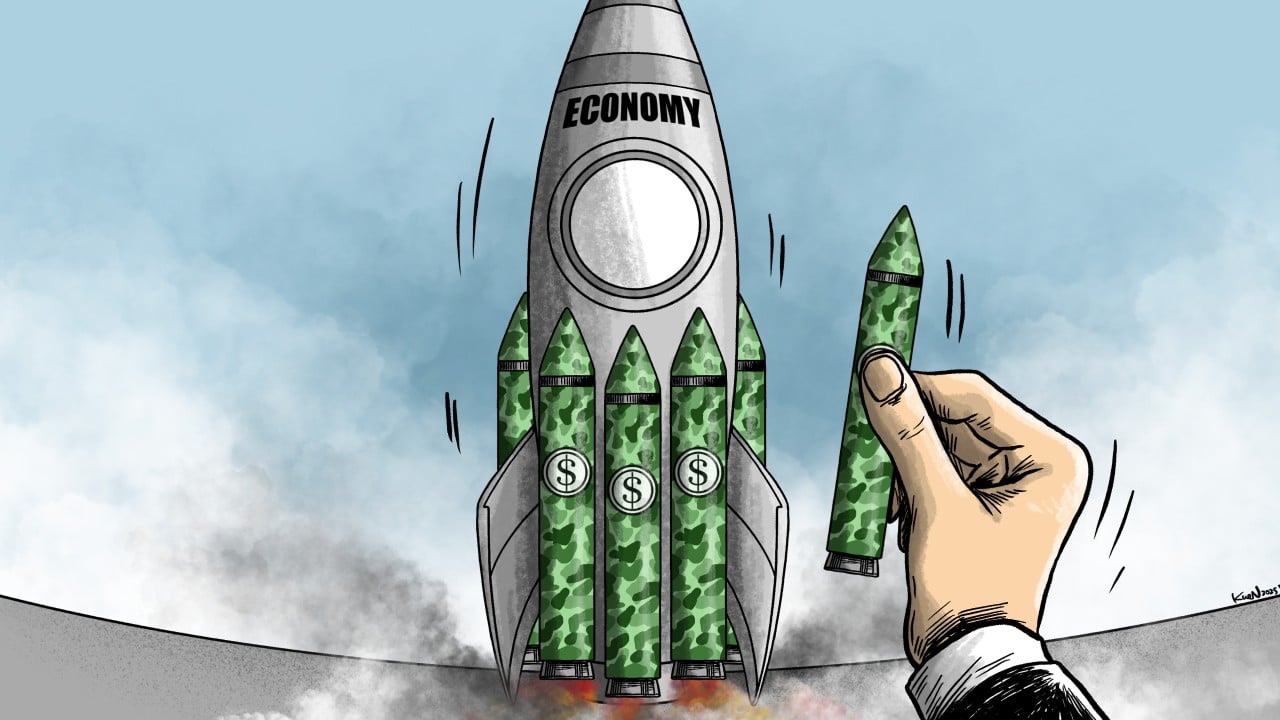
More than six decades after British historian AJP Taylor termed war the “mother of invention”, economies around the world appear to be ramping up their military spending, at least in part, to reinvigorate industrial production.
Taylor was referring to the genesis of the tank, the aeroplane and poison gas in World War I, and that of radar, the jet engine and the atomic bomb in World War II. More modern examples, such as satellite-based navigation systems and the internet, were the products of the Cold War between the United States and the Soviet Union that ended in 1989.
Decades later, the notion of military expenditure as a catalyst for growth, especially in places where heavy industries are flagging, has been thrust back into the spotlight.
Advertisement
Leading developed economies – namely the US, the European Union and Japan – are all ramping up military spending and reviving defence production, a campaign which could also help fulfill non-military goals like economic stimulus, a reversal of deindustrialisation and a jump-starting of technological breakthroughs.
Some have explicitly articulated these aims, while others have been more circumspect, but analysts agreed multiple motives are at play in these efforts.
Advertisement
“Today’s military industry is largely dual-use, not exclusively military: through the military, the state can mobilise its industrial base,” said Chen Fengying, a researcher at the China Institutes of Contemporary International Relations (CICIR), a think tank reportedly affiliated with Beijing’s Ministry of State Security.
While there are nuances in the approaches and motives of different governments, one of their more prominent and common goals is to reduce dependence on China.